La Russophobe has moved!

You should be automatically redirected in 6 seconds. If not, visit
http://larussophobe.wordpress.com
and update your bookmarks.

Take action now to save Darfur

Saturday, September 23, 2006

LR on PP

Check out La Russophobe's latest installment on Publius Pundit, dealing with the question of whether Russia should be admitted to the World Trade Organization. Reader comments on this vital issue are welcome.

Friday, September 22, 2006

Russia Brutalizes Women

A new report from the United Nations excoriates Russia for its brutality against women. La Russophobe has already reported that Russia has the second-highest rate of divorce in the world and that one Russian woman is murdered by her husband every 40 minutes. Now the U.N. concludes that Russia is also brutalizing women economically: "In the Russian Federation, the adverse impact of political and economic transition had disproportionately affected women." The report includes Russia with a group of barbaric regimes known for shocking abuse of women: Iran, Mexico, Afghanistan and Sudan’s Darfur region.

In classic Neo-Soviet fashion, rather than acknolwedge Russia's problems with the abuse of women (leading to chronic shortalls in population), the Kremlin sought to paint the U.N. as a bunch of crazed russophobes. The Russian envoy to the U.N., Valery Loshchinin, called the report "politicized" and complained that "it gave the impression that there was a State policy of violence against women, which was occurring against a background of prevailing insecurity at large." He stated that "those familiar with the contemporary reality in Russia and the role of women in society could not accept these affirmations."

This is through-the-looking-glass, Neo-Soviet stuff. Loshchinin simply ignores basic facts about Russian life known by everyone, as if he were still living behind the Iron Curtain's cloak of secrecy which prevented those in the West from disputing many Russian propaganda assertions. Just as in Soviet times, the regime simply refuses to acknowledge problems and therefore can't reform to alleviate them. The problems fester and grow until the consume the nation's vital organs and destroy it.

Ironically, even as Loshchinin was speaking it was being reported that Russia is considering imposing a tax on women who don't have children so as to penalize them and force them to contribute to the population (apparently, the Kremlin has already given up on the idea that women could be bribed into having more babies). Heaven forbid that Russia should change to make women happier and more desirious of having children; instead, Russia prefers to resort to the methods of Stalin, the same ones that destroyed the USSR and will just as surely bring Russia to her knees.

Putley on Bakhmina

David McDuff's blog One Step at a Time contains a letter from reader Jeremy Putley to the Financial Times regarding the Kremlin's assault on Yukos attorney Svetlana Bakhmina. Bakhima's story is that of one of Neo-Soviet Russia's first victims, and it is a cause that deserves ongoing attention. Jailing the lawyer of a person the state doens't like is a signal hallmark of crude authoritarian dictatorship and demonstrates that nobody is safe from the Kremlin's petulant, wrath, just as in Soviet times.

Putley writes as follows (shame on the FT for failing to publish it!):

Sir

In your second editorial today you are right to say that investors presented with the opportunity to buy into Russia’s oil riches, in the planned stock market flotation of Rosneft, must consider the moral dimension. It is not only the question of whether they will be buying “stolen goods”. There is also the matter of the abuse of legal process to persecute former Yukos employees, and not just Mikhail Khodorkovsky.It has not been widely reported that last week the Yukos lawyer, Svetlana Bakhmina, was sentenced by a Moscow court to seven years imprisonment in a labour camp. She had denied any wrongdoing. Now 36, she has been detained since 7 December 2004, and has not been allowed to see her two children, aged 3 and 7 in that time. Bail was refused for apparently no justifiable reason.The Russian opposition politician, Boris Nemtsov, is reported as saying that Ms Bakhmina does not deserve the sentence, which he calls an act of repression, considering it part of a campaign by the Kremlin aimed at intimidating business employees in order to prevent them from expressing independent views on society in Russia.This appalling case of abuse of legal process in a European capital should arguably carry rather more weight withinvestors even than the other matters that arise in considering potential investment in Russia, such as the unexplained exclusion from Russia of the investor Mr William Browder.

Jeremy Putley

McDuff continues the Bakhmina saga as follows:
Svetlana Bakhmina, the YUKOS lawyer sentenced to six and a half years of imprisonment in a labour camp, has appealed to a Moscow court to have her sentence deferred for nine years, until her youngest child reaches the age of 14, gazeta.ru reports. Public figures and human rights activists in Russia have condemned the sentence given to Ms. Bakhmina, saying that she does not deserve it. Ms. Bakhmina herself has denied any wrongdoing. The Russian opposition politician Boris Nemtsov has called it an act of repression, considering it part of a campaign by the Kremlin aimed at intimidating business employees in order to prevent them from expressing independent views on society in Russia.
It is truly mind-boggling the Kremlin could be so weak and cowardly that destroying Mikhail Khodorkovsky's company, himself and his family would not be enough; just like the mafia, the Kremlin cowards need to go after everyone associated with him, even the mothers of young children. More terrifying, the Kremlin couldn't care less about the public image this presents or how many nations and peoples it alienates in doing so. In other words, this act is an unmistakable echo of the way the USSR treated people like Solzhenitsyn, clear proof that Russians have learned nothing from the decades of despair they suffered under Soviet rule.

NB: No page exists in Wikipedia for Ms. Bakhmina. La Russophobe suggests to readers that somebody take the initiative to create one (anyone can do it, everyone can edit/help).


Brilliant Felgenhauer Exposes the Horrors of Iran-Russia Alliance

Writing in Eurasia Daily Monitor, the brilliant (essential!) Pavel Felgenhauer exposes the prospects of a Russian-Iranian nuclear alliance. David McDuff has a wonderful, awful post analogizing the recent spewing of venom into the U.N. by the Iranian and Venezuelan dictators to the similarly lurid acts of Nikita Krushchev decades ago. Instead of using their U.N. platform as an opportunity to call for peace and cooperation pursuant to the U.N. mandate, these maniacs chose to use it as an opportunity to provoke war (the height of hypocrisy, as they attack the U.S. for doing so). But we must now ask whether today's Russia is any different, indeed much worse. However revolting the behavior of the other maniacs may be, at least they were open and honest in their barbaric warmongering. Vladimir Putin is supplying a massive amount of assault weapons and attack aircraft to Venezuela and nuclear power to Iran, even as he poses publicly with a face of respectability. As Felgenhauer shows below, it is a hop, skip and jump from Russia's support for Iran to its obtaining nuclear weapnos. So, who is more dangerous to democracy - Putin or Kruschchev?

Here's Pavel (how the Moscow Times dared to fire him, La Russophobe will never understand):

On Monday September 18, the chief of the Federal Atomic Energy Agency (Rosatom), Sergei Kiriyenko, told reporters in Vienna that Iran’s Bushehr nuclear power reactor will be operational by September 2007 and is scheduled to begin producing commercial electric power in November 2007. Kiriyenko also confirmed that Iranian Vice President Gholamreza Aghazadeh, chief of the Atomic Energy Organization of Iran (in charge of Iran's nuclear program), will visit Moscow next Monday, September 25, to finalize agreements to launch the Bushehr reactor (RIA-Novosti, September 18).Bushehr was partially constructed in the 1970s by Germany's Siemens and abandoned unfinished after Iran's Islamic Revolution in 1978. The Russian company Atomstroiexport has been rebuilding Bushehr for over 10 years.

It has been reported that today the reactor is over 90% complete, although the previously announced launch date of October 2006 will pass without the reactor becoming operational. Now Kiriyenko insists that the new September 2007 deadline is final (RIA-Novosti, August 29, September 18).Sources at Atomstroiexport say the long delay in completing Bushehr has been simultaneously technical, political, and financial in nature. In the 1990s when oil prices were low, Iran was not paying Atomstroiexport and its Russian subcontractors on time or in full for services rendered.

Nowadays most of the $1 billion stated Bushehr price tag has been already disbursed by the Iranians to Russia, according to former Atomstroiexport officials, including former CEO Kakha Bendukidze, a well known Russian industrialist in the 1990s and early 2000s and, since 2004, a Georgian government minister.With the financial problems ostensibly solved, Kiriyenko has blamed technical difficulties, including the failure of Russian subcontractors "to deliver some assembly units" (RIA-Novosti, August 29).

At the same time, it is clear that there are serious politics involved: While there is no internationally acceptable solution to the Iranian nuclear problem, Moscow has apparently been dragging its feet in making the final, irreversible step of actually launching Bushehr -- a step that could provoke a major Russo-American crisis.For some time now, the Iranians have pressed Moscow to deliver the nuclear fuel rods for Bushehr well ahead of the reactor launch. The fuel -- some 100 tons of low-enriched uranium -- is ready for delivery and is currently stockpiled at a Rosatom plant in Novosibirsk. The fuel must be delivered to Iran to be loaded into the reactor at least several months before it may be launched, and that is when the principal Russo-American problems may begin.

Most nuclear experts agree that the nuclear arms proliferation threat posed by the light water Bushehr VVER-1000 (1,000 megawatt) reactor is limited: It will produce tons of plutonium, but consisting of an isotope mix that cannot easily be used to make bombs. Moscow has also secured an agreement with Tehran that the spent fuel must be sent back for reprocessing.However, plutonium is not the only proliferation danger. Iran today ostensibly possesses all the technologies needed to enrich uranium, but the principal problem is that it lacks uranium to enrich. Any natural uranium deposits that have been so far discovered in Iran are small, while the United States has up to now managed to block all attempts by Tehran to buy natural uranium oxide (yellow cake) on the world market.

The arrival of the Russian nuclear fuel may drastically change the situation: By diverting a relatively small fraction of the 100 tons of the 4% enriched uranium 235 fuel, the Iranians could dramatically speed up their nuclear program and produce hundreds of kilos of arms-grade uranium (over 90% enrichment) in a year or so, using a limited amount of enrichment centrifuges. It is technically much easier to move from 4% to 90% enrichment, than from 0.7% as in natural uranium, to 4% and a nuclear weapon requires only 20 kilos of arms-grade uranium to make.Washington has already told Russia that, while the continued slow construction of Bushehr is OK, the actual transfer of nuclear fuel without a comprehensive solution of the Iranian nuclear problem is unacceptable. Will the Russians heed this warning?

While in Palestine on September 8, Foreign Minster Sergei Lavrov angrily told a news conference that it is "a clear provocation" to suggest that Russia may stop constructing Bushehr and move its specialists out (RIA-Novosti, September 8, 2006).The pro-Kremlin news site Strana.ru reported on September 11 that Russia will not only sell Iran modern anti-aircraft Tor-M1 missiles (a billion-dollar deal announced last November), but also provide more powerful, longer range S300 anti-aircraft missiles and other modern weapons "needed to defend Bushehr and other strategic targets" against possible U.S. air and missile attacks.It is obvious that at least part of the ruling Russian elite is ready to openly side with Iran against the United States, to block the imposition of any sanctions in the United Nations while providing Tehran with modern weapons and nuclear materials. But will Russia's ultimate decision-maker, President Vladimir Putin, risk a showdown? Up to now Putin has opted to postpone a decision, which has meant Bushehr has also been postponed. But the time for pondering is rapidly running out, and Washington and Tehran are both pressing for a clear answer -- something Putin always hates to give.

Russia’s Report Card Shows it Needs to Repeat a Century, not Skip One

A string of high-level surveys of social development over the past year have equated Russia’s level of achievement with that of the African nation of Niger, a landlocked sub-Saharan state of 14 million roughly half of whose national budget is derived from foreign aid.

In October of last year the “Corruption Perceptions Index” from the German think tank Transparency International surveyed 159 nations and found that only 30 (less than 19%) were less corrupt than Russia. Russia found itself tied for 9th most corrupt nation in the world with Niger and Sierra Leone.

Then in June, Foreign Policy’s “Failed States Index” for 2005 identified sixty such “failed states” based on various indicators of instability, and Russia was named as one of them. Only 43 nations in the world are bigger failures than Russia according to Foreign Policy. Laos was a slightly bigger failure than Russia, Niger slightly less. Criteria such as human rights, distribution of wealth, flight, police corruption and elitism were reviewed.

And now last week came the World Bank with its “World Governance Indictors” reports, providing results eerily similar to those of TI. The WB study covered over 200 or more countries and territories in each of several categories. Only 57 nations out of 208 surveyed (less than 28%) had lower scores in such areas as voice and accountability, political stability, effectiveness of the government, the quality of regulatory bodies, the rule of law and control over corruption. Here, Russia was trailed Zambia (148), Uganda (149) and Swaziland (150), with Niger (152), Kazakhstan (153) and East Timor (154) just behind it.

When three different studies from three different well-respected organizations spanning the globe all find that Russia’s government and that of Niger are closely linked in terms of their level of accountability and systemic corruption, you know they are on to something. And a question inevitably arises: Is it an oversight that Niger has been excluded from the G-8, or is it an oversight that Russia has been let in?

To be sure, Russia has nuclear weapons. But so do India and China, and they aren’t members of the G-8. True, Russia has oil. But Saudi Arabia pumps out just as much, and its reserves are far larger than Russia’s and far easier to reach. Yet, Saudi Arabia isn’t in the G-8 either. If every nation with some type of claim is admitted, the G-8 will become the United Nations.

Why then admit Russia, especially when so many Russian actions betray hostility to the organization principles of the G-8? Russia is providing nuclear technology to Iran, assault weapons and attack jets to Venezuela and financial support to Hamas. It has obstructed the efforts of the other G-8 nations to impose sanctions on Iran and it has obstructed their efforts to deal with the terrorist uprising in Lebanon directed by Hezbollah. Russia refuses to recognize either Hamas or Hezbollah as terrorist organizations. Russia provided U.S. military secrets to Sadaam Hussein during the war against Iraq and it is violating its treaty with the U.S. concerning nuclear missiles on submarines. It is seeking to oust U.S. oil interests from Russia, most recently those of Exxon. It has been condemned by a resolution of the U.S. Senate for its failure to protect the civil rights of journalists and it recently announced that it will not bow to the United Nations within its sphere of influence in the former USSR. It is brazenly interfering in the domestic politics of Moldova, Georgia and Ukraine as well as those of Belarus and the Baltic nations. Violent racism is running rampant (incidents increase by 20-30% each year) and Soviet-era ideology is on the rise. Russian energy monoliths, particularly Gazprom, are being used for political advantage without regard to the economic rights of their shareholders.

It’s time to wake up and realize that there is a fox in the G-8 chicken house. Saying that some sort of leverage may be gained over Russian policy if it is “at the table” might just as well have justified admitting the USSR to NATO or the Cosa Nostra to the College of Cardinals. It’s time to understand that the old canard about Russia needing “time” to develop into a progressive state has been repeated for centuries now without results. Not only won’t time heal any wounds in Russia’s case, but even if it could it’s a luxury Russia can’t afford. Every year the country’s population gets smaller and more unhealthy (by 2020 10% of the population will have HIV), so by the time sufficient time has elapsed there may be nobody left to benefit from the changes.

Instead of demanding that Russia repeat the grades it has failed, we are allowing Russia to skip grades it isn’t even ready for and go from elementary school to MIT. No good can come of that. Russia’s low scores come in a climate of rising oil prices and impressive GDP growth; when the business cycle strikes Russia and the Kremlin is forced to play hardball to keep control, Russia’s scores will be off the charts and the world will have a disaster on its hands.

Thursday, September 21, 2006

Motley Fool Blasts Crazed Putin Autocracy

The Motley Fool investment gurus lay waste to the lunatic adminstration of Vladimir Putin in the following scalding assault on the Kremlin's recent spate of efforts to undermine the rule of law and property rights in Russia. Russia is totally destroying its credibility with the outside world, and perhaps it is an intentional effort to codify xenophobia and drive all foreigners from Russia.

"All I really need to know, I learned in kindergarten," goes the saying. Here, at least. Over in Russia, I'm guessing it goes more like: "What I didn't learn in dyetsky sad, I never learned."

Case in point: Russian President Vladimir Putin, who's acting less like a "Vladimir" and more like a tantrum-throwing "Vova" with every passing day. In the latest fit of presidential petulance, The Moscow Times reports that the Kremlin has apparently tried to pull out of a deal for Russian national carrier Aeroflot to purchase 22 Boeing (NYSE: BA) 787s, to counterbalance a similar deal to purchase 22 Airbus A350s. The original plan was for Aeroflot, which is controlled by the Russian state, to make purchases from both of the world's dominant large aircraft-builders, playing one against the other in pricing negotiations.

Back in February, the strategy bore initial fruit as Aeroflot extracted a $100 million discount on its $3 billion purchase from Airbus. Subsequently, Aeroflot got an even better deal out of Boeing, which offered its 22 Dreamliners for just $2.5 billion (about a $220 million discount). Then things got ugly.

First, the Bush administration proved reluctant to accede to Russia's bid for entry into the World Trade Organization. Then, the administration up and levied sanctions against Russian defense contracting powerhouse Rosoboronexport and military jetmaker Sukhoi, over alleged assistance these firms provided to Iran's nuclear program. Neither move endeared the Americans to President Putin, and in an apparent tit-for-tat move, Aeroflot suddenly decided to postpone its purchase of the Boeing planes indefinitely. This put the sale in jeopardy and, according to Russian oligarch Alexander Lebedev, would force Aeroflot to acquire the needed planes elsewhere, at a cost of as much as $3.3 billion -- further illustrating just how important it is for Aeroflot to maintain two price-competitive providers for its planes. Luckily for Aeroflot (and Boeing), Lebedev stepped up yesterday, and had one of his other companies advance $40 million to Boeing to hold Aeroflot's place in line to buy the 787s until the end of this year.

Meanwhile, in Siberia
The situation in Moscow bears an eerie resemblance to recent developments on the other side of the country. Over on the eastern island of Sakhalin, home to two oil and gas "production-sharing" projects titled Sakhalin-1 and Sakhalin-2, Western oil majors Royal Dutch Shell (NYSE: RDS-A) and ExxonMobil (NYSE: XOM) are butting heads with Russian regulators who allege that the companies are violating environmental regulations, and threaten to revoke their licenses. Analysts are pretty unanimous in their opinion that the regulators are less concerned with the environment, and more concerned with renegotiating the firms' production-sharing agreements to give the Russian state a larger share of the loot.

The unhappy moral of this story (for investors): Beware of investing in Russia. Certain children over there have difficulty playing nice with others, and sharing their toys.

For an alternative conspiracy theory (can you ever have too many?) on why Russia might want to cozy up to Airbus at Boeing's expense, read about Russia's recent investment in Airbus parent EADS.

Exposing Russia's Fundamental Weakness

Reader Jeremy Putley points us to a recent article from Newsweek in which the authors expose the fundamental sham that is the Russian economic, and indeed political, system (something La Russophobe has been pointing out for some time now). The fact that even the mainstream media is catching on just goes to show how Neo-Soviet propaganda will have a much tougher row to hoe than the original.

Why Russia Is Really Weak

What happens to Russia when—not if—oil and gas prices begin to retreat?

By Rajan Menon and Alexander Motyl

Newsweek International

Sept. 25, 2006 issue - News stories about Russia these days follow a predictable theme. The country is resurgent and strong, and the West must adjust to this new reality. But that story line is wrong. Russia is weak and getting weaker.

Take the conventional index of power—military might. Yes, Moscow is testing advanced missiles systems and talks buoyantly about countering a U.S. antiballistic-missile system with a new generation of warheads that can evade interceptors. Yet note the failure earlier this month of the highly touted Bulava submarine-launched missile. The United States experiences such mishaps, too, of course. But in Russia they are signs of something deeper. It's no secret that, for all Russia's new oil wealth, its Army remains poorly trained, malnourished and demoralized. Alcoholism, suicide and corruption are rife. Weaponry is aging and newer models arrive at a trickle: India has bought more Russian tanks since 2001 than the Russian Army.

Russia gets credit for economic growth—nearly 7 percent this year, according to the IMF. But the boom has been propelled mainly by rising energy prices. What happens when—not if—oil and gas prices begin to retreat? New investment in production capacity is insufficient to sustain current levels of exports. Meanwhile, economic reform has stalled, state control over strategic economic industries has increased and foreign investment remains low. Of the $648.1 billion in foreign investment worldwide in 2004, only $11.6 billion went to Russia. Not surprisingly, Russia rates poorly in globalization rankings. The 2005 Foreign Policy/A.T. Kearney survey placed it 52nd in a list of 62 countries—a drop of five places from 2004.

Russia's human capital is being ravaged. The population is declining by some 750,000 annually because of low birthrates and unusually high death rates among males; it's also aging rapidly and will therefore become increasingly less productive. Alcoholism remains pervasive, as does drug use. Russia has the highest rate of tuberculosis in Europe. AIDS has yet to crest. Suicide is one the rise. According to WHO data on 46 countries between 1998 and 2003, Russia, with 71 cases per 100,000 of the male population, topped the list.

A nation's power also rests on the strength of its institutions. Here, too, Russia is growing weaker. Putin's authoritarianism has brought order to a once chaotic political scene. But Parliament has been neutered. So have independent civic organizations, political parties and media. The secret police, military and security services—no friends of the rule of law—occupy prominent political positions. Official corruption flourishes.

Abroad, Russia's influence continues to ebb. Its closest allies—Kyrgyzstan, Tajikistan and Uzbekistan—are poor and politically unstable. Energy-rich Kazakhstan and Turkmenistan resent Russia's grip on their exports. Armenia, loyal but penurious, remains embroiled in the Nagorno-Karabakh conflict with increasingly prosperous Azerbaijan. The Kremlin's meddling in Georgia has deepened Tblisi's determination to join NATO and strengthened anti-Russian sentiment. Belarus's dictatorial president envisions union with Russia, but his Soviet-style political order repels many ordinary Russians.

On the wider global stage, Putin displays seeming strength and new confidence. Russian support is key to the negotiations over Iran's nuclear program. Its Security Council veto gives it an important say on various international issues, from Kosovo's independence to the United Nations peacekeeping force in Lebanon. Yet Putin's rhetoric increasingly strikes themes of Great Russia—imperial, nostalgic, nationalistic. However much it resonates with a particular Russian political class, that rhetoric can itself breed weakness.

You see this in the sharp rise of race-related hate crimes in Russia, most recently the clash between Russian xenophobes and Chechens in the north- western town of Kondopga, when a bar brawl triggered huge rallies of ultranationalists demanding the expulsion of ethnic minorities. Right-wing racism and Russia-for-Russians chauvinism augur ill for a multiethnic, multiconfessional Russia, which has near 25 million Muslims.

So, the received wisdom is wrong. What the West must live with is a weak Russia. And history shows that states that talk loudly while carrying a small stick often overreach, creating problems for themselves and others.

Wednesday, September 20, 2006

Blog vs. Blog: Just the Facts, Please

Here's what wacky Wally Shed of the Accidental Russophile recently wrote to La Russophobe in a comment on this blog: "This will be the last time you'll hear from me on this embarassment that you call a 'blog'." This came after he called La Russophobe an "idiot." Which came just before he attacked La Russophobe for "hatemongering." Isn't that ironic. As for the first sentence, here are some statistics comparing the "embarrassing" La Russophobe to Wally's cauldron of outrageous America-bashing propaganda, enabling the rise of dictatorship in Russia.

As of 9am E.S.T. Wednesday September 20:

LA RUSSOPHOBE

11,500 visits in six months or 1,918 visits per month

THE ACCIDENTIAL RUSSOPHILE

11,793 visits in seven months or 1,710 visits per month

LA RUSSOPHOBE

182 links from blogs in six months or 30 links per month.

THE ACCIDENTAL RUSSOPHILE

134 links from blogs in seven months or 19 links per month

LA RUSSOPHOBE

33 linking blogs in six months or 6 linking blogs per month

THE ACCIDENTAL RUSSOPHILE

52 linking blogs in seven months or 7 linking blogs per month

In other words, in every category La Russophobe either vastly exceeds or nearly matches Wally's blog, which is much older than hers. So if this blog is an "embarrassment" then what can we say about the Wallygator's efforts? Ultraembarrassing? Wally's counter registers only slightly more total visits than La Russophobe even though Wally's blog has existed 30% longer than hers has, and he has signifantly fewer views of his profile.

So La Russophobe can't help but wonder . . . is he jealous, or is he just trying to wipe the truth off the face of the earth? In a post about American propaganda on Russia, Wally vehemently condemns American "ignorance." In a post about Russian propaganda on America, he asks the reader to decide whether Russian propaganda is right or wrong. So La Russophobe will let the reader decide about Wally's motivations.

Neo-Soviet Russia Obliterates Property Rights, Alienates Entire World

Previously, La Russophobe reported on how Russia was breaching its contract with the Exxon oil concern, alienating vast swaths of power in the United States. Now, the Moscow Times tells us that this was only part of a wholesale obliteration of property rights, just as in Soviet Times. The state is taking control, and the consequences be damned. It's not the least bit surprising, of course, that a proud KGB spy like Vladimir Putin would pursue such a policy; but that the Russian people would favor with such support as Putin gets in the polls a leader who is merely repeating the mistakes of a failed past is quite shocking, and that the Russian government, one of the world's most offensive polluters, would seek to use environmentalism as a pretext for these neo-Soviet acts is truly disgusting.

Just as in Soviet times we must now begin asking: Who's next?

The Natural Resources Ministry's decision to revoke approval of Shell's Sakhalin-2 project provoked sharp criticism Tuesday from the European Union and Japan, amid signs that the move was part of a broader attempt to put a state stamp on foreign-run energy projects.
EU Energy Commissioner Andris Piebalgs warned against the creation of an unstable investment environment that could halt future energy projects and disrupt global oil supplies. He took "this announcement very seriously indeed," Piebalgs said in a statement, adding that he would soon discuss the issue with Industry and Energy Minister Viktor Khristenko.

Shinzo Abe, Japan's government spokesman and the man tipped to succeed Prime Minister Junichiro Koizumi later this month, said the decision, which effectively suspends all work on the multibillion-dollar project, could harm diplomatic relations between the two countries, Reuters reported.

The Natural Resources Ministry canceled its approval of the Sakhalin-2 project on Monday, citing environmental violations during the construction of an oil and gas pipeline on Sakhalin Island. Shell, with a 55 percent stake in the Sakhalin Energy holding, is the project's operator on behalf of minority shareholders Mitsui and Mitsubishi of Japan.

Japan, heavily dependent on energy imports, is to be the top customer for Sakhalin-2, which will be the world's largest liquefied natural gas, or LNG, project once it comes on stream.
The head of the Paris-based International Energy Agency, Claude Mandil, also warned that the move against Shell could deter investment, Reuters reported.

The revoking of environmental approval was the culmination of months of steadily increasing state pressure on project operator Sakhalin Energy, which announced last year that the estimated cost of the project had doubled to $20 billion. Under its production sharing agreement, or PSA, with Sakhalin Energy, the government must wait until investors recoup their costs before taking in revenue from the project.

The move against Shell comes as PSAs increasingly come under fire as the state seeks to maximize revenue from high oil prices.

Economic Development and Trade Minister German Gref said Tuesday that PSAs were outdated investment mechanisms, and while the state would continue to honor its three existing PSAs, none would be signed in the future, Reuters reported. "We can support far from all proposals regarding greater costs. In our opinion, some of them are not very well considered. There is room for improvement," Gref said, Itar-Tass reported. "As far as the existing agreements are concerned, we shall be obliged to ensure their observance."

ExxonMobil has also been under fire for its involvement in Sakhalin-1. The head of Russia's environmental watchdog in the Far East Federal District, Alexander Poleshchyuk, said the terminal should undergo more checks before being given the green light, Reuters reported.

Total is the operator of the country's other PSA, the Kharyaga oil project in the Nenets autonomous district.

The Sakhalin Energy PSA was signed in 1993, when the country was in the throes of political and social upheaval and eager to provide a sense of stability to wary foreign investors. The stability of recent years, underpinned by high oil prices, has changed that.

PSAs are most often used to cover high-risk ventures, stipulating their own tax and license regimes and thus protecting investors from changes in volatile national tax law.

"The brutality suggests this is more than just Gazprom entering the project," said Adam Landes, oil and gas analyst with Renaissance Capital investment bank. "It is necessary to say at this juncture that Russia wants to change the economic terms of PSAs. "These deals were struck a decade ago, when Russia was in a very different position. Russia would not be offering now the terms it offered back then," he said, adding that "this has happened the world over" since oil climbed to more than $60 per barrel.

Russia is the latest country to move toward regaining control of its energy industry, as governments scramble to fill state coffers with the huge windfalls that high oil prices provide.
In the most extreme recent case, Bolivia deployed its army this summer to wrest control of foreign-run natural gas fields after announcing it would nationalize its oil and gas industry.

In Chad, President Idriss Deby said last month that his government should hold a 60 percent share in oil production and levied hundreds of millions of dollars in back taxes against Chevron and Malaysia's Petronas, which each hold a large share in the country's oil industry.
"There certainly has been a notable trend around the world toward energy nationalization," said Chris Weafer, chief strategist at Alfa Bank. "Yet this is something that has been a feature of energy-dependent countries over the decades."

Russia is likely to avoid the inefficiency and underinvestment that have plagued so many countries' nationalized industries by keeping foreign companies around as partners, Weafer said.
While the Kremlin is not seeking outright nationalization of the energy sector, it is trying to ensure that state-run companies have a much bigger say in the industry.

Analysts said the state was unlikely to revoke Shell's license to develop Sakhalin-2, but would rather ensure that state-run gas giant Gazprom ended up with a significant stake in the project.
"The government will get direct control over the project in this way," said Andrei Gromadin, an oil and gas analyst at MDM Bank. "This is a more effective and more direct tool than renegotiation of the PSA."

Gazprom spokesman Sergei Kupriyanov said that Monday's decision had halted its negotiations with Shell. Gazprom has sought a 25 percent stake in the venture in exchange for half of the Zapolyarnoye field in western Siberia.

The state will likely revisit its PSAs with ExxonMobil in Sakhalin-1 and with Total in the Kharyaga oil project to maintain a controlling stake, Weaver said. "With the other two PSAs, the state will wait for some opportunity to barter something in exchange for an equity stake," he said.

And, as the government looks toward future projects, "Gazprom and Rosneft will have controlling stakes in projects, with foreign companies playing a supporting role," Weafer said.
Oleg Mitvol, deputy head of the Natural Resources Ministry's environmental watchdog, insisted state actions against Sakhalin-2 were driven by environmental concerns.

The Sakhalin-2 project has committed gross violations of the law, Mitvol told a news conference on Tuesday, backing up his point with photographs that he said showed pipelines on Sakhalin Island that crossed rivers and caused land erosion and the destruction of salmon spawning grounds.

"We are just doing what any country in the world would do," Mitvol said. "If [someone had done this] in the United States, he'd be in jail. Here, he's sitting in a Mercedes."

BW Exposes the Horror of Flying Russian Style

Business Week magazine contains an article reviewing the increasingly terrifying prospect of boarding a commerical jet anywhere in Russia. As is often the case in Russia, the ultimate horror here is not even the sickening loss of life, but the even more sickening indifference to it on the part of both the government and the people. In Russia, individual human lives have lost all significance.

The Deadly Skies of Russia

Russia's air safety standards are in the spotlight after a spate of recent accidents due to dangerous airports, tired pilots, and old planes.

With trademark black humor, Russian pilots call the Irkutsk airport the "Siberian Bermuda Triangle."

The thick fog is ubiquitous; the slippery runways slope at odd angles; garages, sheds, and hangars sit precariously close by. Some superstitious locals also say the airport is cursed due to the presence nearby of a mass grave filled with the remains of victims of the Stalin-era terror. Whatever the cause - bad climate, poor infrastructure, or restless angry spirits - nearly one-fifth of the 26 major Russian airline accidents since the breakup of the USSR have occurred in Irkutsk.

Most recently, on 9 July, a Sibir Airlines Airbus A310 overshot a runway while landing, smashed through a concrete fence into nearby garages and burst into flames. Some 124 of the more than 200 passengers and crew on board were killed.Describing the accident as "ill fate," Prime Minister Mikhail Fradkov told Transport Minister Igor Levitin to draft proposals to improve airport safety in Irkutsk.But while Irkutsk's airport is certainly one of Russia's biggest airline safety concerns, it is not the only one. Tragic incidents sometimes occur mid-flight, during what is normally the safest part of the trip.

The most recent such accident took place on 22 August, when a Pulkovo Airlines Tupolev Tu-154, en route from the Black Sea town of Anapa to St. Petersburg, crashed north of the Ukrainian city of Donetsk killing all 170 people on board.And while the Sibir and Pulkovo airlines disasters attracted international headlines, Russia experienced a series of smaller incidents this past summer that got less attention. On 10 July, just a day after the Irkutsk crash, another potential catastrophe was averted when another A310 was forced to make an emergency landing in Simferopol after a dangerously sharp drop in the oil level of one of its engines. On the same day, a Tu-134 Russian Navy plane was forced to land in the Crimea after one of its engines burst into flames.On 27 July two Russian military jets - a MiG-29 fighter and a Be-103 - crashed.

A day earlier, a Yak-26 aerobatic trainer crashed in the Razan region.So why do airlines suffer so many deadly crashes? Analysts cite a variety of reasons including ageing fleets, poorly trained and unqualified pilots, bad airport infrastructure, and corruption.

OLD PLANES, TIRED PILOTS, AND SCARY AIRPORTS.

A technician who worked on the Airbus A310 that crashed in Irkutsk told the newspaper Komsomolskaya Pravda that the aircraft's thrust-reverse had malfunctioned prior to takeoff.According to Aleksandr Bocharov, spokesman for the Airbus office in Russia, an A310 "can operate" safely "for 25 years and a total flying time of 59,000 hours." Whether or not the A310 - which had undergone regular maintenance in Germany one year before the crash and was scheduled for maintenance in 88 days - had exceeded its recommended flying time, experts say this is a common problem for Russia's cash-strapped post-Soviet airline industry.

When the Soviet Union broke up in 1991, so did the state airline Aeroflot, which budded off 500 smaller, regionally-based companies. The smaller of these had little choice but to stick with their ageing Soviet-era fleets. The larger ones could only afford to purchase older foreign aircraft.Eager to unload their older planes, foreign manufacturers offer aircraft to Russian companies on flexible and attractive conditions: easy credit, installment plans, large discounts, and leasing. Russian airlines tend to economize in procuring and maintaining their fleets at the expense of safety, an industry official said, speaking on condition of anonymity due to the sensitivity of the topic.

One exception is the national carrier Aeroflot, which is planning to spend $3 billion for 22 long-haul aircraft. On 15 September, however, Aeroflot announced that it was indefinitely postponing a decision on whether to buy Dreamliners from the U.S. firm Boeing or A350s from its European rival Airbus. "The date of the new board meeting is not set yet.

The final decision is being put off," Aeroflot's Deputy Director General Lev Koshlyakov told Reuters.But even if all of Russia's airlines could afford to make such a purchase, it would not make the skies safer, according to experts. According to some estimates, 70 percent of Russian air crashes involve human error. Just as Russia's fleet of aircraft is ageing, so are its pilots - and there are few younger cadres to replace them.The average age of a Russian pilot is 42, which means that a significant number are over 50. Some medical experts have suggested that a significant number of Russia's older pilots should be grounded for health reasons.

According to the Russian Aviation Workers' Trade Union, airlines face a shortage of skilled pilots as the younger generation is not going into the profession due to low salaries. Moreover, Russia has just two schools training civilian pilots.Compounding these problems is the decrepit state of Russia's airports.

According to the air transport research organization Skytrax, Russia has three of the world's most dangerous airports: the infamous Irkutsk field, Adler, and Petropavlovsk Kamchatsky. In Adler, the airport for the Black Sea city of Sochi, aircraft must perform a complicated - and terrifying - loop maneuver in order to land on a small strip between the mountains and the sea. Moreover, the airport lacks standard radio and lighting equipment. In Petropavlovsk Kamchatsky on the mountainous Kamchatka peninsula, takeoffs and landings are complicated by extreme turbulence, high hills, and volcanoes.

Overall, 39 Russian airports are in need of emergency repairs on runways. Part of the problem is that runways and landing strips at Russian airports are constructed from concrete blocks. On older runways, the center of these blocks tend to sink and form a bowl that accumulates water, leading to hazardously slippery runways flooded with puddles.And then there is plain old fashioned crime and corruption. Police in Moscow, for example, recently caught workers at the Vnukovo Aircraft Repair Works using uncertified parts stolen from the Saturn plant in Rybinsk. Investigators later discovered that many of these faulty parts had been installed on aircraft engines.

LESSONS LEARNED?

Attempting to reassure the public, some Russian airline executives have suggested that the rise in accidents is not really a cause for concern. Russian authorities register many thousands of road accidents every year, they say. Accidents occur on the railroads, on boats, and at factories as well. This is the price people have to pay for the industrial revolution.

The Russian government was only slightly less cavalier. It promised to pay 100,000 rubles ($3,700) to victims' families in the A310 crash in Irkutsk, and 50,000 rubles to survivors. But despite mounting evidence that airlines' habit of buying second-hand aircraft from abroad is harming airline safety, Transport Minister Levitin said the government does not plan to initiate more comprehensive controls on the process.

"The mechanism works and we will not change it," he said, adding that the A310 that crashed in Irkutsk had been regularly maintained and passed all safety tests.But a looming lawsuit may cause the foreign companies supplying Russian airlines to exercise more caution.

The American law firm Speiser Krause has agreed to represent 27 families who lost relatives in the Irkutsk crash. The firm, which claims that a problem in the aircraft's reverse braking system caused the crash, is preparing to sue U.S. and British companies that manufactured parts for the A310 for $800,000 to $1.5 million in compensation per victim.

Tuesday, September 19, 2006

Annals of Cold War II: NATO Reaches Out to Georgia

Reuters reports that the U.S. has fired off another volley in the escalating cold war between itself and Russia, pushing NATO to reach out to Georgia even as Russia seeks to undermine the Georgian president with a failed coup d'etat.

NATO countries have agreed to offer ex-Soviet Georgia talks on closer ties with the Western alliance, NATO sources said on Monday, a move likely to anger Russia.

"It's been agreed," an alliance source said of an agreement between ambassadors representing NATO's 26 members to open a so-called "intensified dialogue" with Georgia.

The move is to be rubber-stamped by NATO foreign ministers meeting in New York on Thursday. The talks are a first step toward membership of NATO but do not make entry automatic.

The United States has lobbied for closer ties with Georgia, but European allies have cited concerns over its disputes with Moscow concerning two rebel regions backed by Russia.
Some questioned whether NATO's borders should extend to the south Caucasus and whether Georgia could be considered European.

"We made it clear (to Georgia) that with this step comes greater responsibility. It mustn't ruin everything with a crisis now," said an alliance source who declined to identified.

Georgia's dispute with the separatist entities of Abkhazia and South Ossetia are one of the so-called "frozen conflicts" of the former Soviet Union which have become the front line of Russia's battle against Western influence in its backyard.

The Ballot in Moldova

The Associated Press reports that Russia has no problem with votes being carried out in foreign countries asking sections of those countries to break away and crawl to Russia. But let any votes occur in which such sections consider breaking away to move away from Russia, and suddenly there is a great protest from Russia about not interfering in soveriegn political systems. Why can Trans-Dniester vote to break away but not Chechnya?

TIRASPOL, Moldova -- Voters in Moldova's breakaway Trans-Dniester region overwhelmingly approved the separatist government's bid to eventually join Russia, election officials said Monday.

Pyotr Denisenko, head of the Trans-Dniester Central Election Commission, said that 97.1 percent of voters had voted in favor of the region's 16-year-old independence course with the ultimate goal of union with Moscow.

Moldova and the West have vowed not to recognize the referendum, just as they have refused to recognize the Russian-speaking region's de facto independence. They have called on Trans-Dniester to return to talks with Moldova, aimed at giving the region broad autonomy but keeping it in Moldova.

Voters in Sunday's poll were also asked whether they wanted to abandon independence and reunite with Moldova, with whom separatists fought a 1992 war that killed 1,500 people. Denisenko said 94.6 percent voted against a union with Moldova.

Russia has also given no indication that it intends to gobble up the impoverished slice of land, home to about 550,000 people, one-fifth of whom are already Russian citizens. Trans-Dniester shares no border with Russia, and the Kremlin has been cautious about assigning significant legal meaning to the referendum.

ROOSKIZUGZWANG

Two columns in yesterday's Moscow Times juxtaposed against each other show two Russians reaching the same destination by different routes: if Russia goes on as it is, all roads lead to ruin. Russia must retrace its steps before it is too late.

NIKOLAI PETROV

Three weeks have passed since the small Karelian town of Kondopoga was engulfed by ethnic violence, and passions are still running high. In fact, it's unlikely things will calm down much in the near future, since the authorities have not so much run into a blind alley as they have come to a fork in the road, with both options being bad.

Going with the flow of the decidedly anti-Chechen sentiment among the vast majority of the town's residents and kicking people from the Caucasus out of the city -- or rather not letting them return -- is clearly out of the question. This would not only be unfair and unconstitutional; it would also create an extremely dangerous precedent for the rest of the country. On the other hand, acting according to the law and helping the Caucasus natives return to the town could lead to an explosion.

The only alternative is to wait and see. Waiting until tempers calm down could be a long process. Things will not settle down in the short term, as Karelia is set to elect its regional parliament at the start of October, meaning that what happened in the town is likely to remain at the center of attention as a campaign issue.

The recent horrific case of the hazing of Private Andrey Sychov, after which both his legs and his genitals had to be amputated, at the Chelyabinsk Armor Academy brought to light a veritable avalanche of reports about similar cases across the country. Just the same, following the events in Kondopoga we have learaned about a slew of reports about other large-scale ethnic conflicts in Samara, Saratov, and elsewhere.

So we have to ask ourselves: Why did this happen in Kondopoga, a relatively quiet -- and prosperous, by the standards of Russia's regions -- town of 300,000 with a successful pulp-and-paper mill as its main business? Most of the residents are ethnic Russians, and the Chechens -- indeed, natives of the Caucasus in general -- are few. Some of these people have been living there for years, while others didn't arrive until after war broke out in Chechnya in 1994 and more have only just arrived. The long-time residents have long nurtured grievances about upstart newcomers, who, they say, show no desire to live by the rules of the local community.This was what ultimately led to the explosion. The conflict between the ethnic Russians and residents originally from the Caucasus in the local restaurant that sparked the wave of unrest was not the first incident.

But two factors played a part in it becoming the start of broader racial violence: the inaction of the local police, who did not step in to try to break things up until almost the very end; and the involvement of activists from the Movement Against Illegal Immigration, who came up from Moscow to fan the flames. Hot on their heels came commissars from pro-Kremlin youth movement Nashi, looking either to put out the flames or to indulge in some political point-scoring. Elections to the State Duma, after all, are just a year away.

But the conflict between locals and Chechens, police inaction and the Movement Against Illegal Immigration's activities are not unique to Kondapoga. These same conditions could combine in any place in the country at any time.

What did make this case unique was that in a town this size everyone knows each other, so the effect was like a detonation. In Moscow or Samara -- or even the Karelian capital, Petrozavodsk -- where communities are less close-knit, it would probably have turned out differently. In any case, Kondopoga was the first event. Only time will tell whether it will be the last.

Hastily conducted opinion polls show that almost one-third of Russians say that unrest similar to that in Kondopoga have happened where they live. In Moscow, 29 percent of respondents said they saw frequent ethnic clashes, while 43 percent said they happened rarely. In small towns like Kondopoga, the figures were significantly lower, at 4 percent and 25 percent, respectively.

The events in Karelia have placed the authorities in what is referred to in chess as a zugzwang, where every available move will leave the player in a weaker position. In addition, they have highlighted a very dangerous -- especially ahead of next year's elections -- and rapidly growing new force, the Movement Against Illegal Immigration, which looks to be committed to capitalizing on ethnically focused protest sentiment.

ALEXEI PANKIN

"We need a sober assessment of where we are to see our society as it really is, with all its possibilities and needs. That is what we need at the moment." Thus wrote Communist Party General Secretary Yury Andropov in the article "Studying Karl Marx and Some Questions of Socialist Construction," published in Kommunist magazine in 1983. I remember that, at the time, the progressive intelligentsia was asking itself whether Comrade Andropov really was a keen enemy of liberty or a closet liberal reformer. The new general secretary's frank admission that the party could get some things wrong lent significant strength in kitchen-table discussions to supporters of the position that he was a closet liberal. Only now do we know from memoirs and historical investigation that the article was, in fact, written for Leonid Brezhnev before he died, that the historic phrase was inserted by Politburo conservative Mikhail Suslov and polished by his colleague Konstantin Chernenko.

Many years have passed, but the same thought can be heard postulated in almost exactly the same way by political figures today. At a recent round table titled "The Sovereign State and Globalization -- Democracy and National Identity," presidential deputy chief of staff Vladislav Surkov said: "Only a people that has a complete idea of itself -- who we are, where we're going, and why we're going there -- can live and develop organically."

Taking this quotation along with Surkov's as milestones, the conclusion has to be that Russia has spent the time between going from who knows where to some place just as tough to find. It's clearly a peculiarity of the country's sovereign democratic development.

The more I ponder the concept of sovereign democracy, the more I come to look at it as a universal key to life in Russia. And the more I look, the more I sympathize with the country's leaders.

For example, a survey published recently by the VTsIOM polling agency indicates that over the past two years the number of people who put liberty before security has risen noticeably, to 44 percent from 27 percent. On the surface, this would seem to be a cause for celebration. But then, on Sept. 11 -- the day when the world remembered the victims of the terrorist attacks on the United States -- I read an article in the newspaper Moskovsky Komsomolets in which the journalist recounted her journey to Moscow on an airplane, belonging to a Russian airline, that had an engine malfunction.

Before takeoff, the crew worked out that bringing in a replacement plane would be too costly for the airline. The pilots even told the journalist that they would only refuse to fly if they were 100 percent sure the plane would crash. The passengers, who were informed about the problem before takeoff, made no particular fuss either -- apparently in line with the Russian proverb that people born to be hanged don't have to worry about drowning. Disturbed by this attitude toward safety, the journalist reminded her readers about three horrific crashes this summer, near Sochi, in Irkutsk and outside Donetsk. She herself did not refuse to fly and, moreover, apparently guided by some very sovereign idea about journalistic ethics -- did not even name the airline in question. Readers of the popular daily henceforth have the right to harbor concerns about any Russian carrier.

After reading the article, I suddenly felt extreme compassion for another state official: Deputy Prime Minister Sergei Ivanov. It is Ivanov who is responsible for aviation safety in a country where ordinary people and journalists take the liberty to play with their own safety and that of others. Encroaching on this liberty, I fear, would only lead to brutal repressions.

Whichever way you look at it, there is a sort of sovereignty exercised by individuals in Russia's democracy. So there is no special need to build it.

Annals of Cold War II: The First Defector

The Chicago Tribune reports that Cold War II now has its first defector.

MAGNITOGORSK, Russia - The engine that drives this gritty, weather-beaten city of belching smokestacks and trolley lines is steel, but its heart and soul is hockey. The pro team here, Metallurg, polishes its prodigies from the age of 6. And it almost always fills its aging 3,500-seat stadium with screaming fans adorned in Metallurg red, white and blue.

So when Magnitogorsk's favorite son, Metallurg forward Evgeni Malkin, suddenly disappeared from the team Aug. 12 in Helsinki, Finland, Russians here gasped and waited. Four days later, when the 20-year-old superstar turned up in the U.S. to embark on a career in the NHL, they seethed.

"What he did isn't right - it's not honest and it's not fair to the team that did so much for him," said Pavel Alikayev, a Magnitogorsk psychologist, moments before catching a game at Metallurg's Romazan Ice Sports Palace.

The reaction from Malkin's bosses at Metallurg has been far more vitriolic. Metallurg general manager Gennady Velichkin called the affair "disgraceful" and accused the NHL of engaging in "pure sports terrorism."

Malkin is only the latest in a long line of Russian hockey marvels who have parted ways with the motherland for the sake of fat contracts and lucrative endorsements in North America. Since Soviet star Alexander Mogilny's defection in 1989, dozens of Russians have jumped ship to pursue fame in the NHL, from 1994 league most valuable player Sergei Fedorov and the speedy Pavel Bure to 20-year-old Washington Capitals phenom Alexander Ovechkin.

Russian hockey has been enjoying a modest renaissance of sorts, with a stream of middle-tier Russian NHL players returning to their homeland to finish out their careers. Nevertheless, Russian hockey continues to give its rising stars more reasons to leave than stay.

The NHL's average salary, $1.8 million, dwarfs wages in the Super League, the equivalent of the NHL in Russia. Corruption and crime continue to plague Russian hockey; several players and officials have been shot dead in contract killings since the late 1990s. And Russian players readily admit the action on Russian rinks is slower.

"Every hockey player in Russia thinks about playing in the NHL because it's the best league in the world," says Alexei Kaigorodov, 23, a center at Metallurg scheduled to leave Magnitorgorsk later this month to play for the NHL's Ottawa Senators. "It's as simple as this: If the best league were in Russia, players wouldn't leave."

There was a time when Russia stood atop the world hockey scene. Nicknamed the "Big Red Machine," the Soviet team won gold at seven Winter Olympics from 1956 to 1988. They were led by such military-minded coaches as the famed Viktor Tikhonov, who kept his teams on grueling 11-month training regimens and sequestered them in dormitories.

After the collapse of the Soviet Union in 1991, Russian hockey withered. Red Army stars such as Bure and Vyacheslav Fetisov left for North America and storied careers in the NHL. With the advent of the 1998 financial crisis, player salaries dropped to as low as $10,000. Cash-strapped teams couldn't afford to replace aging equipment.

And at times there were telltale signs of organized crime's intrusion into the sport. Russian Ice Hockey Federation President Valentin Sych was shot dead in April 1997. The next year, an apparent contract killing claimed St. Petersburg hockey player Nikolai Nikitin. In January 2001, Metallurg Magnitogorsk goalie Sergei Zemchyonok was shot to death in the lobby of his apartment building.

The economy's rebound under President Vladimir Putin has rejuvenated Russian professional hockey, which now is persuading players who left for North America to return. Most of the players are older or play for NHL minor leagues, but their return has injected new life into Russian pro hockey.

Metallurg left winger Ravil Gusmanov, 34, said he doubled his $100,000 salary by leaving the American Hockey League's Chicago Wolves and returning to Russia. "The situation here has changed since the 1990s," Gusmanov said. "You can earn good money here, and there's a lot of competition to start."

Still, Gusmanov readily admits the NHL is every Russian player's holy grail, which is why he doesn't blame Malkin for what happened. Malkin, who signed with the Pittsburgh Penguins on Sept. 5, had always made clear his desire to play in North America. Velichkin and Metallurg management arranged a meeting with Malkin and his parents Aug. 6 in an attempt to persuade him to stay.

What happened at that meeting remains in dispute. According to U.S. media reports, Malkin's agents say Metallurg pressured Malkin into signing a contract extension that would keep him in Magnitogorsk through the 2006-07 season. Velichkin denies any coercive tactics were used."When a player is offered a $3 million salary, do you consider that to be pressure?" Velichkin said.

Six days later, Malkin and the rest of the Metallurg team flew to Helsinki to play in a tournament. When the team arrived at the Helsinki airport and boarded two buses, players noticed Malkin was missing.

Malkin's agent, J.P. Barry, took his star client to a hotel and hid him there until he could obtain an American visa. Malkin arrived in the United States. on Aug. 16.
Barry told The Associated Press that he hid Malkin from the team because he was worried team officials would try to get him back.

"We were worried . . . they would try to look for him, and if they could find him, they would try to continue the psychological pressure," Barry said.

The NHL usually pays teams from other countries $200,000 as a compensation fee. However, Russia is the only major hockey power to refuse to sign on to the NHL's compensation policy. Instead, Velichkin says Metallurg wants $2 million for Malkin and has threatened to sue the Penguins and the NHL.

Velichkin estimates Metallurg, Magnitogorsk's steel production enterprise, has invested millions of dollars more in Malkin's development - from the age of 6 - through hockey school and junior leagues.

"It's kind of like a factory here," Velichkin said. "We take 100 boys when they're 6, and when they're teens maybe 25 are left. We're taking sand and trying to find gold inside. And that isn't easy."

Even the Russophiles can no Longer Stomach Putin's Russia


Who said this, while describing the contract murder of Russian Central Banker Andrei Kozlov:

One of the most discouraging things about this murder is its reminder that life can be very cheap in Russia. For all the decency that I have seen in people in my travels in Russia, there is also a dark side, all too well known by Russians.The outcome of the Kozlov murder is likely to be minimal. Financial markets will remain intact. Someone may be arrested and even tried for the murder. But that person will only be the one who pulled the trigger and not the real parties responsible for such injustices.Real criminals have no fear of being touched in Russia. And while there will be shock and sadness over Kozlov's murder - will there be the anger or determination to do anything about it?
Must have been some evil "Russophobe," huh? Russians don't care about human life, huh? Dark side to Russians, and they know it huh? Doubts Russians will do a thing about this cowardly murder, much less the others that are sure to follow, huh? Massive societal corruption and conspriracy, huh? Yeah, gotta be an anti-Slavic racist, right? Actually, it was none other than the Accidental Russophile Wally Shedd. La Russophobe can only stand on the sidelines and applaud.

Just one problem, of course. Exactly the way the family of an alcoholic can do him more harm than his worst enemy by enabling his drinking and thereby killing him, dear darling Wally has for months now been spewing out all sorts of rationalizations assisting, in his own little way, those who would do so to justify Russia's slide back into totalitarian darkness. And he's not done yet. Why, even as we speak, he's posted something from propaganda machine Russian Life magagazine showing how mean and cruel and unfair to Russia American cartoons were about Russia 100 years ago. Does he also show how unfair Russian cartoons (like the one above, for instance, entitled "Freedom American-Style") were to America? No. Does he pause to notice how hypocritical he's being, attacking a one-sided portrait of Russia while painting one himself? No. He complains that Russians are shown persecuting Jews, but does he discuss the extent to which Russians actually did persecute Jews? No. He complains of an "overreaction" to Russia's "emergence as a world power" but does he mention what followed, namely Stalin and the Cold War? No. And does he ask whether, today, Russia has a magazine published in Russian that explores American culture the way Russian Life explores Russian culture in English? Once again, no.

Wally makes reference to "Conservative Harper's Weekly and other pro-Republican press at this time" causing lots of problems for poor, innocent little Russia. Hmmm, could it be that our Wally is an idealogue, a Democratic partisan? That wouldn't make sense, of course, because for the last six years America's greatest Russophile has been arch-conservative Republican president George Bush, who "looked into the eyes of Putin." But then, not much your average Russophile does makes sense, which is the main point.

Monday, September 18, 2006

KGB Manual on How to Win "Elections": First, Make Pseudo-Parties, Then Have Them Simply Buy Their Votes

Previously, the Guardian reported that the Kremlin was engaged in manufacturing sham opposition parties in order to further manipulate election outcomes. Now, the Guardian reports that those parties are moving forward to actually buy the votes of Russian citizens, focusing on the poor. What's most disturbing about this behavior is not that the proud clan of KGB spies that occupies the Kremlin would engage in it, that should suprise nobody. What's so sickening is the total lack of opposition from any corner of the country.

Roll up, roll up: get your blue jeans and politics here! United Russia, the party which acts as a legislative sledgehammer for the Kremlin, is opening bargain-basement shops with a weather eye on next year's parliamentary elections.

A cut-price furniture store jointly run by the party and a local business opened this week in Nizhny Novgorod, 250 miles east of Moscow. United Russia bosses have said no profit will be made and denied it is a ploy to curry favour with voters. However, a source inside the party told the Kommersant newspaper the venture promised to be "very beneficial".

"Poor people will be able to buy products in shops with the logo of the party for much less money and will start to trust United Russia," the source said. "It's a simple idea and it'll win political points."

Similar "social" shops selling cheap furniture, clothes and shoes are being opened by United Russia in poor regions across the country. A clothes store opened by the party in Kirov offers pairs of jeans for 100 roubles (£2) to 400 roubles, and T-shirts for 30 roubles. War veterans and the disabled get a discount.

Rival parties have threatened to go to court to prove the shops violate electoral law. "Politically one can make this conclusion: the campaign for elections to the state duma has already begun," said Vadim Solovyev, a secretary of the central committee of the Communist party.

More Objective Proof of Utter Russian Political Failure and Total Lack of G-8 Fitness

La Russophobe has previously reported that the German think tank Transparency International had rated Russia tied with Niger and Sierra Leone for the 9th most corrupt economic system on the planet out of 159 nations surved.

Now, the World Bank has provided further confirmation of Russia's byzantine status as a third-world economic and political system. Its "World Governance Indicators" report isssued last Friday places Russia 151st out of 208 countries surveyed, just ahead of Niger and right behind Swaziland, when judged on various criteria for electoral voice and accountability, political stability, effectiveness of the government, the quality of regulatory bodies, the rule of law and control over corruption.

Saudi Arabia has the same daily amount of oil production as Russia and far greater proven reserves, but it isn't a member of the G-8. China and India both have nuclear weapons, far larger populations and far more formidable conventional armies than Russia, but neither sits on the G-8. Isn't it time to admit that objective scientifically gathered evidence from inpartial third parties conclusively proves that Russia is far too corrupt to constitute a viable G-8 partner and expel it from membership?

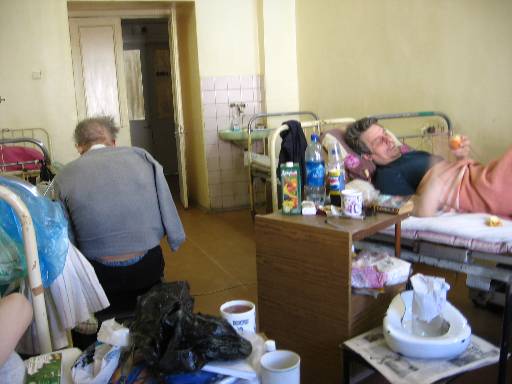
That Form of Torture they Call the Russian Hospital


Global Voices has a harrowing account of a mother's struggle to nurse her son back to health at a Russian hospital. Here is an extract:

A room for five people, one bed’s empty. Gloomy men of various ages lie either with broken legs suspended or simply on their backs. In the room for those who can’t move, there’s no bell to summon the personnel. The door is wide open and this is understandable. First, to yell and be heard in case something happens (this, I guess, is problematic, however - the post is far away and the nurses’ room is all the way around the corner); second, it works like air conditioning. No way to open the window - because they can’t move. And because one bed is underneath the window and the person there can catch a cold.

Mityay has just recovered from a severe cold, he has running nose and cough, and it hurts him to cough. I went to ask the nurse for some nasal drops and [a cough medicine]. I was ready to pay for this “service.” But they don’t have any drops or syrups. They also don’t have any camphora alcohol to prevent bedsores. But I’ve got it with me. As well as a cup, a spoon, toilet paper (thank God, they have sheets - in the children’s hospital […] they once made us bring that, too).

In the Soviet time, I was an in-patient at the traumatology department […]. In general, the hospital was no better. A drunk doctor, lazy nurses. In our room for people who couldn’t move, an old woman with a broken hip died - she had bedsores, she rarely had visitors, it smelled bad in the room. The old woman lied dead for a few hours before my classmates came to visit me and went looking for the staff. I wanted to smoke very much, and when I did light up under the blanket, the other old women said, “Go on smoking, daughter, let there be human smell in here at least…”

You can see the horrible truth about Russian hospitals by clicking here, where a number of photographs of the son's room and the hospital exterior are to be found. Is this a G-8 country flush with oil revenues? You tell La Russophobe.

The Disappearances Begin in Chechnya

The Jamestown Foundation reports that we are now entering the phase of Russia's management of the Chechnya problem where people (including women) that the Kremlin doesn't care for simply start disappearing (like in Argentina):

FEARS GROW OVER MISSING JOURNALIST’S FATE

The Sunday Times reported on September 10 that fears were growing over the fate of Elina Ersenoeva, a young Chechen journalist who was reportedly forced to marry Chechen rebel warlord Shamil Basaev last fall and was abducted at gunpoint, apparently by pro-Moscow Chechen security forces, in Grozny in August, just weeks after Basaev’s death. The British newspaper quoted her mother, Rita Ersenoeva, as saying she was “terrified” that her daughter’s captors had already killed her. “I fear that the men who took her have done terrible things to her,” she said. “She had no choice but to marry Basaev. Now that she is gone I have lost hope. I have lost a golden child.” Rita Ersenoeva told the Sunday Times that she has received anonymous calls warning her not to make a fuss and that she fears that her daughter’s captors will come back for her two brothers, aged 15 and 22. According to the British newspaper, Elina Ersenoeva was approached last autumn by Kheda Saidulaeva, the wife of the late separatist leader Abdul-Khalim Sadulaev, who was a distant relative of Ersenoeva. Saidulaeva told her that she had been chosen to marry a commander known as Ali-Khan Abu Yazidov and that if she refused, her brothers’ lives would be in danger. “On November 30 Elina was approached by an envoy of Abu Yazidov,” the Sunday Times reported. “The man ordered her to get into his car. He blindfolded her and drove her to a house on the outskirts of Grozny. She was led into a room where she came face to face with Basaev.” She was forced to marry the rebel warlord, whom she saw on a few other occasions for several days at a time before he was killed in July of this year. It was only after his death that she revealed to her family that she had been married to Basaev.The FSB questioned Elina Ersenoeva two weeks after Basaev’s death, but they accepted that she had been blackmailed into the marriage and brought no charges against her. On August 17, she was abducted at gunpoint as she and her aunt, Elza Astamirova, were on their way to work in Grozny. “Eight men with machine guns shoved us in and drove us away,” Astamirova told the Sunday Times. “They put sacks over our heads to stop us seeing where they were taking us. I was screaming with fear but they were just laughing. We ended up in a small room with bare walls. Elina was next to me. They let me go and kept her.” On the day she was abducted, Elina telephoned her mother three times to say that she would be released that evening, but she has not been heard from since. The Sunday Times quoted her mother as saying that she fears her captors may have believed rumors that Basaev left behind a stash of millions of dollars and decided to torture her into disclosing its whereabouts. “To think that Basaev would share that information with her is absurd,” her mother said. “To think she lived all those months in fear to protect her family is very distressing. I can’t bear to think what they are doing to her.”

New Zoshchenko

The New Yorker reports that, fittingly, a new translation of the short stories of Russian satirist Mikhail Zoshchenko has just been published. What could be more timely, as the Neo-Soviet Union rises from the ashes of the USSR, that one of the Soviet Union's most acid critics should also reappear.

The Galosh, by Mikhail Zoshchenko, translated from the Russian by Jeremy Hicks (Overlook; $24.95). Though little known to English readers, Zoshchenko was one of the most popular writers in early Soviet Russia—a time when, as Hicks explains in a useful introduction to this collection of brief comic tales, satire was not yet prohibited by the authorities. Describing himself as “a temporary substitute for the proletarian writer,” Zoshchenko wrote in a deliberately simple style, filling his pages with corrupt officials, petty thieves, and confused bureaucrats. Hicks’s fine translations overcome tricky problems—one dénouement involves “Paris” being misread as a word written in Cyrillic—and successfully capture Zoshchenko’s knockabout use of everyday speech. Zoshchenko brought out the latent comedy of people’s adaptation to new ways. In one story, the electrification of an apartment building upsets residents who previously, thanks to the gloom, had not been able to see the squalor in which they lived.