La Russophobe has moved!

You should be automatically redirected in 6 seconds. If not, visit
http://larussophobe.wordpress.com
and update your bookmarks.

Take action now to save Darfur

Friday, February 09, 2007

The Beeb on Russian Poisonings

At left, you see a photograph of a scowling Grigori Yavlinksy, leader of the Yabloko opposition party, hodling a photograph of murdered dissident journalist Yuri Shchekochikhin. A British reader tips us that BBC radio has a radio broadcast available in which they investigate the series of political murders to which the Kremlin has been linked. Click here to listen. Here's their print report:

"He complained about fatigue, and red blotches began to appear on his skin. His internal organs began collapsing one by one. Then he lost almost all his hair."

This was how a witness described the mysterious illness which struck down 53 year old Yuri Shchekochikhin, a member of the Russian Duma or parliament, in June 2003. Within 16 days of falling ill Shchekochikhin was dead. And both colleagues and family suspect he was murdered.

The strange illness of Yuri Shchekochikhin is one of a series of deaths investigated in Russia by File on 4 in the wake of the dramatic radiation poisoning of Russian exile Alexander Litvinenko in London last November. The common factor in these deaths is that in each case people close to the victim suspect that either the state or one of its security arms was involved.

Family frustrated

As a journalist Yuri Shchekochikhin was one of Russia's top corruption investigators. His colleagues say family members were told by medical staff that he may have died from "an allergic reaction". But more than three years after his death, his family are said still to be trying to obtain medical records and tissue samples to allow an independent scientific analysis to be done. A friend of Shchekochikhin, Kirill Kabanov, who is a former member of the Federal Security Service, the FSB, was travelling with him shortly before his illness. Kabanov says that among the targets of Shchekochikhin's investigations were very senior people in the FSB and in other state agencies.

He recalls that with no official help, friends of the dead man mounted an independent assessment of the facts they knew. "We had our own investigation of Yuri's death," says Kirill Kabanov. And I personally had to use some of my old contacts from the security services. And the specialist whom I contacted said that with 90% certainty Yuri's case was a poisoning and most likely he was poisoned with thallium."

(Thallium was initially suspected by doctors treating Alexander Litvinenko in London before further tests pinpointed the radioactive substance polonium-210 as the poison.)

Asked why doctors should give other reasons for the death and why samples should be unobtainable, Kirill Kabanov again draws on his secret service knowledge. "Yuri Schekochikhin's treatment and his post-mortem took place at the Central Clinical Hospital. This is the most important clinic in Russia and it's tightly controlled by the Russian Federal Security Service because it treats top-ranking Russian officials."

So could a cover-up have taken place?

"Recently," says Kabanov darkly, "very few people in Russia find the courage to tell the truth."

Bodyguard's death

There are similar suspicions surrounding the death of another man, Roman Tsepov, aged 42, in St Petersburg in September 2004. Tsepov had been running a security agency since the nineties. He had even guarded the man who became Russia's president seven years ago, Vladimir Putin. After a business trip to Moscow Roman Tsepov fell ill and his condition went downhill dramatically, as his physician, Dr Pyotr Pirumov, recalled, in an account given to the agency for Journalistic Investigations in St Petersburg.

"It was poisoning without a poison... It was as if his immune system was switched off." Again in under three weeks after falling ill the patient was dead. No clear cause of death was issued. And when we called Dr Pirumov he seemed nervous about the case and declined to grant an interview. But File on 4 has now learned that a few weeks after Alexander Litvinenko's death, the files on Roman Tsepov were requested from St Petersburg by the General Prosecutor's Office in Moscow and the case is now being handled from there. A claim made by a Moscow investigative journalist, Igor Korolkov, of the newspaper Novaya Gazeta, only deepens the mystery.

Massive contamination

"My source at the prosecutor's office in St Petersburg told me that a post mortem on Roman Tsepov showed he was contaminated with a radioactive element," says Korolkov. "And the quantity of this element in Tsepov's body exceeded the norm by one million times." Suspicions that the state, or its security or armed services could have had a hand in high profile killings are dismissed by the deputy chairman of the Duma security committee, Mikhail Grishankov.

He is a member of the pro-Putin United Russia Party and is also a former member of the FSB. "Russia is now very different from what it was like back in the 1930s and 1940s," says Mikhail Grishankov. And the myths formed in the West back in those times, are a hangover of the Cold War. And this speculation about the alleged connection of the Russian security services - I see it as an attempt to bring these Cold War skeletons back to life!"


The Beeb on Cruelty to Russian Infants

The BBC has done a nice investigation of the "gagged baby" story that La Russophobe reported several days ago. Here it is:

Mobile phone video of babies in a Russian hospital with sticking plaster apparently covering their mouths made headlines around the world but the plight of the otkazniki - the infants abandoned by their mothers in hospital - goes much deeper. For Maxim Gareyev, editor of Yekaterinburg's parenting newspaper Yeka-mama, the story which broke at Hospital No 15 was no great surprise. "We get confidential letters and private messages from officials and others about babies being maltreated in hospitals but nobody wants to speak out because they don't want to lose their jobs or they fear for their reputations," he told the BBC News website. Mr Gareyev has little to say about the "gagging" case, pointing out that city prosecutors are conducting a criminal investigation.

But what he can talk about is the circumstances of the babies, because it is something he knows well from both his newspaper's own reporting and his charity work to help them. Babies officially taken into care by the state on the grounds that their parents are unfit to rear them are usually out of hospital and in a children's home within a few days of birth, says Mr Gareyev. But otkazniki are often left behind in hospitals for months, awaiting a vacancy. If a carer is not found, they will be packed off to orphanages at the age of three. And their experiences during those first years of life may mark them permanently.

Nowhere to go

The reported events at Hospital No 15 are a first for Carel de Rooy, the Unicef representative in Russia and Belarus, but the issue of otkazniki is one that he has long been pushing for the Russian authorities to address. "Hospital staff are trained to care for the sick - they are not trained to deal with the cognitive and emotional development of babies," he told the BBC News website. "This has serious implications both for the development and long-term health of the child." Given the potential for damage to these babies' make-up, why do they get left in hospital? The answer, Maxim Gareyev explains, is lack of resources.

"We simply do not have enough children's homes in Sverdlovsk [the region around Yekaterinburg] and Russia in general," he says. "These babies get left in hospitals but there are no funds or trained medical staff or special facilities for caring for them. "Of course, the hospitals make space for these babies but the problem is that in the first year of life a baby needs to be cuddled, it needs to be talked to, if it is to develop as a human being."

Overworked nurses

Charities have stepped in to do what they can for the babies. Olga Bizimova, a 27-year-old married mother of two, became a volunteer in Yekaterinburg's Little Stork group because she felt sorry for them. "We buy disposable nappies and baby food," she told the BBC News website.
"We visit our local hospital. We give the babies a bath, we dress them and, if we get permission, we take them out for walks. Then we come back and we play games and feed them." She also once visited Hospital No 15, which treats infectious diseases, and she had the impression that it was a "good, clean hospital where the kids are looked after well. The only problem was that the nurses in charge of them had an awful lot of work to do looking after sick children and simply did not have the time to look after the abandoned babies too," she says.

When Mrs Bizimova was at No 15, she was warned that some of the babies could have infectious diseases. The city has a children's home specially equipped for treating such children but it is currently full, she says. Carel de Rooy notes that the situation of children infected with HIV/Aids in Russia is particularly serious, with some babies "lingering in hospitals for 18 months or more".

Culprits

About 730,000 children are growing up in Russia without their biological parents, of whom only 10% are orphans in the true sense of the word, according to Unicef. Almost 75% of them grow up in families through guardianship, foster care, patronage or adoption but that leaves about 186,000 children growing up in institutions. For volunteer Olga Bizimova, the main reasons why mothers give up their babies are lack of money and living-space along with problems such as alcoholism. Mr de Rooy agrees that Russia's economic growth has "unfortunately not translated into support for the poorest families". But he also calls on the state to allow mothers more time to decide about keeping their children and invest in training for families, which "costs less in the long run than care in state institutions". Maxim Gareyev finds a positive in the investigation at Hospital No 15: hospital staff have been given a "good scare" which will make them more careful about babies, he says. Yet he is worried that a successful prosecution may only mask the longer-term problem of babies left neglected in hospitals. "I for one could not bring myself to condemn outright any nurse that is convicted - it is not the job of hospital staff to care for babies full-time," he says.

"I am afraid that she may be used here as a scapegoat when the real culprit is our state."

Austria Slaps Quota on Odious Russian Tourists

La Russophobe wishes she had a rouble for every time she's heard from a Russophile maniac that Europe sides with Russia against the United States, and/or that Russians can bribe their way out of any problem. Meanwhile, Americans can travel to Austria in any number without a visa, but Russians? Let the Guardian fill you in:

To many resorts they would be viewed as dream guests: tourists prepared to spend huge amounts of money, day and night. But hoteliers in the luxury Austrian ski resort of Kitzbühel think otherwise. According to a memo leaked to the local press, they have voted to limit the number of Russian visitors to 10% of the total number of guests at any one time. According to outgoing tourism chief Renate Danier, the deal reached by 16 out of 20 of Kitzbühel's four- and five-star hotels states that only a limited number of Russians are welcome in the Tyrolean resort. She told reporters: "We have so many bookings from international travel agents that we have a limited ability to take any more guests. We want international variety and not to be 50% Russian." The agreement states that the quota is necessary to retain the "international mix" for which Kitzbühel is well known. It adds that Russian guests are "naturally welcome" but that Kitzbühel wants to avoid becoming a Russian "stronghold". The number of Russian and Ukrainian guests to the Tyrol has been rising each year since the millennium, boosting profits while other resorts fight to keep guests despite low snowfall. Many resorts now accept the rouble, with menus written in Cyrillic and some resorts laying on Russian-speaking shopping scouts. They are known for their big spending - Gucci skis and Chanel skiwear abound, while Maybach cars cruise the streets. Last year Yelena Baturina Luzhkova, wife of the mayor of Moscow, reportedly ordered "kilos of caviar" in a single evening.

The Russians are also notorious for their ability to party hard, as well as for drunkenness and unruly behaviour. But tourism experts believe that the underlying anger of the 9,000 locals stems from the Russian-fuelled property boom. Russians are increasingly buying ski chalets and hotels for £15m or more, driving prices up and pushing locals out of the market, despite the fact only EU citizens have the right to buy property in Kitzbühel. The owner of Chelsea football club, Roman Ambramovich, has reportedly put in a bid for a luxury hotel, while Mrs Luzhkova is said to have bought a golf course on which she plans to build a hotel. Politicians are coming under pressure to deal with the issue as property prices have almost doubled since 2005. "It's time to act before locals are pushed out," said Kitzbühel's mayor, Klaus Winkler. Sepp Schellhorn, president of the Austrian Hoteliers Association, condemned the Russian quota as "absurd" and "shortsighted". "This is not in line with the wishes of those who promote Austria or the Austrian economy," he said.

But the head of Sporthotel Mayr-Reisch, Rupert Mayr-Reisch, said: "We've learned from other resorts, like St Moritz. You get a bit of a nationality imbalance when one nation gets the upper hand. It's more pleasant when there are not too many people from one country in the same hotel." However, Mr Schellhorn said that it was ridiculous to speak of a mix of nations: "Think about it: Kitzbühel has a large number of Germans, but no one has ever thought of trying to limit their numbers."

Now, dear reader, how do you think Russians will react to this news? Will they (a) blame an evil foreign conspiracy of "russophobes" or will they (b) seek to find out why Austrians hate them so much and try to reform or will they (c) laugh it off like little schoolboys, as if it matters not?

Thursday, February 08, 2007

Annals of Cold War II: U.S. State Department Condemns Kremlin over Khodorkovsky

Jurist reports that the U.S. State Department has issued the following official statement concerning the Kremlin's attempt to try Mikhail Khodorkovsky twice for the same crime:

As we have commented in connection with the original trial, the continued prosecution of Mikhail Khodorkovsky and the dismantlement of Yukos raise serious questions about the rule of law in Russia. Khodorkovsky and his associate, Platon Lebedev, would have been eligible to apply for parole this year, having served half of their terms. These new charges would likely preclude their early release. Many of the actions in the case against Khodorkovsky and Yukos have raised serious concerns about the independence of courts, sanctity of contracts and property rights, and the lack of a predictable tax regime. The conduct of Russian authorities in the Khodorkovsky Yukos affair has eroded Russia's reputation and confidence in Russian legal and judicial institutions. Such actions as this and other cases raise questions about Russia's commitment to the responsibilities which all democratic, free market economies countries embrace.

That's rough talk coming from diplomats, as rough as it gets. Way to go, Miss Condi! LR knew she could count on you in a pinch!

Meanwhile, the
Kremlin was announcing a major escalation of the arms race, as the Associated Press reports:

The Russian military will sharply increase the number of new intercontinental ballistic missiles to be deployed this year as part of an ambitious weapons modernization plan, Russia's defense minister said Wednesday. Sergei Ivanov said the military would get 17 new ballistic missiles - a drastic rise compared with an average four deployed annually over recent years. The purchases are part of a weapons modernization program for 2007-2015 worth about $189 billion.

Ivanov said in a speech before lawmakers that the plan envisages the deployment of the total of 34 new silo-based Topol-M missiles and their control units, as well as another 50 such missiles mounted on mobile launchers through 2015; Russia so far has deployed more than 40 silo-based Topol-Ms. The Russian military will sharply increase the number of new intercontinental ballistic missiles to be deployed this year as part of an ambitious weapons modernization plan, Russia's defense minister said Wednesday.

President Vladimir Putin and other Russian officials have described the Topol-M as a bulwark of Russia's nuclear might for years to come, and hailed its ability to penetrate any prospective missile defenses. Putin last week dismissed Washington's claims that missile defense sites it hopes to establish in Poland and the Czech Republic were intended to counter threats posed by Iran, and said that Russia would respond by developing even more efficient weapons systems.

A rising tide of oil revenues gave Russia a chance to increase its defense spending following a desperate money shortage that plagued the military throughout the 1990s. "The economic growth and the scientific achievements allow us to reach a qualitatively new level in military procurement," Ivanov said. Russia's defense budget which stood at $8.1 billion in 2001 nearly quadrupled to $31 billion this year, Ivanov said. But despite a steady increase in military spending in recent years, Putin said last week that Moscow's military budget was still 25 times smaller than Washington's defense spending. Ivanov said that a share of weapons purchases in the military budget also has been growing over years. This year, the military will spend $5.4 billion on new weapons, buying aircraft, tanks and other armored vehicles and four new satellites, he said

Timoshenko Pokes Putin Right in the Eye! You go, girl! Meanwhile, Poland has her back . . .

Stratfor reports that Ukraine has told Russia just where to go on the question of its national pipelines:

The Ukrainian Rada adopted a law Feb. 6 that forever prevents the country's natural gas transport pipelines from falling into foreign hands. The move not only puts the Kremlin on alert that at least in some forms Ukrainian nationalism is alive, well and popular, it also highlights the ongoing oligarchic struggle for Ukraine's assets -- as well as its hearts and minds.

Ukraine's parliament, the Rada, voted by a margin of 430-9 (with 11 members not in attendance) not only to prohibit the sale of the country's natural gas transport system or national energy assets to foreigners, but also to require that any new systems created must be 100 percent owned by the Ukrainian state.

Natural gas-related issues are part and parcel of Ukraine's ongoing West vs. East debate: The western portions of the country often feel estranged from their Russian suppliers and more willing to sign on with the West, while the country's Russofied East instead wants closer political and economic relations with Moscow. The parliamentary effort -- spearheaded by the charismatic Yulia Timoshenko, leader of an eponymous political bloc -- originated in response to comments by both Ukrainian Prime Minister Viktor Yanukovich and Russian President Vladimir Putin that joint management of the Ukrainian network could lead to greater throughput, something that in theory would help both sides increase their income.

Timoshenko would have none of it. She -- and many other Ukrainian nationalists -- see any Russian involvement in the pipelines as the surrender of one of the few levers Kiev holds over Moscow. So long as more than three-quarters of Russia's natural gas exports to the European Union and Turkey flow through Ukrainian-owned lines, the nationalists argue, Moscow cannot dictate terms to Kiev. Beyond the issue of maintaining Ukrainian sovereignty, however, the vote highlights two critical issues.

First, even parliamentarians from Yanukovich's own Moscow-friendly Party of Regions voted en masse for the restriction on the sale of the network. Ukraine is home to nearly 20 million Russians who, by and large, identify more with people across the border in Russia than with those across the country in the nationalist powerbase of Lviv; however, those Russians' sense of political loyalty and national pride apparently are such that they want to keep control of their country's most valuable physical asset in non-Russian hands. A Russia that has been working steadily to reassert its influence in Kiev cannot ignore that fact.

Second, there is more at work here than the often-wily Timoshenko simply securing a nationalist victory. Back around the turn of the millennium, when Timoshenko was in government as energy minister, she was hardly a diligent bureaucrat beyond corruption. She made her personal fortune by grabbing for herself the rights to sell imported Russian natural gas to Ukraine's various regional distributors (to the point that the Russians had an outstanding warrant for her arrest even when she became Ukraine's prime minister in 2004). So long as the infrastructure that made her fortune possible remains firmly in state hands -- and now it will -- Timoshenko has preserved the possibility of replicating such income in the future.

After all, Timoshenko is not only a former energy minister, but also a former prime minister -- and she has every intention of scrambling back to the top again.

Poland opened another front against Russia, as the People's Daily reports:

Poland will uphold its veto of Russia-EU negotiations toward broader economic cooperation if Russia imposes sanctions against Poland in a meat export row, Polish Prime Minister Jaroslaw Kaczynski warned on Tuesday. Poland, which joined the EU in 2004, vetoed the launch of talks on a broader economic cooperation agreement between the EU and Russia in November last year in protest against a year-old Russian ban on imports of meat from Poland. "Under the currently operative Russia-EU agreement, Russia cannot use such methods towards Poland. Poland will in no circumstance withdraw from its veto should Russia use them," Kaczynski told a press conference. Kaczynski said any economic sanctions against Poland would mean sanctions against the EU. Poland will never agree to be treated like a country that is not a EU member, he added.

The prime minister's words followed a report on Tuesday by Russia's Kommersant daily saying that Moscow will impose restrictions on imports of various goods from Poland in retaliation for Poland's blocking of EU-Russia negotiations on the new agreement. The planned restrictions will reduce the value of Poland's exports to Russia by between 1.5 billion and 2 billion U.S. dollars from the present 4 billion, the daily said. Russia, which has been vigilant of its food safety after findings of Poland's falsified veterinary and sanitary certificates, responded with rhetoric. "We believe the ball is in Poland's court. No one other than Poland can solve this problem," Sergei Yastrzhembsky, President Vladimir Putin's special representative on EU relations, said on Tuesday in Moscow. The national elites of some recent EU entrants had "major hang-ups" about their "special relations" in the past with Russia, he said. "(They) try in part to exorcise these hang-ups through their relations with contemporary Russia. These new entrants have to a certain extent influenced the atmosphere of relations between Russia and the EU," said Yastrzhembsky. Russia urged Poland to put aside historical grievances and resolve a dispute over meat imports which is hindering the start of negotiations on the EU-Russia deal. The EU said earlier that the restrictions should be lifted immediately, but agreed that Russia does have a right to send a team of experts into Poland to see for themselves. According to the PAP news agency, Russian veterinary inspectors on Monday visited Poland to inspect selected meat plants accompanied by EU vets.

Putin Sssssspeaks (Over a Forked Tongue)

Some facts about "President" Vladimir Putin's February 1 "press conference" in Moscow:

The transcript of the proceedings comprises 25,426 words. Not one of them came from a reporter from Novaya Gazeta. So much for the idea that a "press conference" occurred.

Putin stated: "Wages rose by 13.3 percent on average, real incomes increased by ten percent from last year’s base, and old-age pensions rose by 5.4 percent." But later he stated "For the first time in modern Russian history we had single-digit inflation – 9 percent - in 2006. It is very good to see that this was precisely what we forecast." If wages rise by 13% and inflation is at 9%, doesn't that mean real wages increased by 4%, not 10%? And do you notice that Putin doesn't care to express the wage growth in monetary terms, but rather only in percentages? Guess why: If the average wage is $400 per month, then 13.3% growth is only $53.20 of additional income per month, less than $2 per day, and that's before taking into account inflation. The same thing occurred when Putin spoke about economic growth. He stated: "We will get the final result for 2006 only in March, but various estimates suggest GDP growth of approximately 6.7-6.9 percent for last year." What he doesn't say is that 7% growth on an economic base of $750 billion only amounts to $52.5 billion spread out among a population of 140 million people -- that's just $375 per person, about a dollar a day. So much for the idea that a transfer of information occurred.

Putin was asked "Vladimir Vladimirovich, when President Yeltsin was in power, he had the habit of naming his successors. Under your rule, it’s quite the opposite and you have not yet named any names." He answered: "You used the word ‘rule’. I do not rule, I simply do my work." This is like a scoop of (decaying rat-flavored) ice cream saying "I am not cold, I just spend all my time in the freezer. I don't taste bad, I'm just made from rat entrails."

The word "murder" was used by only one questioner, never by a Russian reporter. It appears in this exchange:

STEVEN GUTTERMAN (Associated Press): After Anna Politkovskaia’s murder you said that there are people hiding from Russian justice who would like to damage Russia’s reputation. And after Aleksandr Litvinenko’s death your aide Sergei Yastrzhembsky said that this could be part of a plot with that same goal. Can you now tell us a few more details, several months after the tragedy, or say more precisely who you think is behind these murders? Do you think they are foreigners or Russians living abroad? And if yes, then who? Can you name them?

VLADIMIR PUTIN: Only an investigation can determine whoever is behind these murders. And moreover only a court can do so, because at the end of the day it is the court that, having weighed all the pro and contra – both the prosecutors’ arguments and the defense of the accused – makes the final decision. As to prominent murders, then it is true that the problem of the persecution of journalists is a very acute problem both for our country and for many other countries. And we acknowledge our responsibility in this. We shall do everything possible to protect members of the press. I recall not only Anna Politkovskaia – she was quite a sharp critic of the authorities and that is a good thing. I recall other journalists as well, including Paul Khlebnikov. And not long ago one of our American partners said something very true: “Paul Khlebnikov died for a democratic Russia, for the development of democracy in Russia”. I completely agree with him. I fully agree with this evaluation. As to other well-known crimes, you know that just recently the investigation into the murder of the Vice-President of the Russian Central Bank has been finished. I very much hope that the law enforcement agencies will manage to find the criminals who have committed other, no less prominent crimes, and ones that are no less harmful to our country.With regards to Litvinenko, I do not have much to add here, except what I have already said. Aleksandr Litvinenko was dismissed from the security services. Before that he served in the convoy troops. There he didn’t deal with any secrets. He was involved in criminal proceedings in the Russian Federation for abusing his position of service, namely for beating citizens during arrests when he was a security service employee and for stealing explosives. I think that he was provisionally given three years. But there was no need to run anywhere, he did not have any secrets. Everything negative that he could say with respect to his service and his previous employment, he already said a long time ago, so there could be nothing new in what he did later. I repeat that only the investigation can tell us what happened. And with regards to the people who try to harm the Russian Federation, in general it is well-known who they are. They are people hiding from Russian justice for crimes they committed on the territory of the Russian Federation and, first and foremost, economic crimes. They are the so-called runaway oligarchs that are hiding in western Europe or in the Middle East. But I do not really believe in conspiracy theories and, quite frankly, I am not very worried about it. The stability of Russian statehood today allows us to look down at this from above.

Note well: He didn't name a single one of the "enemies" responsible for attacking Russia, nor did he name a single specific measure his regime would take to protect journalists. And note that this question only comes from a foreigner. The Committee to Protect Journalists has just named Russia the most dangerous country not at war in the entire world for the practice of journalism. So much for Putin's laughably dishonest statement that "the problem of the persecution of journalists is a very acute problem both for our country and for many other countries." Russia stands alone in this regard. CPJ states: "Russia has the worst record of impunity among countries in the region. It is also the third deadliest country for journalists worldwide, according to Deadly News, a CPJ analysis of deaths over the past 15 years. Only Iraq, and Algeria when it was riven by civil war, outrank it."

The word "Chechnya" was used only once, here:

SULTAN GALBATSOV (Democracy newspaper, Chechen Republic): In the Chechen Republic more than 70 percent of the available labour force is unemployed. In light of the positive results of the amnesty and the region’s importance, could you please tell us, Vladimir Vladimirovich, what measures are being foreseen to create new jobs? Thank you.

VLADIMIR PUTIN: First of all, I would like to point out that the present government and the Prime Minister of the Chechen Republic were able to accomplish a great deal lately. I watched how the present government worked in Chechnya attentively. I must say that what is happening there is even unexpected. We are witnessing the mobilization of citizens living in Chechnya and there is an obvious desire for a religious peace, to restore order, for discipline, the rule of law, and economic revival. And there are simply visible results of this effort. But of course we still have a lot that we can and must do. We have the corresponding programmes to develop the productive forces. I must say that today the Chechen Republic receives more from the federal budget than other regions in the Russian Federation, including regions in the Northern Caucasus. We intend to continue this policy in the future. I am not going to go into detail here because it would simply not be interesting for everyone (I know it involves a brick factory, cement, and so on). We are going to support what is called for, expedient and agreed upon with the federal authorities.
When he says "I must say that today the Chechen Republic receives more from the federal budget than other regions in the Russian Federation, including regions in the Northern Caucasus" he's talking about money spent on security forces for the terrorizing of the Chechen population, not investment.

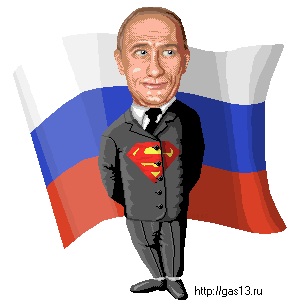
Photo credit: The cartoon of Vladimir Putin that accompanies this article comes from the website of American neo-Nazi David Duke. David is a big, big fan of DyaDya Vladimir. This is no doubt so because extremist crimes of racist violence are dramatically up in Russia under Putin.

Annals of Chechnya: The Violence Continues Apace

The International Herald Tribune reports:

A senior local official in Russia's restive Chechnya province was killed Wednesday in a bomb attack, police said, in the latest violence in a more than decade-long separatist conflict.

A bomb exploded in the morning as Mairbek Murdagamov, deputy head of the southern Vedeno district, was leaving his house, said the local branch of Russia's Interior Ministry.

The explosion ripped off Murdagamov's foot and he was hospitalized, dying a few hours later, the ministry's press service said.

Large-scale fighting has all but ended in Chechnya, a mainly Muslim province in southern Russia where a separatist conflict has persisted for more than 12 years, but small-scale attacks and hit-and-run ambushes on police and government officials persist.

The violence in Chechnya has spilled over into other regions of Russia's troubled North Caucasus, blamed on both criminal gangs and remaining groups of separatist rebels.

Me so Horny II: Annals of Cheap Russian Prostitutes

Some readers (well, moronic apes) have expressed interest in knowing further details about the availability of attractive Russian women selling their bodies on the cheap. A few idiots have even suggested that despite Russia having an average wage one-third that of America's minimum wage, it might be possible that Americans (and other Western foreigners) would still not see Russian prostitutes as inexpensive. On her side, La Russophobe has heard that Russian whores are so popular that mentioning such things can cause a sudden temporary surge of traffic on a website as numerous horny weirdos are apparently trolling the internet looking for such opportunities as Russia is famous for offering them. Hence, if you click here you will find a listing of prostitutes from the city of St. Petersburg Russia who charge no more than $50 per hour (from just one pimping agency, in Russia there is a vast profusion, and St. Petersburg is the second-most expensive city in the country; go into the hinterlands, and prostitutes would become virtually free for Westerners with normal incomes). If anyone knows of a European nation offering a better bargain, do please inform La Russophobe. Albania, maybe? But they probably wouldn't offer such a wide variety of models to choose from, in so many styles and colors, would they? After all, it's a small country. In a nation where the average wage is $2.50 per hour, there's obviously considerable pressure on young women to pursue this mode of "employment." This is well documented in a film we've previously recommended, Lucas Moodysson's "Lilya 4ever." In Seattle in 2002, the going rate for a prostitute was $120 (undoubtedly inflation has bumped the rate to at least $150 since then), so one can find a prostitute in St. Petersburg for 1/3 the price. If one consumed prostitutes heavily enough, one could pay for the cost of a flight and even have a net profit by indulging in the Piter sex trade.

Russia is also a world leader in hosting affordable child pornography for the consumption of Western aficonados, as a recent bulletin from CBS News reports.

Wednesday, February 07, 2007

Draconian Neo-Soviet Travel Restrictions Appear

The Moscow Times reports that Russia has enacted a set of draconian neo-Soviet restrictions on the movements of foreigers within Russia. Logically, all Western governments with citizens subject to these restrictions should now adopt the same rules for Russians traveling in the West. Of course, these restrictions provide the Kremlin with yet anther excuse to harass, jail and eject any foreigner who dares to fail to toe the Kremlin line:

Thinking of jetting up to St. Petersburg for a week to see White Nights this summer? If you're a foreigner and you want to spare your employer from a possible $30,000 fine, you'd better make sure the government knows you're leaving town. According to a new law that came into effect Jan. 15, foreigners are now required to hand over their registration papers to migration officials -- via their employer or other sponsor -- every time they leave the country and re-register upon subsequent entry into the country. But the law is steeped in vagaries. Visa agencies say foreigners could incur heavy fines for their employers if they neglect to inform them of even a short trip out of town.

Hotels, for their part, say the amount of documentation on their foreign guests has become unduly burdensome. At least one St. Petersburg hotel has stopped admitting foreigners altogether.

The new law says a foreigner's "inviting party" -- an employer, landlord, hotel or other Russian host -- is required to inform local migration officials of the foreigner's arrival within three working days of entering the country. The inviting party is also required to inform authorities if the foreigner leaves Russia and it has two working days from the day of departure to do so. "The foreigner has to be stricken off the Federal Migration Service register, because he can't be registered with the Federal Migration Service if he is not in Russia," said Zalina Filimonova, spokeswoman for the Moscow branch of the migration service. "That's pure logic."

The law has been touted by migration officials as a simplification of the registration process. On paper, after all, the inviting party is merely required to submit information about the foreigner's passport, visa and migration card to the local branch of the migration service. Migration officials then issue a registration card that the foreigner carries at all times as proof of being in the country legally. The card makes obsolete the previous practice of placing a registration stamp in passports.

In theory, the entire process can even be done at the post office, with a post office receipt serving as confirmation of a foreigner's registration. But the new procedures could prove to be quite a hassle for foreigners who travel often -- either internationally or within Russia, said Yekaterina Elekchyan of Your Lawyer, a legal firm specializing in visa and work-regulation issues. "On the one hand, it's easier in that the landlord doesn't have to physically go down to the DEZ," Elekchyan said, referring to the local building-utilities administrator offices that were obligatory stopovers for foreigners' landlords under the old registration rules. "But for a foreigner who enters and leaves the country quite often, it's not very convenient to have to turn in documents every time." Foreigners must turn in their registration card when they leave for another region, Filimonova said. Then, upon arrival, the inviting party must register the foreigner with local migration officials within three days and inform them of his departure no later than two days after he leaves.

Under the law, the inviting party is fully responsible for registering the foreigner. According to information posted on the web site of the Moscow branch, fines for breaching the rules run up to 4,000 rubles for a Russian citizen hosting a foreigner and up to 800,000 rubles ($30,000) for employers. One large Western-managed company informed its foreign employees recently in an internal memo that they would have any fines deducted from their salaries if they did not inform the company of their international travel plans. Federal Migration Service spokesman Denis Soldatikov said Friday that authorities would not be "hunting" down violators. "But if people are found in violation, they will be fined," he said.

Inexplicably, Soldatikov contradicted the deadlines and procedures given in the law itself. He said the inviting party must inform authorities of a foreigner's arrival within 30 days and departure with 10 days. Soldatikov -- in another contradiction of what the law says -- also insisted that a foreigner does not have to turn in the registration card upon leaving the country.

Alexei Filipenkov, deputy chairman of Association of European Businesses' visa task force, said the law is so muddled and riddled with holes that it is impossible to enforce. "Nobody knows what is going on," he said. "I ask one migration official what to do, and he tells me one thing. On the same day I go to another official, and they tell me something completely different. Nobody knows what is going on because the rules are constantly being changed."

One group that is already lobbying for changes in the law are hoteliers. One large Moscow hotel said it has had to hire two employees to deal exclusively with filling out the increased paperwork for foreign guests, and because the local branch of the migration service is understaffed, the employees themselves must sit down and enter the data into the migration service's system. "Until our employee sits down and enters every single form in to their system by manually typing, no one is registered," said an executive from the hotel, who spoke on condition of anonymity, citing company policy. Soldatikov, the migration service spokesman, denied that hotel employees might be entering information into the migration service's database. "Access to those computers is restricted," he said. Soldatikov said hotels had no grounds for complaint and that the system had changed little for them.

One small hotel chain in St. Petersburg, however, has stopped accepting foreigners for fear that a single violation of the new law could result in a hefty fine. "Fortunately it's not high season yet, and primarily Russian citizens are on business trips," Marina Slesareva, deputy head of the Rinaldi chain, told Komsomolskaya Pravda. "It's scary to think what will happen in the summer. Not one single branch of the Federal Migration Service can tell us what to do under the new rules."

The Khodorkovsky Charges: Proof that there is No Justice in Russia

Robert Amsterdam, Mikhail Khodorkovsky's American lawyer, has announced that Russia intends to put his client on trial for the same offense twice inside MK's prison in Siberia rather than in court. Siberian Light points out that MK is being charged with "laundering" nearly twice as much money as his maximum net worth, which "shouts out ‘politically motivated charge’." Amsterdam adds that when, upon learning of the news that his client would be charged, Khodorkovsky's Russian lawyer Yuri Schmidt tried to fly to Siberia to meet with his client and was promptly arrested by Moscow authorities at the airport and subjected to harassment. In other words, for all these reasons and more, it's clear that there is no such thing as "justice" in neo-Soviet Russia any more. The regime will do as it likes no matter what the "law" might be, and the lemming-like population will sit by and watch it happen, just as in the days of Stalin.

Amsterdam speculates on the classic neo-Soviet reasons why the Kremlin would want to make a move against the lawyers:

According to our political technologist, the detentions were probably a “dry run” rehearsal of sorts, a “bench test” on a small scale in a safe and controlled environment, where there wouldn’t be any major repercussions if anything went wrong. Better to make mistakes now and have a chance to correct them than to fall flat on one’s face during some really important stage of the game. The power doesn’t like to look weak.

So, what could they have been “testing”? Take your pick – in Russia’s culture of secrecy, nobody will ever know for sure:

• Do the police respond quickly and efficiently to a political order that comes down from above?

• Who are the first people the defense phones in a crisis? (Answer: human rights groups and the domestic and international press, all of whom immediately spread the news worldwide. By allowing the lawyers to make these phone calls during an insignificant incident, the authorities have now learned their “political technology” paradigm.)

• Do they phone anyone in government – is there anybody still left in the halls of power whom they might still consider sympathetic to their cause? (If so, such people are clearly potential enemies and need to be removed from their posts.)

• How does the press respond to such an event? Is the case still newsworthy? (Answer: thankfully for us, yes!)

• Which “press organs” give the story the quickest and deepest and most objective coverage? (These are clearly a threat that needs to be neutralized.)

• In what ways is the true story distorted by the time it hits the headlines? (Useful knowledge if you want to use the “press organs” you control to help “shape” reality for public consumption.)

Lipman on the Market Crackdown

A reader points us to the latest analysis of the Carnegie Center's Masha Lipman in the Washington Post, where she exposes the outrageously racist crackdown in the Russian marketplace:

The government recently outlawed foreign migrant workers at Russian retail markets as of April 1. A similar restriction cuts out middlemen by requiring that at least half of all salespeople sell their own produce. The official rationale is that this legislation protects domestic producers. But this politically motivated, hasty decision is more likely to harm Russian consumers and further exacerbate the situation of migrant workers.

The affected markets are vast premises where salesmen pay for counter space and offer produce and other goods such as clothes. Buyers looking for lower prices or fresher produce than in conventional stores find such foods as homegrown or imported fruit and vegetables, homemade preserves, cottage cheese, pickles, meat and fish.

Given Russia's climate, throughout most of the year vegetables and especially fruit are imported from warmer parts of the world. But the law seeks to impose the same pattern on all regions, even though the products and markets in southern Russian and areas beyond the polar circle are not at all alike. Without the choices provided by middlemen, diet options in many places will be reduced to carrots, potatoes, cabbage and little else.

The new regulations were probably a reaction to growing ethnic intolerance, which took an alarming turn late last summer when a riot in the northwestern town of Kondopoga forced non-Slavic residents to flee, and their businesses were looted and burned. The Russian government is concerned about controlling such hostility, especially in an election year, when any sign of autonomous activism is regarded as a potential threat to the political status quo.

Propagation of tolerance is only a marginal policy for the Kremlin -- it would hardly be efficient given the current degree of xenophobia -- so instead it opted to co-opt the spreading nationalist sentiments. In October, President Vladimir Putin called for "additional measures to improve trade in . . . retail markets in order to protect the interests of the Russian manufacturers and . . . the native population of Russia." He reiterated this concern, in a more balanced form, in his annual news conference on Thursday, saying that "labor market issues . . . have not always been settled to the benefit of Russia's own people, its own citizens."

By this time, however, government monitoring had found that migrant workers at the markets were not a national issue: They were in high proportion to natives only in Moscow and the Far East.

This is not surprising, since those regions are the two that experience workforce shortages, making migrant workers a necessity. In Far East areas near China, this need is filled by Chinese workers, many of whom cross the border to sell cheap goods.

The new regulations have already pushed Chinese traders to sell their stock at catchpenny prices and leave. And local news reports indicate that the markets are staying empty: "The benefit of the new regulation looks vague. But the disadvantages are evident," reported a newspaper in Sakhalin, in the Far East. "For the time being there's no replacement for the cheap Chinese goods and southern fruit."

A Moscow official echoed those concerns: "Do we want to leave the Muscovites without tangerines, raisins and dried apricots?"

Other problems are expected because the law enables employers to cancel contracts with migrant workers without a court decision. Significant numbers of migrant workers could find themselves jobless. Meanwhile, Muscovites are unlikely to want the low-paying, menial jobs of market salesmen. "The citizens of Russia don't wait in lines to take those 28 to 30 thousand jobs in market trade that [the new law] will require. This is a serious vacuum that will have to be filled before April 1," the Moscow official said.

These consequences should have been obvious before the law was enacted. But there wasn't much time -- or desire -- for discussion, as is the case when an initiative originates with the president. After Putin asked his ministers to protect native manufacturers at the markets, the cabinet issued a regulation restricting foreigners' presence in retail trade; in less than three months a bill was put together, passed by both chambers of parliament and signed into law.

Such actions corrode what respect for law and lawmaking is left here. Local officials will probably think of ways around the restrictions, and some are sure to take advantage of new opportunities for graft. Still others expect that the absurdity of some provisions and the damage the law is inflicting on consumers will lead to its revision. Indeed, shortly after the new regulations -- drafted by his own ministry at the president's urging -- took effect, German Gref, the minister of economic development and trade, said a full ban on the employment of migrant foreign workers may be postponed.

Dear Readers

Dear Readers,

Just a brief little observation. Indulge a slightly long-winded introduction, won't you?

Did you ever notice the bizarre nature of the criticism La Russophobe receives from the wacko Russophile set? One minute, they accuse this blog of being devoid of editorializing, doing nothing more than copying the view of others from various sources, and hence being unoriginal. The next minute, they accuse us of doing nothing but editorializing, spewing out endless ideological tirades that betray our personal "hatred" of Russia.

The one point of commonality between these two crazily irreconcilable viewpoints is that, at bottom, they both constitute personal attacks on us rather than an attempt to address the substance of our content. In other words, it's an attempt to distract attention from out content itself. This is the best indication there is of how rock-solid and hard-hitting our content really is, and we couldn't be more delighted.

Oh yeah, the point, the point. We digress. Well, you see, we admit that the first viewpoint does have the most truth in it. As we've said from the beginning, the purpose of this blog is to document the rise of the neo-Soviet state by aggregating the news from the most reliable and varied sources we can find proving that it is occurring. In our own humble opinion, this blog is by far the best aggregator of news on Russia on this planet, and nobody who doesn't read it daily can claim to have any real understanding of what is going on in Russia today. What our critics can't seem to grasp is that nobody else in the whole wide world is doing what we're doing, and that makes us quite original indeed and accounts for why LR is so popular. The popularity is infuriating to them, but even more so they just can't stand the organized presence of all these facts, making it so much harder for them to continue their propagandizing.

Still not the point. Sorry. Just can't resist poking those wacky Russophiles. The point is this: Because we're engaged in doing this, we're in a position to warn you that things are getting pretty darn ugly pretty darn fast in Russia, much faster than even we ever dared dream possible. We can illustrate this for you by simply telling you that in the early going, we had virtually no backup in our publishing log. That simply means that each day, we published everything we had available.

We can't even come close to doing that anymore. At present, we're running a backlog that can reach a dozen posts or more, and we're cutting some material that we simply don't have space for. We feel like those doctors in M*A*S*H trying to decide which horribly wounded person to operate on first. If we kept on publishing everything we have every day, we'd innundate the blog and important material would get lost in the shuffle.

We have so much stuff because things are getting just that nasty in Russia. It's literally a physical challenge to organize and prioritize all the bad news. Another indication of how bad things are getting over there is the increasingly virulent rhetoric being lobbed at this blog by the Russophile wackos as they scurry to rationalize and defend the rise of a neo-Soviet state that is not only indefensible but unimaginable and unacceptable, and yet so horrifyingly real.

In short, as Bette Davis said in All About Eve: "Fasten your seatbelts. It's going to be a bumpy night."

Yours truly,

La Russophobe

Annals of Russophile Hypocrisy

By now, La Russophobe's readers know only too well that if there's one thing she simply can't stand above all else, it's hypocrisy -- when a person says one thing and does the opposite. The Russophile lunatics are particularly given to this form of behavior, as when the eXile tabloid criticized LR for being anonymous in an article with no byline that relied on an anonymous source. Since LR practices anonymity, she doesn't criticize others for engaging in it.

Another recent example is the ZheZhe blog to which La Russophobe has previously made reference. On its home page, ZheZhe claims that its publisher is "not a Russophile." That's a blatant lie. The publisher of ZheZhe not only unquestioningly published the ravings of apparent (and certainly de facto) Kremlin shill Julia Svetlichnaya as she launched a smear campaign against Alexander Litvinenko (LR's questions to Ms. Svetlichnaya on ZheZhe have stood unanswered for weeks now), but the publisher also participates in an e-mail cabal of the most frenzied Russophile extremists, led by Russophile maniac Peter LaVelle [sic, it's our policy to misspell his dishonest, propagandizing name on purpose], heaping fuel upon their fire in the most shameless manner (while not saying a single word about it to readers -- though granted he has precious few).

Here's a sample of the endless tirades spewed forth amidst that cabal against LR by the publisher of ZheZhe (taken from e-mails circulated a few days ago):

It makes no difference if this sort of zealotry (and idiocy) is coming from a blogger, an academic, a lawyer, an international financier, or from the mainstream press. Each of their audiences, though varied in size and scope and with various degrees of crossover amongst themselves, when combined form a larger group with an unfavorably biased and distorted view that serves a specific agenda rather than portraying the objective Russian reality. With all the interest generated on this list regarding Russia and "bad press" im surprised more people on this list are content to ignore LR. O mean really, do the people here think that its only their opinions that matter or get exposure? And just like the NYT's audience is not FOX's audience, this list is not LR's audience. The problem with LR is that there are far, far more of "them" than there are of "us". Sorry to get all cold war-ish...
Us. Them. Cold war. Zealtry. Idiocy. Now LR asks you: Are those the comments of an unbiased, objective observer of Russia? And note the unbridled arrogance. HE knows the "truth" about Russia, and anybody who dares disagree is a quack. Next stop, a Russian psychiatric prison, perhaps?

One member of the e-mail group states: "Yes, there's a lot of tinfoil hattery here but what strikes me is that LsR is picked up (quite often too) by a rather more important blog Publius Pundit and I've seen it quoted elsewhere." It's quite amazing how utterly out of touch with reality a group like this can get. La Russophobe isn't "picked up" by Publius Pundit. She's a member of the creative team at that blog and the material which appears there is written by her and original to that blog.

The sad thing is that some of these cretins are undoubtedly able to convince themselves that they actually aren't biased. You know, like "I'm not pro-Nazi or anything, I'm just saying that you're taking a really one-sided view of the concentration camps and you need to try to see both sides of the issue. After all, Hitler was basically a decent man who was provoked and was just trying to . . . "

This is exactly the way we ended up with Stalin.

Sorokin on Putin's Dictatorship

The German Daily Der Spiegel publishes the following extended interview with Russian author Vladimir Sorokin (pictured, left) whom DS describes as "one of the best- known contemporary authors in Russia. He established his literary reputation in the West with his novels "The Queue," and "Ice." In his latest book, "Day of the Oprichnik," he describes Russia in the year 2028 as a nationalist country ruled with an iron fist that has shut itself off from the West by building a wall."

SPIEGEL:
Mr. Sorokin, in your new novel "Day of the Oprichnik," you portray an authoritarian Russia ruled by a group of members of the secret police. The story is set in the future, but this future is similar to the past under Ivan the Terrible. Aren't you really drawing parallels to today's Russia?

Sorokin: Of course it's a book about the present. Unfortunately, the only way one can describe it is by using the tools of satire. We still live in a country that was established by Ivan the Terrible.

SPIEGEL: His reign was in the 16th century. The czardom was followed by the Soviet Union, then democracy under (former President Boris) Yeltsin and (current President Vladimir) Putin. Has Russia not yet completed its break with the past?

Sorokin: Nothing has changed when it comes to the divide between the people and the state. The state demands a sacred willingness to make sacrifices from the people.

SPIEGEL: The absolute ruler in your book bears some resemblance to President Vladimir Putin ...

Sorokin: ... which was not my intention. Coming up with a Putin satire wouldn't be very thrilling. I'm an artist, not a journalist. And a novel is not a documentary. In my book, I am searching for an answer to the question of what distinguishes Russia from true democracies.

SPIEGEL: What explanation have you found?

Sorokin: Germans, Frenchmen and Englishmen can say of themselves: "I am the state." I cannot say that. In Russia only the people in the Kremlin can say that. All other citizens are nothing more than human material with which they can do all kinds of things.

SPIEGEL: In old Russian, the word "oprichnik" means "a special one." Do you feel that the divide between the top and the bottom in Russia today can no longer be bridged?

Sorokin: In our country there are special people who are permitted to do anything. They are the sacrificial priests of power. Anyone who is not a member of this group has no clout with the state. One can be as pure as can be -- just as magnate Mikhail Khodorkovsky was -- and still lose everything in a flash and end up in prison. The Khodorkovsky case is typical of the "oprichnina" -- the system of oppression I describe.

SPIEGEL: Does a character like Khodorkovsky appear in your book?

Sorokin: Such a parallel didn't occur to me. However, my book does begin with an attack on a rich man. This is almost a daily occurrence nowadays. It has always been that way in Russia. Only those who are loyal to the people in power can become wealthy.

SPIEGEL: How is the elite reacting to the literary images you paint?

Sorokin: The reaction to my book has been tumultuous. But I had no other choice than to put all this on paper. I have been carrying around this wish for a long time, and so it took me only three months to write it.

SPIEGEL: Why did you suddenly feel the need to write this book?

Sorokin: The citizen lives in each of us. In the days of Brezhnev, Andropov, Gorbachev and Yeltsin, I was constantly trying to suppress the responsible citizen in me. I told myself that I was, after all, an artist. As a storyteller I was influenced by the Moscow underground, where it was common to be apolitical. This was one of our favorite anecdotes: As German troops marched into Paris, Picasso sat there and drew an apple. That was our attitude -- you must sit there and draw your apple, no matter what happens around you. I held fast to that principle until I was 50. Now the citizen in me has come to life.

SPIEGEL: Some of your novels are filled with violence. In "Ice," for example, human beings are mistreated with hammers made of ice. Why is Russian society still so preoccupied with violence?

Sorokin: As a child I perceived violence as a sort of natural law. In the totalitarian Soviet Union, oppression held everything together. It was the sinister energy of our country. I had that sense by as early as kindergarten and grade school. Later on I wanted to understand why human beings are unable to do without violence. It's a mystery I haven't solved to this day. Yes, violence is my main theme.

SPIEGEL: How is this sinister energy reflected in Russia today?

Sorokin: It is alive in every bureaucrat. Whenever you encounter a minor official, he lets you know that he is above you and that you depend on him. It is reflected in the superpower mentality that nourishes the Kremlin. An empire always demands sacrifices from its people.

SPIEGEL: Criminal proceedings were launched against you five years ago for supposedly pornographic passages in your novel "Blue Bacon Fat." Is censorship about to be reintroduced in Russia?

Sorokin: What happened at the time was an attempt to test writers' steadfastness and the public's willingness to accept open censorship. It didn't work.

SPIEGEL: Did the pressure that was applied to you intimidate other writers?

Sorokin: Certainly. I have Mikhail Gorbachev and Boris Yeltsin to thank that a Russian writer can not only write anything he wants today, but also publish it. I don't know what will happen in the future. The media -- television, newspapers and magazines -- are already controlled by the state today.

SPIEGEL: One of the characters in your book brags "that not just one diplomat was expelled from Moscow, not just one journalist was thrown from the television tower and not just one whistleblower was drowned in the river." When you wrote this you knew nothing about the murder of investigative journalist Anna Politkovskaya.

Sorokin: I just imagined what would happen to Russia if it isolated itself completely from the Western world -- that is, if it erected a new Iron Curtain. There is much talk about Russia being a fortress. Orthodox churches, autocracy and national traditions are supposed to form a new national ideology. This would mean that Russia would be overtaken by its past, and our past would be our future.

SPIEGEL: How realistic is such a relapse in a globalized world?

Sorokin: Putin likes to quote a sentence from Czar Alexander III, who said that Russian has only two allies -- the army and the navy. As a citizen, this makes me sit up and take notice. This is a concept of self-imposed isolation, a defense strategy that sees Russia surrounded by enemies. When I turn on the TV I see a general calmly claiming that our missiles are ahead of the latest American models by three five-year plans. It's a nightmare. We are creating a concept of the enemy, just as they did in the Soviet era. This is a giant step backward.

SPIEGEL: You have no confidence in the current Kremlin administration?

Sorokin: This is their fault, not mine. My television teaches me that everything was wonderful in the Soviet Union. According to the programs I watch, the KGB and apparatchiks were angels, and the Stalin era was so festive that the heroes of the day must still be celebrated today.

SPIEGEL: Why is there no opposition from Russia's legendary intelligentsia?

Sorokin: It's astonishing. I can't help but gain the impression that our champions of the freedom of opinion -- writers, emigrants and civil rights activists -- had only one goal in mind: the collapse of the Soviet Union, started by Alexander Solzhenitzyn. And now they are all silent.

SPIEGEL: How do you feel about the former chess world champion, Garry Kasparov, who is trying to build an opposition movement?

Sorokin: I have respect for him and other members of the opposition movement, like former Prime Minister Mikhail Kasyanov and (politician) Irina Khakamada. But these politicians do not exist for most people. About the only place you will find them is on the Internet. If a state-owned station were to report tomorrow that Kasyanov was visiting Russian cities and talking to the people, the manager of that station would be looking for a new job the next day.

SPIEGEL: What can be done?

Sorokin: It's pointless to expect change to be ordered from above. The bureaucracy has grown such powerful roots, and corruption is so widespread, that these people have no interest in changing anything.

SPIEGEL: In other words, everything is hopeless?

Sorokin: Everyone must awaken the citizen within himself. The Russian philosopher Nikolay Berdyayev once said that Russia has many ideas and few goods. It was that way throughout the entire 20th century. Only in the last 15 years have the Russians managed to dress up and eat their fill. However, people with full bellies tend become drowsy. This explains, for example, the disinterest among students. In no other country are they as apathetic as they are here.

SPIEGEL: With so much pessimism, do you even like your fellow Russian people?

Sorokin: The word "people" is unpleasant to me. The phrase "Soviet people" was drummed into us from childhood on. I love concrete people, enlightened people who live conscious lives and do not simply sit there and vegetate. To love the people you have to be the general secretary of the Communist Party or an absolute dictator. The poet Josef Brodsky once said: The trees are more important to me than the forest.

SPIEGEL: In your book you describe a wall with which Russia isolates itself from the West. Why is this wall built?

Sorokin: After the Soviet Union collapsed in 1991, former party officials burned their party books and traded in their black Volga limousines for black German-made sedans. That was it. We had no purifying revolution. Neither Communist Party officials nor KGB generals were forced to give up the reins of power. In August 1991, I was in the crowd standing in front of the Lubyanka KGB building when the monument to KGB founder Felix Dzerzhinsky was toppled. It seemed as if a new era was about to begin. But we underestimated the power of the Soviet Union. It became ingrained in people's consciousness over the course of seven decades. After German reunification, West Germany became a mirror for former East German citizens. We didn't have that.

SPIEGEL: You hold a degree in petroleum engineering. Was the latest confrontation with Belarus over natural gas and oil an expression of Moscow's power politics?

Sorokin: Our government hasn't become accustomed to the fact yet that Georgia, Azerbaijan, the Baltic states -- in fact, the entire former Soviet Union -- are now independent countries. Incidentally, I wrote my thesis on the development of dampers for oil pipelines.

SPIEGEL: Did this expertise come in handy in your book?

Sorokin: Yes, there is a sentence in it that reads: "We shut the damper, as the czar ordered."

SPIEGEL: How should German politicians, including Chancellor Angela Merkel, behave in dealing with the Russian government?

Sorokin: The West should be even more vocal in insisting that the Russians respect human rights. All compromise aside, I ask myself whether Russia is moving in the direction of democracy. I don't believe it is! Bit by bit, Russia is slipping back into an authoritarian empire. The worst thing that can happen to us is indifference in the West -- that is, if it were interested in nothing but oil and gas. I am always surprised when I watch the weather report on German television. First they show the map of Europe and then the camera moves to the right. Then comes Kiev, then Moscow and then everything stops. This seems to be the West's view of us -- of a wild Russia that begins past Moscow, a place one prefers not to see. This is a big mistake. The West must pay closer attention.

SPIEGEL: Does the West understand Russia?

Sorokin: Yes and no. In Russia no one is surprised when an official accepts a bribe while at the same time portraying the state as some sacred entity to which the bourgeois should pay homage. This all sounds absurd to you. But for Russians it is completely normal.

SPIEGEL: There used to be a similar attitude toward the state in Germany. But that changed after the Nazi dictatorship. Nowadays the state plays a more modest role in society, just as it does in America.

Sorokin: That just happens to be democracy. The Russian writer Vladimir Nabokov once said: In a Democracy, portraits of a nation's leader should never exceed the size of a postage stamp. That won't happen so quickly in our country.

SPIEGEL: Mr. Sorokin, we thank you for this interview.

Tuesday, February 06, 2007

Russia by the (Horrifying Neo-Soviet) Numbers

Russian Poverty by the Numbers

According to the most recent data published by the Kremlin (as reported last week on
La Russophobe), the average wage for a Russian person is $100 per week or $400 per month or $4,800 per year.

Let's assume this data is correct, even though it's almost certainly an overstatement (because the Kremlin is run by a clan of professional liars who have every incentive to cook these numbers and make themselves look better). We know that Russia has a significant number of millionaires. What is the significance of the fact that it does on the average wage?

The significance is this: for every person with an income of $1,000,000 per year Russia must have over
200 people who only earn $100 per year ($8 per month or $2 per week, fifty times times less than the national average) in order for the national average to remain around $5,000 per year. {here's the ghastly math: 200 people earning $100 per year earn a total of $20,000 plus one person earning $1,000,000 equals $1,020,000 in total income divided by 201 people equals $5,100 per person per year on average}

It's been reported that Russia has roughly 90,000 millionaires today. Assuming that each of them has an income of $1,000,000 per year, that means Russia must have 18 million people earning just $100 per year in order to keep the national average at $4,800 per year. That is equivalent to the populations of Russia's seven largest cities (Moscow, Petersburg, Novosibirsk, Nizhny Novogorod, Yekaterinburg, Samara and Omsk) COMBINED. It's 12% of Russia's total population.

Now, the picture is probably not quite that bleak, because a "millionaire" might merely be defined as a person who has a million dollars of net worth, and such a person could conceivably earn well under $1 million per year. So let's say she earns only $100,000 per year. If Russia has 90,000 people with a net worth of $1 million each earning $100,000 per year, it would need
1.8 million people each earning just $100 per year ($2 per week) to keep the average for the group at $5,000. That's more than the total population of Russia's third-largest city, Novosibirsk.

And that's probably a very conservative estimate, because the 90,000 millionaires could include any number of billionaires and many people with annual incomes of far more than $100,000. It's quite safe to say that although Russia's national average wage may be $400 (it's probably lower) Russia has at least 2 million people "living" on less than $0.50 per work day in wages, or less than $0.06 per hour for an eight-hour workday.

That's to say nothing of the fact that being paid $400 for four forty-hour weeks (160 hours) works out to an average hourly wage of $2.50 per hour in Russia, which is one-third the U.S. minimum legal wage ($7.50 per hour in California, $7.15 in New York). Russia's minimum legal wage is 1,100 rubles per month as of May 1, 2006, or roughly $41 -- so even those earning $100 per month are getting more than twice the legal minimum of $0.25 per hour for a 160 hour week.

In other words, Russia has a vast, vast underclass of desperately poor people propping up a tiny overclass of millionaires, just exactly the way it did a century ago in 1907, a situation that triggered the crazed Bolshevik revolution that led to the killing of more Russians by Russians than by any foreign enemy. Russians have learned nothing from this. They're doing the same thing all over again.

And at the same time, Russia has exactly the same form of government, a KGB dictatorship, that it had in Soviet times (no local elections, no opposition political parties, no independent TV news, dissidents being jailed and murdered, ridiculous 70%+ approval ratings for the dictator, etc.), a situation that caused the USSR to implode and disapppear. Russians have learned nothing from that either. They're doing that same thing all over again, too.

Litvinenko's Widow on Julia Svetlichnaya

When last we heard, Julia Svetlichnaya was threatening to sue the Norwegian newspaper Aftenposten and the British newspaper Times of London for reporting that she had undisclosed connnections to the Kremlin which could draw her credibility into question when she claimed that Alexander Litvinenko was a blackmailer and a crazy person.

Has anybody heard of Julia actually filing suit, or taking any further action against either paper? Has she made any further public comment of any kind? It seems this has not occurred. For sure, she's ignored all the questions that La Russophobe asked her on the ZheZhe blog.

First we learned that Julia's associate James Heartfield was a communist extremist, then the BBC aired two different documentaries showing Litvinenko for who he really was, images totally at odds with what Julia wrote, and now blogger David McDuff offers the following comments from Litvinenko's widow about Ms. Svetlichnaya and her story:

What theory are you inclined to believe? Was it revenge for something in the past, or was it related to something he’d got mixed up in more recently? There was even a story in the press that he’d helped to make a “dirty bomb”, either for the Chechens or for Al Qaeda.

‘Well, it was dreadful when those insinuations began, when Yulia Svetlichnaya made those statements - I saw her at our house. Sasha invited her once, because she was writing a book. When she began to say that Sasha bombarded her with email messages - I mean, Sasha distributed messages to all his friends, sent them to hundreds of addresses. He believed that if you possessed information, you should share it, especially if it was something someone had written about Russia. And if you didn’t like it, then you could simply delete it, or start blocking it. But that statement, that interview about how he might have sold information and blackmailed businessmen, the FSB - that was totally absurd, it went against everything Sasha had ever done. Perhaps that was the real trouble - he was always open and frank. At the press conference he sat with his face uncovered, he didn’t wear dark glasses or a mask. If he wrote articles, he signed them with his own name, even if he didn’t need to. It was all on public record. As they once said, the system doesn’t forgive - and they will reach and punish anyone, in order to teach a lesson to others who might take it into their heads to speak openly. Anya Politkovskaya…. that was also a lesson, that it’s forbidden to write like that. Sasha was never a spy, he never sold out any interests. He was a regular employee of the FSB, with secrets of a completely different kind.”

Russia Flunks . . . Again

Siberian Light points to the most recent installment of the Heritage Foundation's worldwide survey of ecnomic freedom, on which only 37 countries out of 157 under study had less economic freedom than Russia. Georgia ranks 35th, Kazakhstan ranks 75th, and Russia brings up the rear at 120th. La Russophobe has already documented a multitude of other examples of scientific evaluations of Russia by scholars and international organizations which demonstrate that the nation's economic, political and social systems are in a state of doomed retrograde. This is just one more fact to add to a mountain of undeniable evidence of total failure as Russia recreates a Soviet state.

Annals of Russian "Justice": The Khodorkhovsky Persecution, Round II

Over the past few days the Kremlin has launched a shameless series of attacks on jailed oligarch Mikhail Khodorkhovsky, just as he was about to come up for parole. Reuters reports on the filing of new charges against him, which Forbes quoted Khodorkhosky attorney Yuri Schmidt as being "not simply absurd - they are insane. ... Whoever wrote them was either mad or drunk." What he means is that Khodorkhovsky has already been convicted of failing to pay taxes on this allegedly "laundered" money, and now he is being accused of the same "crime" again, but this time just for the mere act of laundering without regard to the consequences. In other words, he'll be tried twice for the same offense, and conceivably sentenced to different periods of incarceration.

Russian prosecutors on Monday brought new charges against Mikhail Khodorkovsky, a move likely to bury the politically ambitious tycoon's hopes of release from jail before 2008 presidential elections. Khodorkovksy, the founder of the YUKOS oil major and once one of Russia's wealthiest and most powerful men , will now be tried on money-laundering charges, his lawyer said. He is already serving an eight-year sentence for fraud and tax evasion. Money laundering is punishable in Russia by up to 10 years in prison. If the charges are proved in court, some of the new sentence could be added to Khodorkovsky's existing term. "One thing all lawyers agree on is that the new charges are absurd," Khodorkovsky's lawyer Karina Moskalenko said by telephone. "They are crazy from start to end." Khodorkovsky's business associate Platon Lebedev was also charged with similar offences on Monday. He too is serving an eight-year sentence for fraud and tax evasion. The Russia's Prosecutor-General's office later released a statement confirming the new charges against Khodorkovsky and Lebedev Khodorkovsky's imprisonment has been widely seen as part of a Kremlin campaign to punish him for his involvement in politics, a taboo for tycoons under President Vladimir Putin. The Kremlin has denied any political motivation behind the trial, which ended in May 2005.

But the United State's State Department said the new charges raised fresh questions about Russia's commitment to democracy and free market economics. "The continued prosecution of Mikhail Khodorkovsky and the dismantlement of Yukos raise serious questions about the rule of law in Russia," State Department spokesman Sean McCormack said at his daily briefing. Under Russian law, Khodorkovsky could apply for early release from October this year, when he will have served half of his sentence.

2008 ELECTION

A member of the Khodorkovsky legal team linked the new charges with the 2008 presidential election, when Putin must step down and a successor is to be chosen. "(The) important thing is the tremendous fear Russia has ... that Mr Khodorkovsky might either become politically active because he was due for a possible parole later this year or that he might finance political parties," said lawyer Robert Amsterdam. Analysts say Khodorkovsky, who made a fortune in murky privatisations in the early 1990s, is not popular among voters and has no chance of becoming a key figure in the presidential polls. But his political independence, backed by solid financial resources, could cause headaches for a Kremlin keen to ensure a smooth handover of power to a new leader who will continue Putin's policies. YUKOS, once Russia's biggest and most profitable oil company, was driven into bankruptcy by back-tax claims. The firm's receiver said last month that YUKOS owed its creditors 667.8 billion roubles ($25.33 billion), up from the previously announced 492 billion roubles. "The Prosecutor-General's office views as criminal practically all YUKOS activities, its creation, oil extraction and sales," Lebedev's lawyer Konstantin Rivkin said commenting on the new charges. "Every step, every sneeze of theirs ... has been found to be criminal." Rivkin said the charges against Lebedev, similar to ones filed against Khodorkovsky, were contained in a 148-page document. It was officially announced to the two in the city of Chita, close to the Chinese border, where they are being held.

The International Herald Tribune reports on the attack on his lawyers:

Lawyers for imprisoned Russian tycoon Mikhail Khodorkovsky and his business partner were briefly detained at a Moscow airport on Sunday, a day before new charges were expected to be filed against their clients, one of the attorneys said. Five lawyers for Khodorkovsky and Platon Lebedev were detained by police at Domodedovo airport in the evening as they were waiting to register for a flight to the Siberian city of Chita, where their clients are in custody, Yuri Shmidt told The Associated Press. Speaking on his mobile phone as he headed for the flight, Shmidt said that he and the others were held for about an hour without explanation, and then were released. Police could not immediately be reached for comment. Khodorkovsky, founder of the now bankrupt oil giant OAO Yukos, has been serving an eight-year sentence in a Siberian prison camp near the Chinese border after being convicted in 2004 on fraud and tax evasion charges following a politically charged trial. He and Lebedev were moved in December to a detention center in Chita, a regional seat, for questioning. Before his arrest and the parallel tax probe that put most of Yukos in state hands, Khodorkovsky was estimated by Forbes magazine to be the richest man in Russia, with a fortune worth US$15 billion (€11.5 billion). The trial and tax probe were widely seen as Kremlin-driven punishment for his challenges of President Vladimir Putin and his perceived political ambitions, as well as part of a drive to boost state control over the strategically important oil sector.

Russia's top prosecutor last month said new money laundering charges would be filed against Khodorkovsky and other former Yukos executives, raising the prospect of years more in prison. Shmidt said Saturday that prosecutors would file the new charges Monday, and had instructed Khodorkovsky's legal team to travel to Chita for the indictment. Khodorkovsky could face up to 15 years for money laundering. He has been in detention since October 2003 and could be eligible for parole later this year. Kremlin critics suggested the new charges were aimed at ensuring he remains in prison and presents no political threat. Prison terms on separate charges are not usually served consecutively in Russia; convicts are jailed for the longest sentence. Prosecutors have not commented on the substance of the new charges. According to Shmidt, they allege Khodorkovsky was involved in laundering oil revenues defrauded from Yukos through his Open Russia foundation. Shmidt said he did not know why the lawyers were detained, but that police had hinted of suspicions that they possessed illegal documents. Lawyers and others linked to Khodorkovsky and Yukos have faced harassment from the authorities.

About that orange snow . . .

Press reports indicate that the Kremlin has stated the orange/yellow, oily, smelly snow that recently fell in Russia is not toxic.

The question is: If the snow WERE toxic, would the Kremlin admit it?

As if.

So then, what's the point of asking?