
La Russophobe has moved!

You should be automatically redirected in 6 seconds. If not, visit
http://larussophobe.wordpress.com
and update your bookmarks.

Take action now to save Darfur

Monday, September 11, 2006

How do you become the greatest Russian female tennis player of all time? Well, first you move to the United States and then . . .
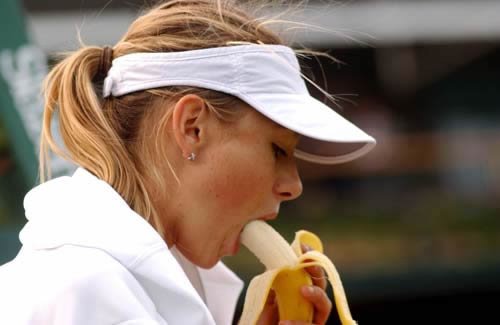
Over the weekend two women met in the finals of the U.S. Open tennis tournament in New York City.

One of them entered the match with five prior tournament wins this season plus two Fed Cup match wins for her country. What's more, she was making history by having appeared in the finals of all four grand slam tournaments this year, already having prevailed in one.

The other? She had won two tournaments, appeared in no other Grand Slam finals and never played for her country in the Fed Cup series. Oh yeah, but she was a better little piece of ass than the first.

Guess which woman got more attention from the media? Guess who had commercials regularly fashing across the screen and a puff piece before the action began, while the other was totally ignored? Yup, the second of course!

Maria Sharapova, woman number two, became unquestionably the greatest "Russian" female tennis player of all time, winning her second grand slam title and having once held, for a few months, the number-one ranking. No other "Russian" woman can boast these achievements.

Yet, as with most things concerning Russia, when we look even a little carefully at the details we see that there is virtually no good news for Russia at all. Not only did Maria move out of Russia when she was a child and acquire her game in the United States, but her game is in reality just a sham.

The pattern of ignominious defeat, and wretched unengaging play even when winning, by the Russian lady tennisistkas continued apace at the U.S. Open last week. Half of its seeded contingent was ejected by lower-ranked players and the world gaped in slack-jawed horror at the robotic play of those that advanced. You know the ladies had it rough when more Russian men made the semis than did women, yet none of the men advanced to the finals. The only good news for Russia was that so-called Russian Sharapova won the ladies' title, but as shown below this was a wolf in sheep's clothing to say the least.

Russia put ten seeded players into the ladies draw and four reached the quarter finals. There, #4 seed Elena Dementieva lost in straight sets to a player not ranked in the world's top 15 (taking only three games out of 15 played). #12 Dinara Safina lost in straights as well, but she lost to the world #1 so she was one of Russia's standout performers.

The result was that a Russian made the semi-finals only because it was guaranteed when the luck of the draw caused #27 Tatiana Golovin met #3 Sharapova (though Golovin officially plays for France and Sharapova lives in the United States, where she owns a good deal of real estate and derives all her income, so it could be argued that all the "real" Russians were eliminated before the semis and only two reached the quarters - that is unless you are a Slavic Russian who doesn't recognize a name like "Safin," which is Tatar and not Slavic; in that case, only one "real Russian" got past the fourth round). As described below, the all-quasi-Russian match proved to be yet another total disaster for the fans unlucky enough to have watched it (especially those who paid for the privilege).

Golovin dismissed #5 seed Petrova in the third round and #23 Anna Chakvetadze in the fourth round, so Chakvetadze is the third Russian who didn't lose to a lower-ranked player (if you count Frenchwoman Golovin -- but Chakvetadze is really a Georgian, so maybe that doesn't count either). #32 Likhovtseva and #33 Zvonareva both also lost to higher-ranked players (Sharapova and Dementieva, respectively).

#6 Kuznetsova lost to the same player who crushed Dementieva, Russian-killer and #19 seed Jelena Jancovic of Serbia.

#11 Myskina lost to an unseeded player in the first round.

#20 Kirilenko lost to an unseeded player in the third round.

Here's how the U.S. Open website ridculed the shameful and unwatchable Sharapova-Golovin match:

Feeling Pretty, Playing Shaky, Sharapova Into Semis
by Aimee Berg
Wednesday, September 6, 2006

Wednesday night in Arthur Ashe Stadium, two teenagers in pretty cocktail dresses frequently lost their serves and nerves and played one-dimensional power games, knowing one of them was guaranteed a berth in the semifinal round. In the end, No. 2 seed Maria Sharapova won a grudge match against her friend Tatiana Golovin, 7-6 (4), 7-6 (0). Afterward, Sharapova acknowleged, “I’ll definitely need to improve before my next one” against top-seeded Amelie Mauresmo. Twenty-one minutes into the first set, fans whispered with concern as Sharapova struggled against the No. 27 seed and trailed 1-3. Luckily for the “It Girl,” Golovin was equally tense. The two broke each other’s serve six times in the first 10 games. Then, at 5-all, they each held serve to force a tiebreak. In the tiebreak, Sharapova led 3-0 when Golovin unexpectedly summoned doctors to treat a foot blister. During the time-out, Sharapova turned Arthur Ashe Stadium into a personal practice court by rehearsing serves into an empty service box. The rules allow it, but the gesture seemed a tad gauche for a multi-millionaire who styles herself after Audrey Hepburn. The blister treatment helped Golovin rally and tie it at 4, but Sharapova won the next three points to capture the set. In the second set, both players managed to hold serve until the sixth game. After that, they took turns breaking each other for the next four. Golovin finally held to tie it at 5. They each won their next service game to force another tiebreak, in which Sharapova blanked Golovin, 7-0. In all, Sharapova won 22 of her 91 points from Golovin’s errors, and Golovin could thank Sharapova for 32 of the 81 points she collected. Neither player approached the net more than 10 times during the 2-hour, 11-minute match, and they shared similar serving power with identical top speeds (114 mph), matching first-serve averages (104 mph) and first serve accuracy (64 percent), as well as double faults (6). Sharapova is now 4-0 against the hot-tempered Golovin, who at one point blasted a ball into the crowd, whizzing past a woman’s head, to vent her frustration.
The "feeling pretty" reference is to Sharapova's latest commercial, wherein she is called pretty by dozens on her way to a match and then, at the first point, awes everyone into silence with her brutal power. Watching this commercial over and over again while Sharapova repeatedly lost her serve and was nearly eliminated by a player not ranked in the world's top 25, who was coming back after a horrific on-court injury, made Sharapova seem even more absurdly lacking in substance than ever. Naturally, the U.S. Open commentator couldn't resist raking her over the coals for her outrageous hubris unsupported by her level of play.

Even more outrageous, though, was the illegal coaching Sharapova received from her father in the stands. The TV commentators documented Mr. Sharapov holding up a cup telling Sharapova when to drink and a banana telling her when to eat, blatantly ignoring the rule forbidding such conduct. Why does Sharapova, seeded #3, need such help against a player not ranked in the world's top 25? Can't she win on her own? Apparently not, since Golovin took Sharapova to two tiebreakers and had numerous chances to take the match. What's next for Maria, steroids? Time will tell.

And then there was the screaming. Sharapova's high-pitched wailing, perhaps a tactic to conceal the sound of the ball striking her racket from her opponent, makes it nearly impossible to watch an entire match, certainly it can't be done without repeated wincing.

So with ten seeded players in the draw only one Russian reached the semi-finals, a "Russian" who speaks English on the court and lives in the United States. Not exactly a breathtaking result.

Sharapova would go on to defeat world #1 Amelie Mauresmo in a truly bizarre semi-final match, winning the first and third sets at love while being easily beaten in the second and taking the match despite having 20% more unforced errors than winners. Mauresmo, the greatest choke player in the history of the women's game, made nearly 40 unforced errors and handed the match to Sharapova in a true laugher, the kind of thing that is seriously underming the sport's fan base.

The news wasn't much better on the men's side. Russia's male hero Marat Safin (brother of Dinara and not, by the standards of Slavic race relations, a "real Russian" at all) was ejected before the quarter finals by a non-top-ten opponent. Unseeded Mikhail Youzhny was a standout, eliminating the number two six in the fourth round and the number two in the quarters before losing honorably to #9 American Andy Roddick in the semis. Youzhny also did well in doubles, his unseeded team ousting the top seeds in the fourth round before being ousted in the quarters. Finally there was #7 seed Nikolai Davydenko, who in the quarters faced the same (lower ranked) player that eliminated Safin and struggled to beat him in five after losing the first two sets. Davydenko went on to lose honorably, as everyone does, to #1 juggernaut Roger Federer, and is another "Russian," since he was born in the Ukraine and lived most of his life in Germany; he now resides in Monte Carlo. How he gets denominated "Russian" along with Youzhny, born and currently residing in Moscow, is anybody's guess.

As for Sharapova, her 6-4, 6-4 win over Justine Henin-Hardenne was a real outrage, and not just because of the excrutiatingly unwatchable quality of Sharapova's one-dimensional play. The TV network hyped Sharapova's pretty face continuously while ignoring Henin-Hardenne's existence, even though Justine had just completed one of the most amazing achievements in the sport's history, appearing in the finals of all four grand-slam events this year; instead, it sought to market the match based on Sharapova's sex appeal. At the trophy ceremony after Sharapova's victory, the presenter called upon the audience to give a round of applause for the match and had to ask twice just to force a smattering of clapping out of those assembled, because the match was just about as boring as they get (a clear pattern where Sharapova is concerned). Weirdly, Sharapova had once again struck 20% more unforced errors than her opponent, just like in the Mauresmo match, yet still managed to prevail by relying on the same uncanny dumb luck that allowed her to emmigrate to the U.S. as a child from Siberia.

So now this is "Russia's" greatest player, someone who owns homes in Florida and California but not in Russia, who speaks English without an accent on the court but not Russian and who has lived her entire life in the U.S. and acquired her game from American coaches, and never once played for the Russian national team. In other words, her victory is really just an embarrassment for Russia and bad for the sport as well, pushing true champions to the sidelines and elevating form over substance.

And so it goes in Russia.

Did you give thanks for tanks on Sunday?

If not, shame on you. As Itar-Tass reported, Sunday was "tank day" in Russia, yet another Soviet holiday to commemorate militarism, aggression and imperialism that Russia has not only not seen fit to abolish but still officially celebrates.

Sunday, September 10, 2006

The Sunday Funnies


English Russia offers readers a wealth of hilarious (and terrifying) candid views of the Moscow subway. Click through to have a gander.

More Truth is Funnier than Fiction

The Moscow Times reports:

A car thief with a tragicomic record of heists gone awry was arrested Thursday morning after the Volkswagen he had stolen ran out of gas in rush hour traffic, police said.A car thief with a tragicomic record of heists gone awry was arrested Thursday morning after the Volkswagen he had stolen ran out of gas in rush hour traffic, police said. Traffic police arrested Alexei Ashurin, 30, at around 9 a.m., after the 15-year-old red Volkswagen he was driving ran out of gas near Tsaritsino Park in southern Moscow, police spokesman Valery Buzovkin said. "The officers helped him push the car off to the side of the road to clear the way for cars behind him, but then they noticed that something was fishy," Buzovkin said. "There was a screwdriver sticking out of the ignition, and the lock on the door had been damaged." Volkswagens are the most commonly targeted imported vehicles by car thieves in Russia. Ashurin, who has been convicted for car theft and drug possession in the past, did not even try to talk his way out of the situation, Buzovkin said. "After the officers asked to see his documents, he immediately told them he had stolen the car," Buzovkin said, adding that Ashurin broke down and cried in front of the arresting officers. Ashurin has been charged with theft and faces up to two years in prison if convicted. It apparently was not the first time that Ashurin ran into technical difficulties while plying his trade. The suspect told police that his previous conviction stemmed from an incident in which he stole a car from an auto repair shop, Buzovkin said. "The owner of the car left it at the shop to get the brakes repaired, and [Ashurin] stole it from the lot," Buzovkin said. "But the brakes had not been repaired yet, and when he tried to stop at a red light, he went through the intersection and slammed into a Jeep." Ashurin also told police that on another occasion, he passed out drunk behind the wheel of a car he had just stolen. He abandoned the car after getting in a single-car accident, Buzovkin said.

CBS News reports:

Just outside the Kremlin, there's a high-level conference going on this week that affects us all: the World Toilet Summit. It's been organized by the WTO — the World Toilet Organization — a very serious group that is flush with ideas on how to improve sanitation. "The World Toilet Organization is the voice for a subject that has been neglected for so long," says WTO founder Jack Sim. "The World Toilet Summit is creating a revolution, because people were not talking about toilets before." He says that about 200 delegates have focused their talks on a number of issues, including how to induce the construction of more restrooms, improving sewage treatment and fighting diseases that can be spread via lavatories. In general, the non-profit organization to influence governments and companies on a wide range of questions related to toilet usage and standards. It also sponsors World Toilet Day every November 19. Toilets are a subject that may make people giggle, but it's heady stuff ... as serious as the subjects raised by that "other" WTO, the World Trade Organization. "Have you ever wondered why we made the acronym WTO? We use humor to propagate our message," explains Sim, who was a businessman in Singapore before founding the group. "When people are inhibited, to break the ice, you make them laugh. After they laugh, then they are listening and eventually they become serious. And they take action." The average person spends about four years of their life in the bathroom. Exhibits at the summit show there are plenty of ways to make that quality time. There are handmade toilet paper holders that play music. One of them has male and female figurines on top, who come together to kiss as the toilet paper is ripped. The music? The theme song to the movie “Love Story.” Another of the toilet paper holders features miniature soccer players — and as the toilet paper is pulled down, a small toy ball goes into a soccer net. The exhibit also features a Japanese commode which comes with its own remote. The remote control can make the toilet flush, make its seat go up or down, or make a retractable bidet attachment pop out from the wall of the bowl. The toilet’s cost? More than $6,000. There are also high-tech public toilets. One freestanding cabin is made of silvery metal and is shaped like a space capsule. Another toilet unit on display has two fake marble bowls attacked to a giant metal box. The bowls spin around so that once can be retracted and disinfected as the other is used. World Toilet Summits have been held each year since 2001. Moscow is a good place for the meeting because, in this department, Russia still has a long way to go to catch up with the West. About a third of Russian homes still have an outhouse. And as for public toilets, port-a-potties are state of the art. Russia has few public restrooms. But at least people who hear the call of nature can now use the plastic portable toilets that have been set up recently in many public spaces. For example, just outside Red Square, there are a number of port-a-johns that can be used for 10 rubles (about 35 cents). In fact, more than 40 percent of the world's population — more than 2½ billion people — lacks indoor plumbing. That means the work of the WTO isn't likely to go to waste.

Sunday Supplement: Rocking Out, Banned in Moscow


The Independent on yet another incident where, when Russians can't handle something, their response is to ban, suppress and destroy it. It has always been so in Russia, leaving the country blind to facts that ultimately destroy it for lack of preparation. This time, it's the rock group Leningrad. Is the Kremlin really afraid of these rockers because they use bad words, or it is it because they appear to be popular free thinkers who don't bow to the Kremlin's authority, and hence a bad example? You be the judge.

If you thought the gypsy-punk theatrics of Eugene Hutz and his band Gogol Bordello were a one-off, you won't have heard of Leningrad. This 15-piece Russian ska/punk/salsa/rock/gypsy/hip-hop outfit, formed by Sergey Shnurov in St Petersburg in 1997, are the darlings of millions of vodka-fuelled Russian youngsters and expat hellraisers.

Their popularity is at odds with the radio play they get - virtually none, owing to their contentious, often obscene lyrics. They were banned by Moscow's mayor Yuri Lushkov from performing in the capital. Perhaps this is because, as the vocalist Shnurov once suggested: "Leningrad is like a porno film." So they remain a guilty pleasure in spite of huge record sales and regular sell-out tours.

"They still don't like us much in Moscow," says Shnur, as he's known, when we meet to talk about their first UK-distributed album, Hleb. Their previous CD was a collaboration with the London-based gypsy cabaret three-piece The Tiger Lillies.

Shnur thinks the new album's title is one of Leningrad's most dubious. "The interpretation comes from the sacred Christian rite of communion," he says, explaining no more. Schnur, who has been described as reclusive, is not a man to waste too much time on long sentences.

When I suggest that all his songs have stories attached, he counters that "the stories are not important at all - [what's] important is the emotional message". Asked which are Leningrad's favourite topics, he says simply: "Corruption, politics, religion and sex."

The only time Schnur gets fired up is when we talk about Chelsea and its Russian owner Roman Abramovich. "It's strange for me that the governor of Chukotka invests in English football, although he has achieved tangible results. I support Zenith [a St Petersburg club] and Arsenal. I don't like Chelsea that much because of their pragmatic style - although what can you expect from a team owned by such a pragmatic man?"

The band's debut album Pulya was recorded by Leonid Fyodorov (ex-leader of the famous Russian band Auktyon) in 1999. Their original vocalist was Igor Vdovin, but he quit and bassist Shnur was thrust to the front with his gravelly voice, which he says is fuelled by "vodka, cigarettes and something else".

"There were great live bands and clubs in St Petersburg then," he says. "It meant more to sell out smaller, hotter venues than play big, cold stadiums. Leningrad tried to become, without much practising, one of the coolest bands around. That's how our style was born."

They were, and still are, inspired by the likes of Led Zeppelin, Massive Attack, Stravinsky, Shostakovich and Grazhdanskaya Oborona (a Siberian punk band). However, unlike many bands, they went out of their way to avoid sounding like just another homogenised Western act.

"The same as any British band doesn't try to sound Russian, we, existing in the context of our culture, feel like a fish in the right water, the way we are," Shnur says. Which might explain why they have such empathy with their fans. "There's no barrier between the audience and us," Shnur says. "Stage and audience, one big performance. But as to who is the more drunk... I still have to think about that."

It doesn't take a genius to work out that booze plays a big role in Leningrad's music. It represents a language most people understand, alongside their street poetry and political criticism. An example, from the track "The Truth", goes: "They don't swear on TV, how nice/ How could we live without a format? We need a format/ Our politicians are great people, they never swear... Nice guys, the policemen/ Teach us good manners/ They also never swear/ And don't take bribes, well, just like our politicians."

Leningrad take the art of swearing to a new level, helped by the fact that Russian swear-words are a language in themselves. Based on a linguistic system called Mat, it provides a wealth of caustic combinations, of which Shnur is a master. He tends to use them to add force to subjects such as corruption, poverty or prison conditions, or even just getting drunk and having a good time. This is what endears Leningrad to common people and intellectuals alike.

"In our country, in virtually every family there is someone who's either been to prison, or in the army - which basically means the same thing. That's why everyone can relate to the songs."

The band's fascination with Russian prison songs of the 1930s onwards is augmented by their use of accordion, double bass, xylophone, balalaikas, singing saws and a sizeable brass section, which blast out reinvigorated versions. But there are more sedate tracks such as "Nebesnyi Tennis" (Heavenly Tennis), a cautionary tale about the gulf between ordinary Russians and their sports idols, in this case the tennis player Maria Sharapova ("Here you have your anti-stress pills, my super princess/ Everything is so trite and simple/ I fall on my bed and cry in my pillow/ It's stupid to wait for heavenly sweets, from Sharapova, fucking, Masha [Maria]...").

The melancholic delivery of "Nebesnyi Tennis" and "Svoboda" has a lineage to underground Soviet writers of the 1970s, such as Arkady Severnyi. Asked why he thinks Severnyi is such a good writer, Shnur says curtly: "If anyone could have explained that, he would have been a bad songwriter." The beauty is not in the explanation, but the emotion - and, like Severnyi, Leningrad have plenty of that.

LR on PP

Click out La Russophobe's latest on Publius Pundit, where she reviews information coming out of Georgia that the Kremlin sought unsuccessfully to foment a coup d'etat against Georgia's elected president, who wants to move Georgia into the EU and NATO, exposing the crazed, seething hatred of the Russophile crowd for the Georgian government.

We've seen the Kremlin poison an opposition candidate for the presidency in Ukraine and use energy blackmail there as well as in Belarus and the Baltics while opening supporting favored leaders like Lukashenko and Yanukovich. Now, apparently, the Kremlin has decided that these methods won't be enough in rebelious Georgia, so it is resorting the the crude tactics of Soviet imperialism in its effort to dominate the scene. Your comments on the unfolding developments and the disturbing future possibilities are welcome.

EnglishRussia

La Russophobe has stumbled across an entertainment blog called EnglishRussia which has some interesting content and statistics.

As to content, there's for example a YouTube video of a clash between two groups of soccer hooligans in St. Petersburg, accompanied by a comment from a reader that states: "This video makes me sad. Why can’t the Russians just get long? Why can’t they target Muslims or niggers instead?" It also offers a series of photos from the Moscow Metro, linked to in the Sunday Funnies, above.

As to statistics, although the blog only contains 2 months worth of archives, Technorati indicates it has been linked to 821 times by 456 blogs, placing it 4,414th out of all blogs in the world and perhaps making it the most popular Russia-relataed blog in the world. Oddly, it doesn't contain a list of blog links or much other information beyond its content. Perplexingly, its site counter states that it has had 919,184 vistors so far, and that 504,627 of these have come in the last week alone. It does not tag itself on Technorati as a "Russia blog" although some of its tags make reference to Russia; its tags do make repeated reference to "Russian girls," for instance.

Perhaps this blog has existed longer than its archives and site counter indicate; in any case its an interesting find, and La Russophobe asks readers if they have any additional information about EnglishRussia or about any other English language Russia blogs which are unknown to her and may not be easy to discover. We are always interested in updating our blog index.

Video from Kondopoga

Yahoo! Russia has video of the Kondopoga violence. Click the link and then find and click "Racie Riot in Russia" under the "Video" heading in the sidebar. You may need to click the link more than once to get it to work, but the video is good quality and worth watching.

Saturday, September 09, 2006

The Russian Navy: Keystone Sailors Running Aground


Reuters reports that the Russian "navy" is slipping slowly beneath the waves:

MOSCOW (Reuters) - A spate of mishaps in Russia's navy has exposed the gap between the Kremlin's ambition of restoring lost military might and the reality of temperamental equipment and badly paid crews.

The navy suffered the double humiliation on Thursday of a fire on a nuclear-powered submarine that killed two crew members and a failed missile test launch.

"The Russian Navy is equipped for parading itself in front of President Vladimir Putin but underneath, there is still a dilapidated infrastructure," said Igor Kudrik, chief submarine expert with the Oslo-based Bellona environmental group.

Russia's submarine fleet -- the second largest in the world after the United States and a key part in Russia's nuclear defense shield -- has been especially accident-prone.

An electrical fire on board an attack submarine in the Barents Sea killed two crew who were trying to put it out. The navy's commander-in-chief said the vessel was overdue for scheduled repairs.

Hours later, a prototype inter-continental missile launched from a submarine in the Pacific Ocean fell back into the sea. The Bulava missile is a flagship project intended as an equivalent to the U.S. Trident, local media reported.

The Kremlin is splurging cash on its military, with the biggest increase in hardware spending. But that is not enough, said Ruslan Pukhov, Director of Moscow military think tank CAST.

"The main problems of the .. navy, including the submarine fleet, is not the equipment, but personnel," he said.

"There is not enough training for crews, they are not at sea very much and they are paid little. Technical accidents, for the most part, stem from the human factor."

The navy has caused Putin personal embarrassment. When the Kursk submarine sank six years ago, killing all 118 crew, he was accused of being uncaring because he did not immediately break off his holiday.

In 2004, Putin dressed up in a military-style outfit to watch a huge missile-firing exercise in the Barents Sea. But one ICBM failed to launch from a submarine.

Navy chief Admiral Vladimir Kuroyedov was dismissed last year. His replacement, Admiral Vladimir Masorin, pledged a radical shake-up. But he too has been dogged by mishaps.

The Jamestown Foundation has more.

Images from the Kondopoga Tragedy: What is this child guilty of in the eyes of the Slavophiles?

Reuters photo: A Chechen family, Fatima (C) and her two sons Magomed (L) and Muslim (R), from Karelian town of Kondopoga stand in the corridor of a rest house in Petrozavodsk, September 8, 2006. The family fled from Kondopoga after hundreds of people marched through the town and looted shops held by Caucasus businessmen.

Out of the Mouths of Russians

Here's a powerful statement by Alexei, the Russian publisher of the Russian Dilettante blog:

I have always argued that most Russians are simply too uneducated to make qualified decisions outside their private lives, and that the ruling elites have no interest in educating the masses. I am consistent in this.
Now, if La Russophobe were to make a statement like that, she'd be accused by the Russophile wackos of being a "racist" or a "bigot," wouldn't she?

When describing widespread Russian ignorance (isn't it ironic that Russians project themselves to foreigners as a highly educated, erudite population, especially compared to Americans?), Alexei adopts a tone of irony and sarcasm. La Russophobe asked Alexei whether he didn't think this tended to undercut his message somewhat, making it seem that pursuing the education of the Russian people was a matter for joking, an impossibility. He responded:
My irony, in case you did not notice, is a simple device to conceal pain and dispair -- a device necessary in this postmodern age, when expressions like "saving your country" can only earn you ridicule.
Indeed, La Russophobe does often call upon Russians to take action to save their country, and the response is quite often ridicule. Apparently Alexei has himself been victimized by this treatment once too often and, like many Russians, has given up trying. Thank goodness for the indomitable fortitude of La Russophobe.

Alexei is certainly right in saying that the Kremlin doesn't want an educated population in Russia. That's why it keeps the salaries of teachers so low, preventing talented young people from entering the profession. That's why it censors textbooks and controls curriculum. If Russians received a real education, then they'd become free thinkers, and free thinkers are much more difficult for the Kremlin to control. For the same reason, the Kremlin likes to keep the Russian population suffering from all manner of sickness, which further weakens critical powers.

But how does the Kremlin manage to convince Russians that, despite actually being ignorant, they are clever and well-educated? That's quite a trick, isn't it? Truly, the one area where Russia leads the world is propaganda.

Alexei himself is even a victim. For instance, in a recent post he claims that reporting by the Associated Press about the Kondopoga race riots was "misleading." Alexei (who La Russophobe believes is a Slavic Russian) makes the general charge that "liberal Western media are picturing the riots as an unprovoked attack on defenseless immigrants." Yet, in his post he doesn't make reference to one single specific statement made by the AP reporter which was allegedly inaccurate or misleading. This is the style of the Soviet propagandist, and Alexei has been victimized by it, though he may not even be aware of the crime.

And it gets worse. Alexei then seeks to tell us the "real story" of what happened at Konodopoga. How does he do it? What are his sources, superior to the Associated Press? Well, let Alexei tell you in his own words:
Using Russian online sources, including internet forumes and LiveJournal.com postings, I have tried to understand what actually happened in Kondopoga in the late August and early September of 2006.Can you believe it?
Alexei chooses to rely upon anonymous blogs written by Slavic Russians he not only doesn't know but whom he can't verify were ever anywhere near Kondopoga, much less firsthand witnesses to the events there. Even if they're not simply lying, they could be basing their statements on what they see on state-controlled, propagandizing Russian TV. But Alexei doesn't even warn his readers about this possiblity, he takes theirs statements as gospel (and doens't even link readers to the posts so they can read them for themselves).

Based on reading Russian blogs, Alexei comes up with this amazing statement:
About a hundred young men left the town square and, heated by alcohol, rushed to set fire to the restaurant where it all started, owned by a "Caucasus ethnic." (Likely not a Chechen. A telling detail though -- a few years ago, the owner's son shot a Russian girl and walked free.)
So, Alexei says that in fact the Slavs of Kondopoga were not guilty of an "unprovoked attack on defenseless immigrants" but rather were defending themselves from a cruel murderer of children. The only thing is, there isn't one single shred of documentation for this claim to be found on Alexei's website, not even the simple identity of the blog writer who said it. The Russian blogosphere is full of racist websites and all forms of racist propaganda, and it is a classic form of Russian igorance, the kind Alexei decried, to repeat a statement like this with no warning as to how reliable it is. Shame on you, Alexei!

And for the final show of ignorance, what did Alexei do when La Russophobe called him on this behavior? He just refused to speak to her anymore about it, and plunged his head further into the sands of ignorance. In other words, yet another classic Soviet response.

This is the way it depressingly goes in Russia. Even when you have a Russian who gets it half right, he inevitably manages to get the other half twice as wrong, negating progress. For this reason century after century Russian government looks oddly similar and the nation continues its downward spiral. And when occasionally someone comes forward to get up in their faces about it (Pushkin, Dostoevsky, Solzhenitisyn) they are inevitably shouted down, imprisoned, exiled or simply killed.

And so it goes in Russia.

On the Disintegration of Russia

A Step at a Time blog points out an argument by Russian analyst Aleksei Pantykin, who "says the Kondopoga events highlight the danger that 'the Russian Federation may collapse in the same way the USSR did.'" ASAAT's David McDuff continues:

He bases his argument on the fact that the reaction of Russian officialdom and even many Russians resembles all too closely the disastrous misreading of the start of the war in Nagorno-Karabakh between Armenia and Azerbaijan, a conflict that ultimately contributed to the demise of the Soviet Union. At that time, he recalls, one Politburo member (V.I. Dolgikh) travelled to the region and bemoaned the fact that tehre was a dispute between "two Muslim peoples," a statement that not only distorted the facts - Armenia is historically Christian - but highlighted the extent to which the Soviet leadership was out of touch with reality. Citing the observation of Ortega y Gasset that elites must restrain their peoples, Pantykin suggests that at present many elites in Russia are doing just the reverse, pushing both sides in the conflict in Kondopoga toward more and broader conflicts rather than calming the situation.

Others agree: Pavel Svyatenkov noted that Russia was rapidly becoming a place in which one section of the country might decide to fight another, a situation unthinkable elsewhere: "even in a nightmare," he said, "it is impossible to imagine Texas forces advancing on California". And Oleg Kashin argued that Russian elites bear much of the responsibility for this deterioration, not only by failing to discuss what is going on but by offering television time to extremist Russian nationalists like Yegor Khomogorov to advance their agendas.

But however valid or invalid these generalizations may be, the Kondopoga events are already having three major consequences. First, officials in both Karelia and Moscow have rushed to blame the non-Russian immigrants for what happened rather than exploring the complex of causes behind this explosion. Second, non-Russians in major Russian cities are rushing to say that their communities will never destabilize the situation there, however bad things may get. Indeed, the head of the Uzbek community in St. Petersburg said his people would remain calm despite recent knifings of its members. And third, in some Russian cities, officials now feel themselves empowered to repress non-Russians and especially people from the Caucasus even more harshly. In Kaliningrad, ANN reported on Tuesday militia have been going house to house and asking: "Are there any suspicious people there? Any persons of Caucasus nationality?"

Officials there say they are doing this to enhance security in advance of what they hope will be a visit to that non-contiguous portion of the Russian Federation later this month. But few people be they Russian or non-Russian will fail to conclude that what is going on is something bigger than that. And to the extent they are correct, one of the two more apocalyptic conclusions offered above - either a repressive Russian nationalist state or the disintegration of the Russian Federation - could prove true, despite the expectations or hopes of many in virtually all camps
One thing above all can't be questioned: If Russia really is doing well economically, then these acts are truly barbaric indications of latent and fundmental racism permeating Russian society that need not rely on economic motivations. If the acts are driven by poverty, then all the claims about Russia's oil revenues are proven nothing more than smoke and mirrors.

Friday, September 08, 2006

Yet Another Russian Plane Kills


It is now being reported that "a Russian-made Tupolev 154 aircraft blew a tire, skidded off a runway and caught fire while landing in northeastern Iran on a few hours ago, killing up to 80 of the 147 passengers aboard. The Tu-154, the workhorse of passenger airlines in the former Soviet Union, has been in commercial service since 1972. More than 900 have been built and more than 160 exported to airlines around the world. Due to noise and pollution regulations, the planes do not fly to Western destinations." As previously reported on La Russophobe, a Tu-154 crashed during a thunderstorm in Ukraine on Aug. 22 while en route from a Black Sea resort to St. Petersburg, Russia, killing all 170 aboard. That craft was owned by Russia's Pulkovo Airlines, and was only the latest in recent string of Russian air disasters.


LR Welcomes 10,000th Visitor

A few minutes ago La Russophobe was pleased to welcome the 10,000th visit to the blog. Visit #10,000 came from Egham, Slough, United Kingdom.

It took La Russophobe 153 days to reach this milestone, meaning that she averaged 65 visits per day during the first 5+ months of her existence (visit #10,000 came six days after her five-month anniversary). At her current rate of traffic, it will only take about 105 days for her to accrue a second 10,000 visits.

Though she knows she's still a baby, La Russophobe is already a force to be reckoned with in the Russia-watching world because she is the most heavily trafficked and most content-rich Russia specialty blog on the planet.

If you are reading these words, (and especially if you are writing or commenting on others) you are a part of La Russophobe and her accomplishments are yours as well. But her challenges are also yours, and there is a long, long way to go before even a reasonable semblance of democracy or freedom arrives in Russia, much less a benign, non-imperial government (if it ever does). La Russophobe thanks all her readers and especially her contributors for their continuing support and courage in the face of the rising Neo-Soviet monstrosity.

Neo-Soviet Russia Attempts Coup D'etat in Georgia

The Moscow News reports that Russia has attempted, in the manner of the Bay of Pigs, to funnel support to Georgian coup plotters seeking to destabilize Georgia's elected government in order to avoid Georgia falling into the evil clutches of NATO and the European Union. In combination with the dire state of human rights in Russia as documented on La Russophobe this can only be viewed as a shocking escalation of Neo-Soviet behavior and naked imperialism. It is truly breathtaking hypocrisy for Russia to intervene in Georgian and Ukrainian politics while screaming to high heaven if any foreign country interferes with Russia in Chechnya. And it is truly horrifying to imagine that Russia is now so drunk on oil revenues that it is prepared to court disaster with such provocative behavior.

Nearly 30 people were arrested in Georgia on suspicion of plotting a coup against the government, officials said. They say those detained are supporters of Igor Giorgadze — the fugitive former head of the state security service. Lawyers for those arrested deny the coup accusations, saying the arrests amount to political persecution.

Giorgadze fled Georgia after being accused of trying to assassinate then President Eduard Shevardnadze in 1995 — a charge he denies. “They will be charged under Article 315 of the Georgian criminal code — plotting against the state and overthrowing the government,” Georgian Interior Minister Vano Merabishvili told reporters.

Among those detained are officials of two opposition parties — the pro-Russian Justice Party and the Conservative Monarchists.

The Russian newspaper Kommersant wrote Thursday that Georgia has accused Moscow of backing the plotters. Vano Mirabishvili announced that an attempted coup financed by Russia had been prevented. The opposition says that a new political era has begun in Georgia as “the authorities try to hold on to power through repression alone.”

On Wednesday afternoon, Georgian security forces broke raided apartments of the leaders of Justice Party, Anti-Soros Movement and Conservative Monarchists Party across the country. Those parties make up the so-called Igor Giorgadze bloc. Police operations were also carried out at the homes of his relatives. After searches were conducted, 29 opposition leaders and activists were arrested. Searches of the opposition groups’ offices were conducted simultaneously and, according to official accounts, charter documents, computers, money and weapons were seized.

Georgia also accuses Moscow of backing separatists in Georgia’s breakaway provinces, while Russia has banned the import of certain Georgian goods.

RIA Novosti says that the problems are far from over:

TBILISI, September 7 (RIA Novosti) - A Georgian opposition party, Justice, called Thursday for a national disobedience campaign to topple the president and his government as 14 party activists were charged with preparing a coup.

The interior minister said Wednesday the country's law enforcement agencies had information that supporters of controversial former Georgian minister and security chief Igor Giorgadze were preparing to overthrow the government and making arrangements for Giorgadze's return from exile. In all, 29 people were detained in raids and 14 individuals who remained in custody Thursday were officially charged.

But Justice party representative Irina Sarishvili told a news conference that her party would seek to bring down President Mikheil Saakashvili, who himself came to power on the back of popular protests, and his government.

"We propose setting up a national disobedience movement and starting large-scale actions with only one demand: that the country's current leadership resigns," said Sarishvili, who runs the Igor Giorgadze Foundation in Georgia's capital, Tbilisi.

Justice party leader Giorgadze himself is said to live in Russia after fleeing the country in 1995 when he was accused of organizing an assassination attempt on then-president Eduard Shevardnadze. He has denied the claims.

"If these authorities want revolution, they will get it," said Sarishvili, who also claimed Wednesday her office was being searched by security officers.

Georgian law enforcement agencies carried out an operation Wednesday to arrest supporters of Giorgadze, his Justice party and other public and political organizations, including the leader of the opposition Conservative Monarchist party, Teimuraz Zhorzholiani, and of the Anti-Soros political movement, Maya Nikoleishvili.

President Saakashvili told journalists in Poland, where he is on an official visit, that the alleged plotters would be dealt with harshly. "They will get what they deserve, and those who finance them can be sure of that," he said.

But Sarishvili rejected a statement by the Georgian Interior Ministry about an alleged conspiracy aiming at overthrowing the authorities at a party conference on May 4. "There was no conference and, of course, no plan to overthrow authorities," she said.

The detained activists have protested their innocence and have said their political work led to their arrest, which prompted Sarishvili to say the detentions looked like the start of a political repression campaign.

A senior Russian diplomat said Moscow, which has had tense relations with Tbilisi since the 2003 "rose revolution" brought Saakashvili to power, regarded the arrests as a domestic matter for Georgia.

"We regard yesterday's arrests of opposition representatives as the country's internal affair," Yury Popov, Russia's ambassador-at-large and co-chairman of the Joint Control Commission for Georgian-South Ossetian conflict resolution, told a news conference.

The diplomat also said it was unsurprising that some politicians in Georgia had accused Russia of financing the opposition's activities. "Georgia by habit blames Russia for all its troubles," Popov said.

*EVENT OF INTEREST*

On Saturday October 7th, at 1 pm in the 37 Arts Gallery located at 450 West 37th Street in Manhattan, Russian political activist Garry Kasparov will be interviewed by David Remnick, editor of the New Yorker magazine. The cost of attending is $25 and further details can be obtained by calling (877) 391-0545. All those interested in the development of democracy and political alternatives in Russia should consider attending and expressing their support to the valiant Mr. Kasparov, who is risking all to give Russia a choice. The event is part of the 7th Annual New Yorker Festival, and is especially timely in light of the shocking attempt by Russia, detailed above, to subvert the elected regime in Georgia (after attempting the same thing in Ukraine) and the orgy of racism and other human rights violations sweeping the country. Even if you don't specifically support Mr. Kasparov, you should support his presence on the political landscape as way of encouraging other prospective leaders to throw their hats into the ring and give Russians real choices during elections. La Russopohbe has already documented the Kremlin's relentless attacks on Mr. Kasparov and his party, showing how significant they really are and how genuine is Mr. Kasparov's commitment.

Annals of Cold War II: The Arms Race Redux

Did somebody say "Star Wars redux"? In yet another harbinger of the cold war Russia has provoked with the United States, Russia is now panicking over the U.S. plan to develop a ballistic missile shield. 7Days reports:

The planned US anti-missile shield is a threat to global security as it could lead to another arms race, Russia’s army chief, General Yuri Baluyevski, said in an article published in a Polish newspaper yesterday. "Deploying the large-scale US anti-missile shield threatens to spark a new arms race," Baluyevski said in the Polish daily Dziennik. Of particular concern, according to Baluyevski, was Washington’s intention to base some of the anti-missile shield in central Europe. Poland and the Czech Republic are being considered for the European base of the anti-missile shield, although opposition to that plan is rising in both countries. Other countries where the United States could base its interceptor missiles and radar are Bulgaria, Hungary or Turkey. "We are firmly convinced that, if the US project is carried out, it could lead to the deployment near the Russian border of systems which threaten to upset the strategic balance in weapons positioning," Baluyevski said. The US missile defence system employs radar and satellites to detect enemy missile launches and guide interceptors to their targets. The command centre is based in the southwestern US state of Colorado, and interceptor missiles are located in Alaska and in California. The head of the US missile defence agency, General Henry Obering, said last month he expects to make recommendations in a matter of months on where to position interceptor missiles and radar in Europe.

Meanwhile, the RSNF blog reports that even as it complains about U.S. policy Russia is seeking to unilaterally withdraw from a major SALT provision, the INF medium range ICMB agreement. Russia obviously wants these weapons to terrorize the former Soviet slave states who are reluctant for obvious reasons to come under Russia's thumb, such as Ukraine and Georgia.

LR on PP

Take a look at La Russophobe's item on Publius Pundit summarizing the shocking series of events last weekend on the human rights scene in Russia. As noted below, the story coming out of Kondopoga is getting worse by the hour, and the total picture gives every indication of rapidly spinning out of control. "President" Putin's silence in the face of these events is disgusting to say the least (though hardly suprising). Comments from readers are especially welcome on this important issue.

Thursday, September 07, 2006

More Racist Outrage in Kondopoga

Radio Free Europe reports that on Tuesday night "a sports school was torched in Kondopoga, a small city of 35,000 inhabitants in the northwestern Karelia Republic. Reports say that one of the trainers employed there is of Caucasus origin and that several families from Central Asia were living in the school at the time."

Looks like Chechens are not the only ones ready, willing and able to launch attacks on Russian schools.

As RFE notes, this comes after "
angry mobs burned down the restaurant where the Russians were killed and destroyed a street market and several stores owned by Chechens and other people from the Caucasus. The violence has been accompanied by street rallies in Kondopoga demanding the expulsion of immigrants."

Meanwhile, RIA Novosti reports that huge numbers of dark-skinned people have fled the town and are now refugees, impoverished and imperiled. To its credit, RIA refers to the actions of the local population as a "pogrom."

Even more horrifying than the violence itself, RFE documents various political leaders in Russia expressing support for the racists, while "President" Putin has remained nauseatingly silent:

Several nationalist parties have expressed support for the riots. Some reports claim these parties actually orchestrated them. Aleksandr Belov, the leader of the radical Movement Against Illegal Migration, denies involvement in the rampage. But he backed the protests in Kondopoga during a news conference in Moscow on September 5. "People gathered spontaneously to express their demands," Belov said. "Their demands were simple: [foreigners] get out of here, you have 24 hours. Why? You've come here without invitation and we're fed up with you. These are the two reasons behind the problems in Kondopoga and elsewhere." Belov said representatives of his movement, know for its aggressive xenophobic rhetoric, had plans to station representatives permanently in Karelia to "help," in his words, local residents.

But the Movement Against Illegal Migration is not the only group to publicly support the events in Kondopoga. Nikolai Kuryanovich, a deputy from the ultranationalist Liberal Democratic Party of Russia, joined forces with Belov at the news conference. This is the solution he proposed to tackle ethnic tensions in Russia: "Once again, this time totally, subjugate the Caucasus and toughen migration laws," Kuryanovich said. "Total cleansing. All criminal elements must be brought to responsibility -- even destroyed -- like the president said. We are waiting for him to make good on his promise to 'wipe them out in the outhouse.'" Kuryanovich also proposed to build what he called a "wall of China" that would separate the North Caucasus republics from the rest of Russia.

Despite President Vladimir Putin's silence, the crisis in Kondopoga has spiraled into a national issue. Ramzan Kadyrov, the prime minister of the pro-Moscow government in Chechnya, has blamed Karelian officials for failing to stop the riots and has vowed to restore order if necessary.
It's quite amazing, even by Russian standards, that a "liberal democrat" in Russia can not only openly call for "ethnic cleansing" but purport to be merely following the edicts of the president of the country, without any challenge from the president himself to that claim, much less public opposition.

Interfax quotes Communist Leader Gennady Zyuganov as seeking to rationalize the violence by claiming that "despair, substandard living conditions, the absence of jobs and respect for the past engender extremism and aggressiveness." It's a sad day indeed, as it was when the Communists presented the only credible opposition to Yeltsin and Putin, when a Commie Pinko like Zyuganov is a source of truth, but he's right when he says Russia is an economic disaster despite the rising price of oil. How can Russians favor "President" Putin with 70%+ approval ratings when this is so? Ah yes, riddle wrapped in a mystery stuff. But Zyuganov likes to overlook the fact that the only reason Russia is in this economic state today is because his party bankrupted it, and the current president is a proud KGB spy.

But the most horrifying prospect of all is "President" Putin using these events as an excuse for even more draconian crackdowns on civil liberties which will do nothing (as he stands mute on the topic) to quell race violence but which will slam the door on freedom and democracy in Russia, dooming the country to a bleak and hopeless future.

Annals of Cold War II: Already, a Doomsday Scenario for Russia Emerges

Publius Pundit has reported the discovery by America of perhaps 15 billion barrels of oil, enough to meet 100% of America's energy needs for nearly seven years, under the sea floor in the Gulf of Mexico. It cites a Globe & Mail story.

Now, just for the sake of argument, let's say that America and Russia are involved in a Cold War, and America wants to destroy Russia's economy, destabilize the Putin regime and drive its KGB miscreants from power the same way it did with the Bolsheviks.

If this oil reserve is as large is predicted, all America has to do is stop buying oil on the world markets. For seven years.

Or it could buy 50% less oil. For fourteen years.

Or it could buy 25% less oil. For twenty-eight years.

Do you have any idea what would happen to the price of oil on world markets if America, by far the world's largest consumer of crude, announced it was going to buy 25% less oil for three decades? The Kremlin would be driven into insolvency and ruin, easily within the first decade if not sooner. If America stopped making purchases entirely, Russia probably wouldn't last the first year.

During those three decades, America would have plenty of time to fully develop the massive Canadian oil shales which can make American energy independent for centuries, making the price drop permanent. That's to say nothing of conservation measures in the U.S. (wind and solar power, fuel cell cars, etc.).

And it's to say nothing of all the other measures America can take to ratchet up economic pressure on Russia's pathetic excuse for an economy and wretched sham of a currency, much less what America's many allies can do.

And, come to think of it, there is a Cold War brewing between the U.S. and Russia. Why, just yesterday La Russophobe reported that Russia had cancelled joint military exercises with the U.S. and filed a lawsuit to block a Western oil company from doing business in Russia. She has a whole sidebar section devoted to the unfolding cold war events between the two countries.

Gee, if La Russophobe were Vladimir Putin, she'd be pretty worried.

Intelligent.ru: A Festival of Crazed Russopilia

If you check out the English language version of the Russophile blog "Intelligent.ru" (a misnomer if there ever was one) on Technorati, you will find that the blog itself isn't even listed there and has only been linked to 20 times by blogs that are listed, mainly the the wacko Russophile blogs "Russian Blog" and "Russia Blog." (La Russophobe for instance has been linked to more than 150 times). That's a good thing, because if people were paying any attention to the crazed propaganda found on this blog, they'd be walking around in a fog of ignorance.

If you check out the biography of one of Intelligent's "authors" (to use the blog's term), Mike Averko, you will learn that he "has served as a consultant for several mainstream American news shows." Interestingly, no mention is made here of Mr. Averko's claim, documented previously on La Russophobe, that he is a commentator published in the likes of the New York Times (as La Russophobe is shown, all he's ever done is write letters to the editor). Oddly, Mr. Averko doesn't care to mention which "news shows" he has "consulted" on -- perhaps because that would make it too easy to ridicule him (or expose him as a liar), and he doesn't identify himself as a TV consultant when he writes for Russia Blog (there, he's a Times columnist). This sort of thing is the classic hallmark of the Russophile propagandist, namely the total absence of any obligation to dwell in the real world, source facts or otherwise substantiate claims. This is the way business was done in the USSR, and it's why the USSR doesn't exist any more.

Other "authors" at Intelligent include Russia Blog's Yuri Mamchur, Russophile extremist Sharon Tennison and wacko Russophile nutjob Kirill Pankratov. Pankratov is not only a scientist but also a writer/pornographer: his website refers to his Russian prose collection by warning "ranging from lyrical to erotic (very explicit, a warning should be added)." Naturally, he's a qualified expert in political affairs, and a regular contributor to that bible of authoritative analysis the eXile, and the author of a really bizarre stream-of-consciousness blabbering article called "America Your Time is Up" on the People's Voices blog. Mamchur, by contrast, touts his being a "graduate of the Russian Tax Academy School of Law in Moscow" as previously discussed by La Russophobe. Tennison is "president of the Center for Citizen Initiatives, USA and Russia." Wikipedia says of her: "President Sharon Tennison is a political pragmatist, favoring the rapprochement of U.S.-Russia relations at the expense of debate on divisive topics including human rights and political freedom issues." She has written a staunch defense of KGB spy Vladimir Putin. It's argued that the Wikipedia article about her has been planted by a sycophant and is not reliable. Note that it's just fine for all these people to hate and scathingly attack America, but if anyone dares to reciprocate where Russia is concerned then they are of course a "bigot" and "racist" (even though Russia isn't a race but nationality, a fact they never tire of ignoring).

If you review the current contents of Intelligent you find a remarkable barrage of Russophile propaganda. First there's Yuri Mamchur's attack on the Wall Street Journal's coverage of the extremism law, already thoroughly discredited on La Russophobe and for which Mamchur apologized on Russia Blog. Then there's the "editor's column" by Intelligent's English version boss, Sergei Roy. Roy is identifed as a linguist. Here's what this crazed, hysterical Russophile has to say about the President of Georgia:

Recently, seven leading medical institutions (Norway’s Tonsberg Psychiatric Center; Norway’s National Institute of Public Health; Germany’s Center for Diseases of the Nervous System at Christian Albrecht University; the Psychiatric Department of Geneva University; Vienna Medical School’s Department of Psychoanalysis and Psychotherapy; Finland’s Psychiatric Department; and Amsterdam University’s Department of Clinical Psychology) were asked to evaluate Georgian President Saakashvili’s mental health. The evaluation excerpts published in various oppositionist papers in Georgia describe Saakashvili as a negative and aggressive person with extreme egocentricity, a hysteroid typetending toward megalomania and an obsessive or maniacal syndrome characterized by a personal conviction of being destined to be the “chosen one,” etc. etc. There’s lots of this psychiatric gobbledegook in the published materials, but the diagnosis is clear enough: “Expansive type of paranoid dysfunction (according to ICD-IO) combined with narcissist type of hysteroid personality.” Beautiful. To me, it translates into one brief word: psycho
If you look in a Russophile dictionary, you will see that the definition of "psycho" is anyone who opposed Russian hegemony.

Reviewing the other current contents of Intelligent we find an article bashing Israel, accusing the U.S. Congress of insulting Russia's dignity by daring to discuss Russian imperalism, touting Russia's wonderful success at the G-8 Summit (where it got booted out of the WTO and confronted by several world leaders on its human rights record), attacking the U.S. for "disastrous" new Cold War policies and begging the world to "give the Bear some time." Time for what? Time to consolidate dictatorial power and try again to enslave the world? Intelligent also, not surprisingly, published the crazed tirade of Professor Steve Cohen already thoroughly discredited on La Russophobe.

La Russophobe thinks Intelligent is a perfect example of insular Russian and Russophile on-lookers firing bits of propaganda back and forth between themselves and imagining, just as did the members of the old Politburo, that they are conclusively proving their own superiority. All the while, Russia continues sinking into a morass of incompetence and corruption from which it likely will never emerge.

Who funds Intelligent? The website doesn't say, nor does it say that it's a charitable enterprise. Does its money come from the Kremlin? From Yuri Mamchur's Discovery Institute? La Russophobe intends to explore the matter further.

The Extremism Law Exposed as Neo-Soviet Censorship

The Moscow Times offers a column from Mikhail Fedotov, secretary of the Russian Union of Journalists and one of the authors of the federal media law, obliterating the obscene Russophile canard (propagated most especially by the nefarious Yuri Mamchur of Russia Blog) that Russia's new law on extremism is a reasonable measure designed to guard against racism.

The author Vasily Grossman once said the hardest problems always generate the simplest and most incorrect solutions. Amendments to the federal media law and administrative code introduced as measures to combat terrorism, which go before the State Duma for a first reading Wednesday, contain a definition of "extremism" that expands the term to the point of absurdity. This in a country where official reaction to real acts of violence against individuals based on their racial, ethnic, linguistic, religious or social backgrounds is rare and selective.

The broader the definition of extremism, the easier it is for the authorities to use it against anyone who has displeased them. The latest amendments define it as "infringing on the rights and freedoms of a citizen or citizens or doing damage to the health and/or property of citizens on the basis of their convictions, racial or ethnic affiliation, creed, social affiliation or social origin."

Translated from legalese, almost any derogatory article can now be interpreted as extremism if the author cannot prove that a statement corresponds strictly to reality. Thus, journalists will need the investigative authority of a prosecutor and faith that a voice recording (which they had better have) will be enough against a high-placed crooked official.

This legal novelty has drawn scant attention from commentators. Everyone has been talking about the fact that the anti-extremism law passed earlier this year includes "the public defamation of any government official" in the definition. The first application of this legal novelty was against Viktor Shmakov, the editor of Provintsiyalniye Vesti, a newspaper in Bashkortostan. He was charged after the publication of the articles "Experienced advice. Instructions for the Behavior of Revolutionaries During Mass Popular Demonstrations" and "The Bashkir Revolutionary Committee Short Program of Emergency and Frontline Measures For the First 100 days After the Revolution."

Shmakov shouldn't be worried, however, as the defamation of officials must be, according to the law, established by the courts. The Criminal Code does not as yet contain such an article.

But this loophole will undoubtedly be closed. Criticizing the authorities will be defamation, and defamation will be extremism. And, according to the new amendments, any media outlet can be closed down for acting as the "cause of damage to the person or health of citizens, the environment, public order, public safety, property or the legal economic interests of individuals or legal entities, society or the state." This net is wide enough to snare just about anyone, especially if those doing the fishing are acting on personal interests and the victim has only the Constitution and the European Court of Human Rights on his or her side.

What is important is that we don't confuse extremism with opposition, criticism, or dissent -- even when these are expressed in extreme terms. Established democracies long ago not only stopped punishing dissent, but also those who promoted it. Those statutes that do remain long ago became dead law. In British law, for example, "incitement to mutiny" remains a serious crime, but since 1945 has been interpreted to cover actions designed to provoke social unrest and civil disobedience with the aim of disrupting the government's legal functioning and has not been invoked since 1947.

French legislation still includes an 1881 statute that criminalizes defamation of a state institution, minister, lawmaker or civil servant. But this law also has not been applied in practice for decades and, in effect, has lost its power. This is the result of the simple fact that these societies now look differently on criticism and interpret freedom of speech more broadly.

All of this has to be balanced against matters of necessity in a Russia where extremism, and ethnic hatred in particular, have clearly become a reality. Horrific events like the murder of a 9-year-old Tajik girl or a Peruvian student in St. Petersburg, or the recent bombing of Moscow's Cherkizovsky market can no longer be dismissed as isolated incidents. Political discussion is rife with conspiracy theories that nationalist groups like the White Patrol and the Movement Against Illegal Immigration are just parts of a highly clandestine extremist nationalist organization seeking to take power. Implicit in these theories is the prescription that only a powerful Kremlin can stop this absolute evil from triumphing.

Unfortunately, it doesn't look like law enforcement or security bodies are serious about countering the real growth of extremism in the country. Law-enforcement agencies are themselves hotbeds of xenophobia. A nationwide survey by the Levada Center polling agency said 40 percent of police officers supported the idea that Russia should be a country for ethnic Russians, while 67 percent expressed negative views about people from the Caucasus and Central Asia.

Moreover, state officials still frivolously label extremist acts as simple hooliganism or the escapades of madmen. Statements from the top addressing the issue seriously are interpreted further down the "power vertical" as necessary rituals, but little else. "We know very well all of those who should be [behind bars], and it would only take a couple of days to haul them all in," a friend in law enforcement told me recently. "But nobody seems to be interested in this."

So a vicious circle is forming. The authorities refuse to take systemic corrective action against the growing problem of extremism in society, preferring instead to use it as a pretext for maniacally plugging any cracks through which free thought could have an influence on the political process. In turn, the deliberate undermining of democratic institutions fans extremism further, as it does not allow outlets for protest or opposition on the field of normal political competition. The authorities could still break this vicious circle. The question is whether they have the will, ability or time.


Russian Untouchables

The Chicago Tribune reports on the slavery-like horrors of the Russian labor market:

SOFRINO, Russia - A glimpse of Russia's immigration conundrum can be found behind the pallets of brick, lumber, sheet metal and iron at a sprawling construction-materials yard in this Moscow suburb, where ironworker Abdumalik Kholikov eats and sleeps in a trailer smaller than a prison cell.

The mattresses he and a fellow Tajik laborer sleep on take up most of the space. They store their clothes in plastic bags hung on the walls. A hot plate caked in grease and resting on bricks substitutes as a stove. There's no toilet and no shower; they pour plastic bottles of water over each other to wash.

"I've lived like this for four years," said Kholikov, who sends much of his $370 monthly pay home to Tajikistan to support his wife and five children. "I doubt things will change anytime soon."

Kholikov and legions of immigrants like him from Central Asia's dirt-poor economies are much of the brawn behind Moscow's frenzied building boom - the construction workers, welders, loaders and bricklayers changing the cityscape with every new high rise.

They're also Russia's untouchables, stymied by a bureaucracy that makes attaining legal status virtually impossible, and are routinely exploited by corrupt police and unscrupulous employers.

Estimates of the number of illegal migrant workers in Russia range from 5 million to 14 million. Long before they emigrate, they know the Catch-22 they'll face.

As citizens of former Soviet republics, they don't need visas. But within three days of their arrival in Moscow they must notify authorities of their new residence. Most Russian apartment owners refuse to rent to Tajiks and other Central Asian migrants. So without an apartment, they become instant lawbreakers.

That makes them easy prey in a society where a shadow economy flourishes and corruption is rife.

Construction companies routinely renege on paying wages to Central Asian migrant laborers. The housing they provide workers at job sites amounts to little more than ramshackle one-room cabins or abandoned railway cars. As many as a dozen laborers can be crammed into the cars for several months, often through the Russian capital's unforgiving winters.

In many instances, groups of workers are traded from one construction firm to another like chattel, said Gavkhar Dzhurayeva, head of the Migration and Law Center, a Moscow-based advocacy group for migrant workers.

"The system doesn't allow these workers to become legalized, because there are too many people in government and at these companies with a stake in what's going on," Dzhurayeva said. "The whole system is predicated on these workers being treated as slaves."

Russia needs workers like Kholikov. The country's economy is in the midst of an epic comeback, but a relentless plunge in population has leaders worried about having a labor force large enough to sustain that comeback. Russia's population, now 142.4 million, is dropping at a rate of about 600,000 people each year.

So far, the government has waded gingerly into the problem.

Last year, it embarked on a pilot project to grant amnesty to 7,000 illegal migrant workers in 10 Russian provinces. There was talk of expanding the program to millions of other migrant workers, but no action has been taken. Immigration remains a sensitive subject in Russia, where nationalist-minded segments of the population look upon Central Asians and people from the Caucasus region with deep resentment.

Elena Tiurukanova, a researcher at Moscow's Institute for Socioeconomic Population Studies, cited recent polls suggesting that, while more than half of Russians acknowledge using services provided by immigrants, "60 percent are intolerant of immigrants - they don't want them here."

Employers who rely on illegal migrants have a very different reason for resisting meaningful change in Russian migration laws. By using illegal workers, employers can avoid paying taxes, hold back wages whenever they want and impose 12- or even 14-hour workdays. If a worker complains, they simply turn him over to the police.

Workers rarely complain, though. As bad as they have it in Russia, their lot is worse back home. In Tajikistan, wages are as low as $4 a month and average about $30 monthly. Their desperation is easily witnessed on any given day along Yaroslavsky Highway in the Moscow suburb of Mytishchi.

Each morning, dozens of illegal Tajik immigrants swarm around every car that pulls up. The man behind the wheel offers a handful of jobs, waves a few Tajiks into the car and drives away. Those left behind sit on their haunches or on guardrails and wait for the next car.

Zafar Bachayev, 23, has been a regular along Yaroslavsky Highway for six years. At his last job at a suburban apartment building construction site, his employer promised him $600 and paid him $150. "We slept in a railroad car, 12 people in the car," said Bachayev, who is saving up to finish his studies at a Tajikistan university. "We worked 14 hours a day."

Fellow Tajik Said Vatoyev came to Mytishchi when he was 14 and has bounced between construction sites and odd jobs ever since. "They give us cabins without beds or mattresses and allow us to wash once a week," said Vatoyev, now 18. "We're treated like dogs at these work sites."

The Federal Migration Service expects the situation to improve in January, when the only document that migrant workers will need is a work permit, said Natalya Vlasova, deputy chief of the agency's foreign labor department. Advocates for illegal migrant workers say such steps don't go far enough.

The agency needs to beef up the ranks of its inspectors to ferret out exploitation of migrant workers at job sites, Dzhurayeva said. And Russian authorities need to clamp down on the corruption that makes the use of illegal migrant workers so lucrative for employers and local police.

"For 15 years, a lack of law enforcement has given rise to this entrenched network between employers, authorities and migrant workers," Dzhurayeva said. "Breaking up that network won't be easy."

Annals of the Neo-Soviet Union: Textbook Censorship is Renewed

The Moscow Times reports that Russia has adopted a neo-Soviet textbook review process which will force Russians to continue living in ignorance indefinitely, just the way a dictatorship likes the people to be kept:

India is a continent, the oceans are infested with squid that stretch 20 meters, and the human soul is known to leave the body during sleep. These are just a few of the many, many errors found in grade-school textbooks across the country.

Now, the state is returning to its old Soviet ways to cleanse textbooks of obvious and embarrassing mistakes, although some educators wonder what kind of cleansing is taking place. Last year, a new review process was adopted. A lot of work remains: In 2006, just 18 percent of the textbooks reviewed passed muster.

"There are many typos and errors that are simply ridiculous," said Sergei Sidorenko, a member of the panel from the Russian Academy of Sciences charged with weeding out the errors.

The Education and Science Ministry could not provide exact figures for how many error-filled textbooks were in circulation. Nor is it clear when all books in use will have the Academy's stamp of approval. Svetlana Teterina, who heads the textbook division at the ministry, said the government was targeting fall 2007, but given there are hundreds, if not thousands, of books yet to be reviewed, that date seems overly optimistic.

The problem dates to the Soviet collapse, when the rigorous, communist-era system of reviewing -- and, in many cases, whitewashing or editing -- textbooks ended. Beginning in the early 1990s, publishers were required only to get the approval of two "independent experts," Teterina said. Often, those experts were paid off to facilitate publication.

Compounding the problem is the fact that many schoolteachers do not know enough to spot errors.

Larisa, a Moscow-region research biologist with a son in the ninth grade, was appalled by her son's biology textbooks. She declined to give her last name for fear he would suffer consequences in the classroom.

Larisa noted that in her son's textbook, bacteria were incorrectly referred to as bacilli, plant sugars were improperly classified, and a discussion of cell structure omitted the mention of cell membranes. The missing cell membrane -- and the schoolteacher's failure to incorporate it into her lectures -- was noticed by at least one student, who recalled a guest lecture on cells Larisa had given her son's class a few years earlier. After the student brought it to the teacher's attention, Larisa's son was apparently penalized.

"Since then, my son can't get anything above a 4 in biology," she said. Students are graded on a scale of 1 to 5, with five being the highest mark.

These are not the only mistakes and oddities found in Russian science books, Sidorenko said. One biology text, he said, included a section on the soul, which has never been empirically proven to exist. Several chemistry books, he said, assign the wrong formulas to substances.

And math books, Sidorenko observed, are rife with sloppy problems. One problem, he recalled, stated that Masha lived 3 kilometers from school, and Kolya lived 5 kilometers from school, and then asked: How far away from each other do they live? The correct answer given was 8 kilometers. But Sidorenko pointed out that would only be true if Masha and Kolya lived at perfectly antipodal locations, or opposite coordinates. Because the problem does not specify this, the answer could be anywhere between 2 and 8.

Problems like this were largely absent in times past.

Under the Soviet regime, textbooks were reviewed by multiple boards and panels of experts and teachers at the Russian Academy of Sciences and the Academy of Pedagogic Sciences (now the Academy of Education), and then were tested in special schools before being mass produced by state publishers.

The education ministry's recent recentralization of the review process is strongly reminiscent of the old, more airtight system, said Dmitry Zuyev, who served as editor-in-chief of Prosveshcheniye, one of the Soviet Union's major academic publishing houses, from 1969 to 1993.

In keeping with their Soviet predecessors, Russian authorities place a premium on history -- once viewed as the scientific basis for socialism, and now considered a key ingredient in the making of an upstanding Russian citizen.

"History books are very important in bringing up Russian citizens," Teterina said. "They receive our special attention and interest." She added that four of the "most responsible publishers" have sent in history books for early review.

Platon Manotskov, who has been teaching history in St. Petersburg grade schools for 37 years, said the only errors he had spotted in textbooks over the years were relatively minor -- for example, wrong dates.

The more serious problem facing history teachers, Manotskov said, was that the education ministry's new teaching mandated jettisoning the traditional, chronologically organized curriculum. Now, he said, students study world history in a compressed, two-year period and then focus on selected periods.

Manotskov was skeptical of the ministry's new review process. "I have a strong hunch that the ministry means something else by mistakes -- not factual errors but rather interpretations of history," he said. "I would not want, as a teacher, to be strictly told to inculcate civic pride or to teach within a certain ideological framework, and I'm afraid that might happen."

Wednesday, September 06, 2006

LR on PP

Check out La Russophobe's latest contribution to Publius Pundit, a summary of the recent attack on the key independent newspaper Kommersant. The piece is paired with a complimentary item by Sean Guillory regarding the events and provides an opportunity for reader comment regarding these important breaking developments as the Kremlin continues its brutal crackdown on Russian media. The blogosphere is way out ahead of the mainstream press in recognizing and prominently reporting these events, to the shame of the Western newspapers (especially leading so-called liberal outlets like the New York Times and the Washington Post, which have yet to do anything with the story). Readers concerned about the fate of democracy in Russia (and in the world) should be writing letters to these newspapers calling for action.

Annals of the Neo-Soviet Failure: Russian Grain Harvest Plummets

Interfax reports more bad economic news for Russia. Just like in the bad old Soviet days, Russia is having grain problems. Too bad Russians can't drink their oil.

MOSCOW. Sept 5 (Interfax) - Russia had harvested 55.9 million tonnes of grain as of September 4, which is 7.2 million tonnes less than on the same date of 2005, the Agriculture Ministry said.

Grain and grain legumes have been harvested from an area of 25.1 million hectares, which is 57% of the planned area and 3.9 million tonnes less than on the same date of 2005. The yield for grain totals 2.23 tonnes per hectare, up by 0.5 hectares from the yield of the 2005 harvest.

Agricultural enterprises have harvested potatoes from 6.1% of the targeted area, turning over more than 152,000 tonnes of potato tubers with yield of 16.3 tonnes per hectare compared to 15.35 tonnes last year. About 200,000 tonnes of vegetables have been harvested from 22.4% of the targeted area with yield at 10.8 tonnes per hectare, which is 0.5 tonnes per hectare more than last year.

Winter grain crops for next year's harvest have been planted on 2.2 million hectares, which is one million hectares less than on the same date of 2005. Winter tillage has been carried out on 3.3 million hectares, which is 1.8 million hectares less than on the same date of 2005.

Yanukovich Turns Toward Europe!

Russophiles across the land are groaning at the news that Ukraine's Victor Yanukovich, supposedly the savior of Russia's grand imperialism designs, is cuddling up to Europe in a most unexpectd fashion. And just when it looked like Russia had a chance to dig its claws into Ukraine after Yanukovich weasled his way into the prime ministership! What a tragedy! Ukraine Forum reports that alleged Russophile Yanukovich has joined with Victor Yushchenko to support Ukraine joining the European Union, Russia's ultimate nightmare (combined with NATO membership):

Prime Minister of Ukraine Victor Yanukovich considers that the future EU partners of Ukraine must treat our country as a strong and interesting partner, but not as a suppliant.

“Government of Ukraine sets a task to turn the state from a suppliant, the role of which Ukraine has played, into all-sufficient and interesting partner of Brussels,” Yanukovich said speaking in the parliament.

He considers that the government must do its best to bring Ukrainian legislation in correspondence with legislation of the European Union.

“In this process we will pay great attention to mutual beneficial and good-neignbouring relations with Russia. We are sure this is an obligatory condition to lead the country to the way of speeded up economic development,” the Premier noted.

Yanukovich underlined that the Cabinet intends to guarantee supplies of energy carriers to Ukraine, and through its territory to the European Union. “We are reliable partners of both Russia and Europe, and we will maintain such reputation of our state, establishing energy policy, which answers interests of Ukraine,” the Premier assured the parliamentarians.