La Russophobe has moved!

You should be automatically redirected in 6 seconds. If not, visit
http://larussophobe.wordpress.com
and update your bookmarks.

Take action now to save Darfur

Wednesday, September 13, 2006

On Russia's "Feeble" Potemkin Military

The Jamestown Foundation's Eurasia Daily Monitor reports on "Russia's Feeble Military" and the illusion that Tsar Vladimir would like to create to the contrary while he struggles to build one that is actually capable of serious threats:

There was nothing particularly disturbing about the failed launch of the experimental Bulava (SS-NX-30) strategic missile from the Dmitry Donskoi submarine on the evening of September 7. Failures happen, and they are quite useful for identifying problems that should be addressed before the missile is approved for deployment and mass production.

Two previous tests, in September 2005 and December 2005, were entirely successful, so from a technical point of view, Yuri Solomonov, head of the Moscow Institute of Heat Engineering design bureau, should not be that worried. Technicalities regarding the guidance system, however, are of only secondary importance in this project, since the as-yet-non-existent Bulava is already a big political issue (Kommersant; Lenta.ru, September 8).

Russian President Vladimir Putin has repeatedly portrayed this missile as tangible proof of the modernization of the Russian armed forces. In all fairness, it should be pointed out that the decision to cancel the alternative Bark missile, developed by the Makeyev design bureau in Miass, was taken in 1998 after four unsuccessful tests. The main rationale was saving money, as Bulava was supposed to be a cheap modification of the Topol-M land-based strategic missile that could be produced at the same Votkinsk plant.

As often happens in military production, the promised economy has turned into major over-spending as the costs of the “adaptation” for underwater launch exceeded expectations, while the new submarine Yuri Dolgoruky, launched in 1996, had to undergo reconstruction before being completed (Moskovsky komsomolets, April 27). Money, however, is not the problem now that the Kremlin can pump any amount of “petro-rubles” into the military-industrial complex.The real problem is that Bulava (which means “mace”) constitutes a central element of a new policy that could be called “virtual deterrence” as it aims at enhancing Russia’s international status mostly by means of PR campaigns and strategic bluff.

This policy has a pronounced anti-U.S. character, emphasized by the stream of statements about the uniquely maneuverable warheads that could penetrate any missile-defense system. Simultaneously, Moscow seeks to convince the United States to start a new round of high-profile arms control negotiations. Defense Minister Sergei Ivanov tried to sell this idea to U.S. Secretary of Defense Donald Rumsfeld a few weeks ago, and for lack of better arguments dropped a hint that Russia might withdraw from the Intermediate-Range Nuclear Forces (INF) Treaty that had marked a breakthrough in Gorbachev’s New Political Thinking back in 1988 (Ezhednevny zhurnal, August 30).

This complicated strategic-diplomatic dance with Washington, perhaps suits Putin’s perceptions of how a “great power” should behave, but the performance has become increasingly awkward as his lead stumbles and slips with every step. The fire on the nuclear submarine Daniil Moskovsky revealed massive problems with maintenance of the strategic forces (Lenta.ru; see EDM, September 8). The launch of the old Sineva (SS-N-23) missile by the Ekaterinburg from under the Arctic ice on September 9 was successful, and Pavel Podvig, one of the top experts on Russian strategic forces, reminds on his blog that the Delta IV submarines could remain in service for another ten years until the unfortunate Yuri Dolgoruky and two other submarines of this series would enter into service (russianforces.org).

Nevertheless, the naval leg of the Russian nuclear triad remains so vulnerable to accidents that it makes very little sense to enter into any disarmament talks; mismanagement and disrepair all but guarantee self-cuts.Another, quite unexpected stumble happened recently when the joint U.S.-Russian military exercises, named Torgau-2006, were postponed indefinitely. They should have marked a high point in bilateral cooperation later this month (Kommersant; Washington Post, September 6). The setback was explained away by legal technicalities, but in fact the Kremlin had miscalculated the political fallout. The was plenty of “enemy-at-the-gates” commentary and undisguised gloating in the mainstream media when a few hundred protesters blocked the U.S.-Ukrainian exercises in the Crimea last June (Ezhednevny zhurnal, September 7). The Communist Party promised to stage far noisier protests in Nizhny Novgorod where some 250 U.S. troops were to conduct joint peacekeeping training with Russian forces.

The Communists are only a marginal political force, but their leader, Gennady Zyuganov, seeks to tap into the anti-U.S. sentiments fanned by official propaganda and actually caught Putin in a trap set by his own self-assertive rhetoric. It has turned out that the very useful political technique of appealing to “patriotic” feelings makes it quite difficult to maintain even symbolic security cooperation with an adversary that is accused of cherishing so many evil intentions, from blocking Russia’s entry into the WTO to encouraging Georgia’s desperate run toward joining NATO. In a somewhat similar way, the exploitation of nationalistic sentiments has brought such undesirable results as the ugly anti-Caucasian pogrom in Kodopoga, Karelia (Nezavisimaya gazeta, September 7).

The authorities find themselves hard pressed to explain whether they really mean what they say and to deliver on promises made as a figure of speech.As far as military matters are concerned, it is becoming increasingly difficult to reconcile grand plans such as the recently approved Armaments Program for 2007-2015, estimated at $185 billion, with the fact that the Russian Army is able to buy only 15-30 tanks a year, while India has purchased more than 300 Russian tanks without greatly straining its defense budget (Polit.ru, May 12). Putin is rushing his “pet programs” like Bulava as if strategic confrontation with the United States is already on track, while the last elements of military cooperation are being dismantled or discontinued. Just a year ago, the value of such cooperation was vividly demonstrated when a British rescue team saved the Russian mini-sub Priz trapped in old radar antennas near Kamchatka. Now the enlarged military pride of the “great energy power” demands confident swinging of the nuclear “mace,” even if only virtual.

Annals of Cold War II: From Kaliningrad in the Baltic to . . . ?.

The Independent reports on yet another skirmish in the widening Cold War II that Russia has provoked with the United States, this time an entirely European battle showing that Russia has alienating the entire world as, drunk on oil revenues, it seeks to reestablish the Soviet empire.

Russia has broken what it regarded as an unfriendly European Union blockade of Kaliningrad by opening a sea route to connect the heavily militarised Russian enclave with "the motherland" for the first time.

A sliver of Russian territory sandwiched between Poland and Lithuania, Kaliningrad found itself marooned hundreds of miles from the Russian mainland when the two countries joined the EU in 2004.

Since then the enclave has been a source of tension between Moscow and Brussels, with Russia arguing that its access to the region is hampered by Lithuania's government, with which it enjoys frosty relations.

Russia's fears were compounded recently when Vilnius threatened to close the main rail route into Kaliningrad "for repairs" in a tit-for-tat row with Moscow over oil supplies. Moscow is therefore billing the new twice-weekly ferry service as an antidote to what has been sarcastically called a new iron or "blue" curtain (the colour of the European Union flag). From now on the Kremlin will be able to supply its most westerly region via a one-day sea route stretching across the Baltic Sea from the port of Baltiisk in the Kaliningrad region to the port of Ust-Luga in the Leningrad region, near St Petersburg.

The route, which will initially be only for cargo shipments but may be extended to passenger services, was inaugurated on Sunday under the watchful eye of President Vladimir Putin, who hailed it as "a matter of national security". Russia's state-owned Rossiya television channel was more blunt; it said the route would "deprive the Baltic states of an instrument of influence over Russia". Symbolically the first cargo load included artillery equipment being sent back to the Russian mainland for repair.

Russian television showed Sergey Ivanov, the Defence Minister, complaining that Lithuania had prevented Moscow from transiting such equipment in the past. The service does not yet have the capacity to replace the rail service completely since Russia does not have enough ferries and needs to build at least four more vessels. That Kaliningrad even exists is a quirk of history. It was originally called Konigsberg and was part of German East Prussia but in 1945 it had a dramatic "rebranding" when the Red Army seized it from the Nazis as a trophy of war and it was subsumed into the USSR.

When the Soviet Union collapsed in 1991 it found itself cut off from Russia and when the European Union borders washed over it in 2004 life became even more complicated. Shifting geopolitics left the region, which is the headquarters of Russia's Baltic Fleet and home to one million Russian citizens, in a situation that Russian nationalists compared to the Soviet blockade of West Berlin from 1948 to 1949.

Today, to Russians' annoyance, they must apply for Lithuanian travel documents to visit what is another part of their own country since they must transit Lithuania to get there. However, the new ferry service will allow Moscow to re-supply Kaliningrad without having to cross Lithuania, a country the Kremlin perceives as "unfriendly".

In other Cold War news, Russia proudly announced that it had test-fired an Intercontinental (as in "between Eurasia and North America") Ballistic Missile from a submarine in the North Pole.

Tuesday, September 12, 2006

Der Speigel Exposes Gazprom: How Long will it Take the World to Wake Up and Smell the Neo-Soviet Borshcht?

The German Daily Der Speigel exposes the vile, Neo-Soviet character of Russia's Gazprom in the following brilliant and comprehensive opus (which includes a forum where you can express your thoughts on the topic). Those who say the term "neo-Soviet" is not quite right for modern Russia will have a hard time advancing their position after reading it; Russia is manipulating its economic assests for political gain rather than economic growth in exactly the same way the USSR did even though everybody knows that policy brought the USSR to rubble. The arrogance and insularity of the Kremlin knows no bounds.

Opposition politicians in Moscow have a name for the Russian oil and natural gas market: "Kremlin Incorporated." It's not the market that decides who the state-owned energy company Gazprom sells to -- it's Russian President Vladimir Putin. The gigantic concern is run by cronies from Putin's days as deputy mayor of St. Petersburg.


A seemingly endless desert of ice covers the Yamal Peninsula, which lies north of the Arctic Circle. Even the March sun fails to warm the air temperature above -20 degrees Celcius (-4 degrees Fahrenheit).

Yamal's indigenous population, members of the Nenets tribe, travel through the bare tundra -- dotted only with fir trees and shrubs -- on handmade wooden sleds pulled by reindeer. A dozen workers stand at the center of the peninsula, along the Obskaya-Bovanenkovo train route. Brigadier Alexander Balasovitch uses a crane to lay 25-meter (82 feet) train tracks on the ground.

A brawny colleague from Georgia uses a heavy wrench to fasten the new train tracks. His breath leaves a thin layer of hoarfrost on his chin. They are hardened workers from all over the former Soviet Union, and they've grown accustomed to the raw climate, with temperatures that can drop to as low as -61 degrees Celsius.

Yet as inhospitable a nook as Yamal may be, it is considered a "region of strategic interest" by Gazprom, the Russian energy giant. Below the peninsula's thick layers of snow and ice lie enormous reserves of natural gas. Measuring more than 10 billion cubic meters, they are Russia's largest reserves. One day, natural gas condensate and other resources will be transported southwest on this train route on its way to Europe.

Heat from the cold and barren land is already warming German living rooms. Last year, 40 billion cubic meters of natural gas from the region were consumed in Germany -- about two-fifths of the European country's total natural gas consumption.

Gazprom, the giant corporation controlled by the Kremlin, which also now has former German Chancellor Gerhard Schröder on its payroll, wants to dramatically expand natural gas extraction on the Yamal Peninsula in the coming years. Eighty kilometers southeast of Yamal, in Yamburg in western Siberia and in nearby Novyy Urengoy, two Gazprom subsidiaries are already channeling 74 percent of their natural gas into the pipeline to Europe.

From CEO to prison inmate


The steel drilling derricks of a facility run by the Yuganskneftegas oil company, which employs 6,000 workers, are located about 500 kilometers south of Novyy Urengoy. The crown jewel of Russian oil production, the facility was part of the business empire of oil baron Mikhail Khodorkovsky until 2004.

The former CEO of what used to be the largest private oil company in Russia is now an inmate at the Krasnokamensk penitentiary in eastern Siberia following his conviction on charges of business-related crimes including tax fraud. The Nefteyugansk facilities, once the prime asset of his company, were purchased by the state-owned Rosneft corporation for $9.35 billion dollars at a 2004 auction organized by the Kremlin. Putin's deputy chief of staff, Igor Sechin, is also Rosneft's chairman.

Rosneft made its initial public offering on the London and Moscow Stock Exchanges in time for the G-8 summit in St. Petersburg in mid-July. The purpose was clear: to mobilize capital for new investments in Siberia and in the far eastern regions of Russia. The IPO was coordinated with the Kremlin. And the move was meant to signal that Rosneft was open to doing business with the rest of the world and was designed to help the corporation achieve its goal of becoming one of the most important global players in the oil business.

But the Kremlin has no intention of surrendering its influence over the oil and gas business. Under Putin, the Russian government has expanded its stake in Gazprom to over 50 percent. In September 2005, the corporation -- whose chairman of the board Dimitry Medvedev is the Russian deputy prime minister -- purchased a controlling interest in the oil corporation Sibneft for $13 billion. With its acquisition of Yuganskneftegas, Rosneft, which controls Russia's largest oil reserves, catapulted itself to become the third-largest Russian oil company.

But neither Gazprom, with its 175 subsidiaries, nor Rosneft are particularly transparent by international standards. The manner of Gazprom CEO Aleksei Miller -- who was a confidant of Putin during the latter's time as deputy mayor of St. Petersburg and who obtained his position thanks to the Kremlin -- is more reminiscent of a Kremlin official than the head of one of the world's largest energy corporations.

Who Miller closes business deals with, whom he sells gas to and at what price is decided less by the market than by the Russian president, who Miller regularly briefs. The team surrounding Miller is recruited mainly from the personal networks of St. Petersburg-based Putin associates, as well as from old comrades from the Committee for State Security, a.k.a. the KGB.

KGB connections

Gazprom Deputy Chairman Sergei Ushakov is one former KGB man. Like his predecessor Sergei Lukash, who came to Gazprom from the Federal Guards Service, Ushakov is responsible for security matters at the corporation. Gazprom's chief accountant, Elena Vasilyeva, worked in the Central Accounting Office of the Port of St. Petersburg Open Joint Stock Company during the 1990s -- where Miller was director for development and investment at the same time.

Many St. Petersburg professionals who have entered the oil business and made a career there have grown breath-takingly rich during the last few years, insiders say. "A lot of them have dollar bills in their eyes," jokes a former KGB leader. Gary Kasparov, a chess world champion active in Russia's political opposition, remarks cynically that Russia has "the richest bureaucracy in the world."

The shady business networks prosper in part thanks to the absence of public criticism. Putin's associates in the gas business have used Gazprom's holding company Gazprom Media -- which has purchased the country's largest private TV network, NTV -- to cure the country's journalists of whatever inclination for investigative journalism they may once have had. The two main state-owned TV channels tend to be soft on Gazprom anyway.

True, Gazprom board member and Russian Economics Minister German Gref wanted to split up Gazprom when he took office in 2000. But Miller had a word with Putin, and the president was quick to put his foot down. The official line since then has been that plans to split up Gazprom are "not on the agenda."

Putin considers it a personal achievement that Gazprom is now worth about $260 billion and ranks as the third-largest corporation worldwide in terms of market capitalization, after ExxonMobil and General Electric. The position Gazprom now holds in the international energy trade is "the result of concerted state activity," Putin said in his state of the nation address in May.

During the past few years, Putin has in fact been telling his associates in the gas business to make sure Gazprom's weaker subsidiaries shape up. One consequence of the corporation's newly centralized structure has been a loss of power at the subsidiaries: The company headquarters decide their budgets for them, on the basis of internal negotiations.

A political instrument

One result of this is that the corporation that controls the largest gas reserves in the world lacks funds for long-overdue investments. For example, Gazprom has failed to meet the aims formulated in a program for the "reconstruction and technical adaptation" of gas pipelines -- the program came complete with a timeline that ends in 2006. A report from the central auditing authority also laments that the state-owned corporation has not invested sufficiently in the exploration of new gas extraction sites.

If Gazprom continues to develop its facilities for extracting the natural gas under the Yamal Peninsula as slowly as it has been doing until now, "we could end up waiting another 300 years before extraction begins," Resource Minister Yury Trutnev said sarcastically at a conference of Russia's leading state officials in Moscow.

What is more, the state is using Gazprom as a political instrument. For example, the energy corporation has to provide millions of Russians in small villages with gas for heating. The costs associated with the related pipelines run to $1 billion.

Gazprom's headquarters are still subsidizing a number of subsidiaries that have little to do with the gas business. The beneficiaries include a boiler factory in the town of Armavir, in the North Caucasus, a producer of gas stoves based in Vladikavkas and a tire plant in Omsk, Siberia. The burden of the corporation's social commitments is even weightier: The Russian price for natural gas has been fixed so low by the state that Gazprom makes a loss with its domestic sales. That's not likely to change soon, since the Kremlin is resolved to prevent impoverished Russian citizens taking to the streets to protest gas price hikes -- especially one year before the Duma elections scheduled for late 2007.

The holiday homes and sanatoriums financed by the corporation in Sochi on the Black Sea coast and elsewhere also cost more than they make for Gazprom. But the special rates the corporation's employees receive when they want to spend their vacation in the shade of the palm trees on Sochi's shingle beach help make Gazprom a strike-free business, just like the option of free visits to health resorts owned by the corporation.

With its 350,000 employees, Gazprom presents itself as a paternalistically administered island of social partnership in the rough seas of Russia's post-Soviet capitalism -- as a model of the "socially responsible business" that Putin has called for.

The financial losses associated with the state-owned corporation's business engagements in two regions south of the Russian border show that the gas giant follows the logic of political power more than the laws of the market. For years Gazprom has been providing natural gas to Transnistria, a rebel republic located in Moldavia that has never been recognized as a state by the international community.

By July of last year, the would-be state had run up a natural gas debt of $495.6 million. But even though Transnistria's "president," Igor Smirnov, has made it perfectly clear that his republic can't pay, and even though Gazprom managers have occasionally threatened to cut off the gas supply to the rebels by the Dniester River, the threat has never been implemented. The reason? President Putin has decided that the pro-Russian rebels need to receive massive support in their struggle with the Moldavian state.

The investments effected by Gazprom in South Ossetia, another republic not recognized as a state by the international community, seem to be another such case of subsidies disguised as business. The heavily armed de facto rulers of the impoverished self-proclaimed republic in Georgia can now look forward to receiving natural gas from neighboring North Ossetia, which is part of Russia's territory.

Gazprom's leadership went as far as receiving South Ossetian "President" Eduard Kokoity for negotiations last October. The subject of the negotiations was an ambitious pipeline construction project. The pipeline would lead across the Caucasian Crest and into South Ossetia's capital city of Tskhinvali. Both the smirking rebel leader and the Gazprom managers knew only too well that the project, developed by the Kremlin, wasn't motivated by expectation of financial gain, but by the desire for political power.

A new Russian empire

And so Moscow-based ideologues of Russian power like Alexander Prochanov, the editor in chief of the patriotic Savtra newspaper, are already giving their imagination free rein. "With its steel pincers," Prochanov writes, "Gazprom could build a new kind of Russian geopolitical empire."

The oppositional Moscow weekly Novoye Vremya has found a name for the state-crafted power network of the Russian oil and gas industries: "Kremlin Incorporated." Vadim Kleiner criticizes the company management's tendency to cooperate with dubious intermediary firms. Kleiner's candidacy for Gazprom's supervisory board, where he wants to defend the interests of minority shareholders, has been unsuccessful for years.

The activities involving intermediate firms first came to light during the conflict over natural gas carried out between Russia and Ukraine in January 2006. Gazprom used the intermediary trade firm RosUkrEnergo as an exporter to Ukraine. RosUkrEnergo is an obscure company based in Switzerland. One half of its shares is owned by Gazprom's bank, the other is owned by dubious Ukrainian businessmen.

The state-orchestrated oil deals are hardly more transparent. Insiders know the obscure business transactions often follow a three-part scheme. First an oil trading company purchases petroleum from an oil production company, paying only between a tenth and one-fifth of the market price. Then the trading company sells the petroleum to subsidiaries in tax havens such as the Cayman Islands or the Bermuda Islands, below the world market price. Finally these subsidiary companies offer the petroleum to Western customers at the standard international price.

In 2005, Gazprom was Russia's most important tax payer: It paid €14 billion ($18 billion) in taxes. But estimates by Moscow's central auditing authority suggest that the Russian state loses out on three to four billion US dollars in tax payments every year, due to the devious business transactions involving sunny tax havens.

It's not just stinginess towards the tax authorities that is all the rage among Russia's oil and natural gas executives. They shy away from investing in outdated refineries too. The principle underlying this choice is the same that ruled the economics of real socialism: Live off what you have for as long as you can.

Making the rich richer

True, the Russians sell roughly $500 million worth of oil every day, and this has caused the value of the ruble to rise. But the rest of the Russian export economy -- which is not particularly competitive anyhow -- suffers from this state of affairs.

Instead of benefiting the Russian economy, the oil boom has made Moscow's billionaires even richer. Their villa neighborhoods surround the city like a ring of lard. Ten of the 33 billionaires featured on the 2006 Forbes list got rich thanks to the oil business.

The economic boom doesn't benefit the majority of the Russian population. According to official figures, about 70 percent of Russians had a monthly income of less than €200 ($257) in 2004. Twenty-seven percent brought home less than €100 ($129) a month.

Worse yet, many citizens, especially in rural areas, still don't have access to natural gas -- and this in the country that has the largest natural gas reserves in the world. Countless villagers heat their homes with wood-burning stoves, just as in the 19th century.

Despite rising oil prices, Russia's economic growth rate is declining, as the World Bank laments. During the first quarter of 2006, the growth rate of Russia's industrial production was three percent -- even less than the same period the previous year.

The "national projects" staged by the Kremlin were accompanied by grand propaganda campaigns. With some €3.2 billion in funding, the projects see the government improving education and health systems, the construction of apartments and improvments in the agricultural sector -- as if there were no end of funds available to distribute. But in reality the projects function as a surrogate for real structural reform. Nothing is improved by the projects except the meager salaries of employees. What is more, the projects also fuel inflation in a country where the inflation rate already stood at 5.4 percent between January and April of this year.

If the country doesn't begin investing its revenue from the resource trade into the modernization of its economy, "then Russia will become the Nigeria of natural gas," warns Yuri Solosobov of the Institute for National Strategy in Moscow. The Nigerian state is widely seen as a prime example of how not to handle oil profits.

The struggle over the revenue set free by the resource trade tends not to lead to reforms, but rather to strong-arming and violence. With increasing frequency, the struggle over oil and natural gas leads to bloodshed. On March 23 of this year, Igor Khorshunov, the deputy chairman of a company run by the Gazprom subsidiary Sibur was gunned down in the town of Togliatti.

Khorshunov, a veteran of the war in Afghanistan and a retired commander of the domestic intelligence service, had been charged with curbing the influence exercised on the company by organized crime. The manager of another Sibur company had been injured by shots from a machine gun in neighboring Samara two months earlier.

In the fall of 2004, bandits kidnapped and murdered a leading executive of the Gazprom subsidiary Yugtransgas in the town of Saratov near the Volga River. A short time earlier, his colleagues at the Zentrgas company in Tula, south of Moscow, buried their former vice chairman, Boris Shishikin. He was beaten to death by an unknown killer on his way home.

When such cases occur, Russian prosecutors usually conclude that the homicides are "related to the professional activities of the victim." But they seldom find out who the perpetrator is or who hired him. Police investigations are most likely to be successful when the perpetrator suddenly falls from grace politically, as was the case with Alexei Pichugin.

The former chief of Yukos's security service first had to appear in front of a Moscow court in March of this year. He faces the charge of having ordered the assassination of Vladimir Petuchov, the mayor of the oil town Nefteyugansk, in June of 1998. The local politician is said to have complained about the corporation's reluctance to pay its taxes.

Investigators in Moscow would like to know more about the special jobs Pichugin was charged with by Leonid Nevslin. Trained as a computer engineer and known for his interest in the bloody history of the Bolshevik purges, Nevslin was vice chairman of Yukos and responsible for the company's security service, making him Pichugin's boss.

But before a bill of arrest could be issued for Nevslin, charging him with tax fraud and accomplice to murder, the former chairman of the Russian-Jewish Congress obtained Israeli citizenship and moved from chilly Moscow to the milder climes of Tel Aviv. Israel categorically refuses to extradite its citizens to other states.

Russia Blog Survey

In a brief survey over the Russia-blogging landscape, La Russophobe notices that several previously significant blogs are no more: Siberian Light went belly-up last December, From Russia with Blog became comatose in July and the only Russia speciality blog listed on the New York Times' totally pathetic Russia index page, Laughter in the Dark, is now a dead link (laughably, pun intended, the Times still hasn't noticed this yet). Siberian Light founder Andrew Young currently has a new blog, Taking Aim, but it's a globalist blog without a Russia focus, so Siberian Light is a net loss. Meanwhile, the Accidental Russophile is down to posting once-per-month and may be on life support (maybe, with any luck, he's thought better of spewing out pro-Russia propaganda as the icy fingers of failed dictatorship close once again around Russia's throat). Rusecon, tragically, appears to be in a similar category.

Sadly, La Russophobe's research indicates only a handful of blogs with public counters devoted to discussing Russia in English and regularly posting new material that have made a significant impact on the web. These are La Russophobe, Moscow in My Eyes, Scraps of Moscow, Sean’s Russia Blog, Vilhelm Konnander, Moscow in Our Eyes and EnglishRussia (readers, please let LR know if you are aware of others). Of these only three attempt to regularly address Russia's political and social issues, namely Konnander (most blogs linked), Sean (most links from blogs) and Russophobe (most traffic, not surprising since it's the only one that offers multiple daily postings of new content). This is a mighty small universe indeed, and testament both to the extent that Russia generates titanic non-interest in the eyes of most of the world and to the importance of nurturing the few available resources; those committed to understanding Russia are few and, therefore, essential given the considerable problems Russia presents. The other four blogs are basically just entertainment vehicles offering cultural windows. The photoblog EnglishRussia appears to be by far the most significant English-language Russia blog in terms of both link activity and traffic, although it may be using web-manipulation tactics to generate its flow (oddly, it isn't tagged on Technorati as a Russia blog; if you search Technorati for Russia blogs, the top result is The Agonist, a globalist blog that only occasionally deals with Russia in detail).

Blogs that don't publish counter data include Russia Blog, Russian Blog, One Step at a Time, Renner World, Snowsquare, Russian Dilettante, Russian Marketing Blog and Ruminations on Russia. There's no way of telling how many people are visiting these blogs, but according to Technorati none of them has been linked to by as many as half the number that link to Moscow in My Eyes, the second-place Russia speciality blog in terms of the number of blogs linking to it (after EnglishRussia).

Monday, September 11, 2006

Let's Remember on this Somber Day

Five years ago today, a squad of crazed Islamic terrorists attacked the innocent people in the World Trade Towers, killing women and children as well as many Muslims. Heroic Americans responded by downing one of the terrorist jets and risking their lives rushing to the scenes of the attacks to peform valiant rescue work. We owe it to their memory that such a thing not be repeated, and for the past five years America has been 100% free of terror incidents on its home soil. We all must pause this day and honor the heroes of 9/11. As Lincoln said, no words we can utter are meaningful on such an occasion, only our deeds can matter.

On this somber day, as the fork-tongued serpent named Putin tries to propagandize by reminding the world that he was the first to call President Bush to offer 9/11 condolences, let's not forget that Russia is complicit in this outrageous act, and more importantly in future similar acts which may befall America despite her best efforts to defend herself. Here's why:

  • Russia has long supported Islamic terror, especially that aimed at the U.S., through its secret police. It's quite possible that KGB know-how was passed to the 9/11 terrorists through Russia's contacts in the Islamic world and used by the terrorist to acquire the level of sophistication needed to carry out the attacks.
  • Russia passed U.S. military secrets to Iraq during the U.S. attack on Sadaam Hussein; it also did everything it could to obstruct the invasion on the dipolmatic front.
  • Russia is now supplying both assault weapons and attack jets to U.S.-hating Venezuela, from where they may be exported to Bolivia and other South American nations.
  • Russia is now supplying sophisticated nuclear technology to Iran, another ardent U.S. foe, which is seeking atomic weapons.
  • Russia is supplyling both dipomatic cover and financial support to both Hamas and Hezbollah (neither of which it will recognize as terrorist organizations) as they struggle to destroy U.S. interests in the Middle East.
  • By doing all these things (and more) Russia has created a climate of ambivalence which indicates to the terrorists that American responses to their outrageous actions will be tempered by Russian resistance, making them bolder and bolder.
How many Russians publicly rejoiced with the Twin Towers were attacked, and how many more secretely? How many Russians came forward to publicly scold those who rejoiced? Even as we speak, drunk with oil revenues, Russia is willfully provoking the U.S. into a second cold war. Many believe the Russian secret police capable of having planted the bombs that exploded in Moscow apartment buildings just before Russia launched its second military campaign in Chechnya. The Kremlin's callous disregard of Russian lives during the Beslan and Dubrovka crises is well known. Would the Kremlin really hesitate, then, to take actions that would jeopardize American lives?

In short, signs of genuine Russian friendship towards America are difficult indeed to identify, while signs of enmnity abound.

Russia and Islamic Terror: The View from Inside

Global Politician offers readers a series of excerpts from the book Spetsnaz written by KGB defector Victor Suvurov. They highlight Russian involvement in international terrorism and are particuarly apposite on the somber anniversary of 9/11.

"…Soviet secret police, the KGB, carries out different functions (than the Spetsnaz) and has other priorities. It has its own terrorist apparatus, which includes an organization very similar to spetsnaz, known as osnaz. The KGB uses osnaz for carrying out a range of tasks not dissimilar to those performed by the GRU's spetsnaz. But the Soviet leaders consider that it is best not to have any monopolies in the field of secret warfare. Competition, they feel, gives far better results than ration."

"…Osnaz apparently came into being practically at the same time as the Communist dictatorship. In the very first moments of the existence of the Soviet regime, we find references to detachments osobogo nazhacheniya-special purpose detachments. Osnaz means military-terrorist units, which came into being as shock troops of the Communist Party whose job was to defend the party. Osnaz was later handed over to the secret police, which changed its own name from time to time as easily as a snake changes its skins: Cheka-Vcheka-OGPU-NKVD-NKGB-MGB-MVD-KGB. Once a snake, however, always a snake."

"It is the fact that Spetsnaz belongs to the army, and Osnaz to the secret police, that accounts for all the differences between them. Spetsnaz operates mainly against external enemies; Osnaz does the same but mainly in its own territory and against its own citizens. Even if both Spetsnaz and Osnaz are faced with carrying out one and the same operation, the Soviet leadership is not inclined to rely so much on co-operation between the army and the secret police as on the strong competitive instincts between them."

"…Thus if it is relatively easy to recruit a man to act as a 'sleeper', what about recruiting a foreigner to act as a real terrorist, prepared to commit murder, use explosives and fire buildings? Surely that is much more difficult? The answer is that, surprisingly, it is not."

"A Spetsnaz officer out to recruit agents for direct terrorist action has a wonderful base for his work in the West. There are a tremendous number of people who are discontented and ready to protest against absolutely anything. And while millions protest peacefully, some individuals will resort to any means to make their protest. The spetsnaz officer has only to find the malcontent who is ready to go to extremes."

"On another occasion a group of animal rights activists in the UK injected bars of chocolate with poison. If spetsnaz were able to contact that group, and there is every chance it might, it would be extremely keen (without, of course, mentioning its name) to suggest to them a number of even more effective ways of protesting. Activists, radicals, peace campaigners, green party members: as far as the leaders of the GRU are concerned, these are like ripe water-melons, green on the outside, but red on the inside-and mouth-watering. So there is a good base for recruiting."

"The spetsnaz network of agents has much in common with international terrorism, a common center, for example-yet they are different things and must not be confused. It would be foolhardy to claim that international terrorism came into being on orders from Moscow. But to claim that, without Moscow's support, international terrorism would never have assumed the scale it has would not be rash. Terrorism has been born in a variety of situations, in various circumstances and in different kinds of soil. Local nationalism has always been a potent source, and the Soviet Union supports it in any form, just as it offers concrete support to extremist groups operating within nationalist movements. Exceptions are made, of course, of the nationalist groups within the Soviet Union and the countries under its influence."

"If groups of extremists emerge in areas where there is no sure Soviet influence, you may be sure that the Soviet Union will very shortly be their best friend. In the GRU alone there are two independent and very powerful bodies dealing with questions relating to extremists and terrorists."

"…The GRU's tactics toward terrorists are simple: never give them any orders, never tell them what to do. They are destroying Western civilization: they know how to do it, the argument goes, so let them get on with it unfettered by petty supervision. Among them there are idealists ready to die for their own ideas. So let them die for them. The most important thing is to preserve their illusion that they are completely free and independent."

"Although the vast majority of spetsnaz is made up of Slavonic personnel, there are some exceptions…And spetsnaz contains Turks, Kurds, Greeks, Koreans, Mongolians, Finns and people of other nationalities."

"The Soviet Union condemns the civil war in Lebanon. But there is no need for it to condemn the war. All it has to do is hold back the next transportation of ammunition and war will cease."

"Apart from military and financial support, the Soviet Union also provides the terrorists aid in the form of training. Training centers have been set up in the Soviet Union for training terrorists from a number of different countries."

"Every terrorist is studied carefully during his training, and among them will be noted the potential leaders and the born rebels who will not submit to any authority…Of equal importance are the students' weaknesses and ambitions, and their relationships with one another. Some time, many years ahead, one of them may become an important leader, but not one approved by Moscow, so it is vital to know in advance who his likely friends and enemies will be."

"The reward for the GRU is that a terrorist doing work for spetsnaz does not, in the great majority of cases, suspect he is being used. He is utterly convinced that he is acting independently, of his own will and by his own choice. The GRU does not leave its signature or his fingerprints around."

"Even in cases where it is not a question of individual terrorists but of experienced leaders of terrorist organizations, the GRU takes extraordinary steps to ensure that not only all outsiders but even the terrorist leader himself should not realize the extent of his subordination to spetsnaz and consequently to the GRU."

"The overture is a series of large and small operations the purpose of which is, before actual military operations begin, to weaken the enemy's morale, create an atmosphere of general suspicion, fear and uncertainty, and divert the attention of the enemy's armies and police forces to a huge number of different targets, each of which may be the object of the next attack."

"The overture is carried by agents of the secret services of the Soviet satellite countries and by mercenaries recruited by intermediaries. The principal method employed at this stage is "gray terror", that is, a kind of terror which is not conducted in the name of the Soviet Union. The Soviet secret services do not at this stage leave their visiting cards, or leave other people's cards. The terror is carried out in the name of already existing extremist groups not connected in any way with the Soviet Union, or in the name of the fictitious organizations. The GRU reckons that in this period its operations should be regarded as natural disasters, actions by forces beyond human control, mistakes by people, or as terrorist acts by organizations not connected with the Soviet Union."

"The terrorist acts carried out in the course of the 'overture' require very few people, very few weapons and little equipment. In some cases all that may be needed is one man who has a weapon nothing more than a screwdriver, a box of marches or a glass ampoule. Some of the operations can have catastrophic consequences. For example, an epidemic of an infectious disease at seven of the most important naval bases in the West could have the effect of halving the combined naval might of the Soviet Union's enemies."

"There is a marked increase in the strength of the peace movement. In many countries there are continual demand to make the country neutral and not to support American foreign policy, which has been discredited. At this point the 'gray terror' gathers scope and strength and in the last days of peace reaches its peak."

The Valdai Club Betrays Democracy, Many Dance as Putin Pulls the Strings

Last Friday, the Moscow Times carried an article by its former editor Lynn Berry. The article relates how she and a group other Western Russia-watchers (whom she misleading refers to as "experts") talked with "a senior Kremlin official" (whom she refuses to identify) during this year's round of meetings in Russia by the so-called "Valdai Discussion Club."

In reality, this "club" is a propaganda ruse. It's merely an opportunity for the Kremlin to wine and dine foreign Russia commentators (who the Kremlin flies to Russia at its expense and allows to hobnob with bigwigs in the Putin administration, stroking their massive egos) and hence win favorable publicity and commentary in the future as the Neo-Soviet Union consolidates its power. La Russophobe has already documented the sycophantic drivel spouted by the JRL's David Johnson after attending one of these soirees. Unfortunately, the participants who report on their activities make little effort to disclose the perks they received much less to ask whether this results in bias. The mere fact that the participants choose to refer to themselves as "member" of a "club" speaks volumes about their objectivity. You scratch my back, I'll scratch yours, is apparently the slogan of this "club."


Now, Berry allows the Kremlin to dupe her into reporting that unless Russia is given WTO entry "bad things" will surely happen. In other words, she allows herself to be the mouthpiece for blackmail. La Russophobe dares to wonder how many tins of caviar and glasses of expensive champagne Ms. Berry was plied with before this "interview" took place. Notice how there is not one critical word about Putin, the Kremlin or anyone associated with it in the piece, and at the same time a strident attack on the Kremlin's foreign "enemies." Berry, incidentally, is the MT editor who booted out MT columnist Pavel Felgenhaur, one of the Kremlin's staunchest Russian critics.

Here's what Berry wrote about the incident:


By failing to reach an agreement with Russia on its accession to the World Trade Organization, the United States is undermining President Vladimir Putin and strengthening the hand of the siloviki, a senior Kremlin official said Thursday evening.

The official denied that the siloviki in the Kremlin had won the struggle for power over the more liberal camp represented by Economic Development and Trade Minister German Gref and Finance Minister Alexei Kudrin. The siloviki, he said, had no role in government strategy, only in its implementation.

But if the United States refused to sign off on Russia's WTO bid soon, it should not be surprised if the siloviki win, the official said, speaking to a group of foreign Russia experts on condition he not be further identified.

"For us young reformers, Putin is our hope," he said in response to a question from Andrew Kuchins of the Carnegie Endowment for International Peace.

"The WTO game is directly related to the siloviki," the official said. "These people who are playing the game don't understand what's going to happen if we don't get a deal at this time."

Expectations had been high that an agreement on the WTO would be signed in time for the Group of Eight summit in July, but talks broke down on the eve of the summit over the issue of U.S. meat imports. Both sides expressed hope at the time that a deal could be reached by late October, but tensions have only grown since, with Gref warning U.S. trade negotiators that Russia would scrap agreements on all meat imports if the October deadline was not met.

Russian officials have denied that decisions on the participation of U.S. oil companies in the development of Gazprom's Shtokman field and on Boeing's bid to sell planes to Aeroflot were linked to a WTO agreement. But the Kremlin official said all three issues were tied in the sense that it was wrong for the United States to expect favorable treatment from Russia on the issues it cares about while denying Russia entry into the WTO.

When asked by Angela Stent, professor of government at Georgetown University, how the WTO negotiations should play forward now, he said a political decision was needed from U.S. President George W. Bush.

"We have to get the message across to Bush: 'Boys, stop drinking Russian blood,'" the official said.

Ariel Cohen of The Heritage Foundation followed up on the issue, and he and the official traded barbs on the degree of pressure each president was under at home from the agricultural lobby. Cohen said Bush was in a relatively strong position because he was leaving office soon. The Kremlin official said Putin also was leaving office, but there was a difference: "Putin has to leave a person who will continue his policies."

The group of visiting Russia experts, part of what has come to be called the Valdai Discussion Club, was expected to meet with Putin on Saturday.

Indeed. WE have to get the message across, you and me, Lynn baby. We have to tell the world that the U.S. is "drinking Russian blood." So, forget about the fact that Russia has the world's 9th most corrupt economy. Forget that it is obliterating human rights and democracy. Ignore the fact that is providing nuclear technology to Iran, financial support to Hamas and weapons to Venezuela and Hezbollah, while seeking to block U.S. sanctions against those foes. Force the U.S., that "blood sucker," to admit Russia to the WTO even though it's not in America's interest, so that Russia can pretend to be a democracy while "President" Putin consolidates his hold on the nation's throat.

Pretty please, won't you be so kind?

Post's Hoagland not (entirely) Duped by Putin at Valdai

The Washington Post's columnist Jim Hoagland reports from the Valdai Club on Putin's wining and dining of foreign Russia "experts" he wants to brainwash (note that Putin's chef isn't Russian and didn't serve Russian cuisine):

What he has done to the once-turbulent Russian political scene Vladimir Putin would like to do to the world's equally volatile energy markets: Make them as stable and peaceful as the graveyard.

This grand ambition comes through vividly if implicitly as I listen to the Russian president outline in detail the concept of "energy security" that he had presented to world leaders in July at the Group of Eight summit. Putin wants markets built on long-term contracts guaranteeing not only adequate supply (of oil and gas from Russia) but also sustained demand (from consumers willing to pay fixed prices that would hold for decades).

His fellow leaders listened politely but did not commit to an idea that might have seemed quixotic coming from anyone else. Given the year that Putin is having, however, no one was willing to bet that he would fail at grand designs.

He has crushed the vibrant domestic opposition that flourished under Boris Yeltsin. With a 70 percent approval rating, he holds the power to name his successor. He has gained control over the flood of oil dollars pouring into Russia. And perhaps most satisfyingly for him, the political revolution lapping at Russia's frontiers a year ago has receded as reformers who accomplished Ukraine's Orange Revolution splintered and as his non-democratic allies in Belarus easily won reelection.

So the wiry former KGB colonel was chipper as he underwent an annual political checkup of sorts by a group of about 40 American, European and Asian policy and academic experts at his sprawling dacha in suburban Moscow yesterday. He took questions between servings of octopus carpaccio, baked sea bass and figs with yogurt sorbet, all prepared by his Italian chef and washed down by an unassuming pinot grigio 2005.

The clearest sign that fortune has smiled broadly on Putin since he met with the same organization, the Valdai Discussion Group, a year ago in the Kremlin was his warm praise for Ukrainian President Viktor Yushchenko, whom he now magnanimously terms "a serious, responsible" leader. Last September, he accused Yushchenko of allowing corruption to flourish in Ukraine while suggesting that the West was fomenting upheaval throughout the former Soviet Union.

President Bush also came in for praise and was offered a carefully hedged olive branch on Iran:"Iran is a special case" located "in a very dangerous area," Putin said. Other nuclear-capable countries such as Brazil or South Africa "do not establish in their constitutions the goal of destroying another state," as he said Iran did with Israel.

"Iran should abandon its plans for nuclear enrichment on its soil," he continued. When asked specifically if Russia would support U.S. calls for sanctions, he declined to rule them out. Economic reprisals should be avoided if possible and adopted only after more discussions between Iran and the six-nation negotiating group that includes Russia and the United States.

But Putin's remarks, delivered in simultaneous translation, lent weight to reports that Moscow has agreed to support symbolic sanctions if Iran remains adamant.

Putin, however, does not do mellow for long. He remains intense, focused and at times prickly even when munching the octopus carpaccio (quite tasty, by the way). His eyes flare when the subject turns to energy supplies and the vast infrastructure of new pipelines and producing fields that Russia intends to develop over a decade to become the world's dominant exporter of energy.

Putin and his aides insist that to justify the investment needed to build that infrastructure, consuming nations must begin to sign 20- to 30-year contracts with Russia now to avoid the boom-and-bust cycles of petroleum and natural gas prices of the past three decades.

"We have tremendous potential in energy. Not everybody appreciates that potential," Russia's president said in a waspish swipe aimed at the European Union, which is wrangling with Moscow over natural gas supplies. "But it is not their resource. It is Russia's resource," which must be developed "under clear rules of behavior ."

Asked by British political theorist Anthony Giddens to consider swift changes that technology could force on energy suppliers because of global warming in that time frame, Putin turned the question away: "Stability is what the world economy needs . . . to become more predictable."

In his view, the same is true for Russia's political future. Putin promised again not to change the constitution so he could serve a third term after 2008. "Public opinion wants a country that will be stable, and stability is not assured by one man alone," Putin said. It comes instead from following Moscow rules.

For more insights on how Putin manipulates the Western media, check out this insightful item on Vilhelm Konnander's blog.

Hoagland, at least, reminds readers about Putin's brutal crackdown on democracy; as noted above, many other participants at Valdai seem just as starstruck by Putin as Chamberlain was at Munich by Hitler. Yet, not even Hoagland pays enough attention to the potential for this event to constitute outright bribery, to lull the senses of the unwary, to be a trap set by a cunning KGB spy who has spent his life learning how to deceive.

Hoagland loses sight, however, like the rest, of Russia's current litany of desperate problems. The population is rapidly declining; AIDS will infect 10% within 15 years; personal incomes hover at $300 per month, with millions living in third-world poverty. Russia is on the fast track to total disaster, repeating all the errors that brought the USSR to its knees, a Potemkin village easily blown down by the first economic storm. In short, Hoagland ought to spend a bit less time at Valdai and a bit more at La Russophobe.

Kommersant Exposes Russian Energy Imperialism

Kommersant reports that Russia is engaged in a full-scale cold war against Ukraine, with several outrageously imperlialistic goals: (a) seize control of existing gas and oil pipelines in Ukraine; (b) seize control of Ukraine's energy sector; (c) block the development of pipelines from central Asia to Europe through Ukraine. This naked Neo-Soviet aggression against Ukraine, when added to the recent Russian effort to foment a coup d'etat against Georgia, is terrifying and cries out for immediate and concerted action by the world if it wishes to avoid another protracted period of struggle with a totalitatarian Russia. Kommersant paints the ugly picture:

Kommersant has learned that Gazprom has promised Ukraine to keep gas prices at $95 per thousand cubic meters until the end of the year. In return, the gas giant is demanding a share in the country's assets and a return to the question of control over its main gas pipelines. Russia's position is so harsh that Ukraine has apparently joined the global ranks of Gazprom's foes. Yesterday Ukrainian president Viktor Yushchenko announced that the country's new energy strategy calls for the beginning of gas deliveries from a shelf in the Caspian Sea and participation in a project to deliver gas from the region to Europe via a pipeline that would bypass Russia.

Talks between Gazprom chief manager Aleksey Miller and Ukrainian prime minister Viktor Yanukovych concerning the regularization of the energy balance between Ukraine and Russia for late 2006 and early 2007 were concluded on Thursday. According to Kommersant's sources, Ukraine was assured that it would not be left without gas and that, despite the fact that Gazprom will begin to buy Turkmen gas for $100 per cubic meter in October, Ukraine will still be able to purchase its gas for $95 until the end of the year. However, this does not come without a cost. In return, Gazprom is demanding control over Ukraine's major gas arteries and the opportunity to purchase stakes in the country's fuel and energy sectors. Ukraine's leadership is opposed to both demands, and it is possible that the situation could lead to another escalation of the conflict over gas between the two countries. The workings of both countries' gas industries still happen behind closed doors, with few comments from either side. However, yesterday Yushchenko announced that he had reached an agreement with Azeri president Ilham Aliyev to create a gas transport network to deliver gas from the Caspian Sea to Western Europe. The planned network would cut Russia out of the loop entirely. Russia is, unsurprisingly, taking steps to head off such construction. In May, Russian president Vladimir Putin even promised to buy gas from Kazakhstan for $140 per thousand cubic meters (the current price is $65) in exchange for reassurances that the country will not build pipelines that would cut Russia out of its delivery network. A similar offer was made to the president of Turkmenistan. On September 6, Aleksey Miller signed an agreement with Turkmen president Saparmurat Niyazov to buy 162 billion cubic meters of Turkmen gas for $100 per cubic meter (the current price is $65) in 2006-2009. During the signing, President Niyazov assured the Gazprom chief that all of the gas will be delivered through Russia and that Turkmenistan is not interested in a trans-Caspian pipeline. However, the US, which has good relations with Ukraine and Poland, is lobbying hard for the pipeline. According to the Polish media, the country's prime minister will visit Washington next week to discuss financing (Poland needs to commit $5 billion to the project). Similar negotiations with Ukraine are possible, meaning that the chances of such a pipeline being built are increasing slowly but surely.

How do you become the greatest Russian female tennis player of all time? Well, first you move to the United States and then . . .

Over the weekend two women met in the finals of the U.S. Open tennis tournament in New York City.

One of them entered the match with five prior tournament wins this season plus two Fed Cup match wins for her country. What's more, she was making history by having appeared in the finals of all four grand slam tournaments this year, already having prevailed in one.

The other? She had won two tournaments, appeared in no other Grand Slam finals and never played for her country in the Fed Cup series. Oh yeah, but she was a better little piece of ass than the first.

Guess which woman got more attention from the media? Guess who had commercials regularly fashing across the screen and a puff piece before the action began, while the other was totally ignored? Yup, the second of course!

Maria Sharapova, woman number two, became unquestionably the greatest "Russian" female tennis player of all time, winning her second grand slam title and having once held, for a few months, the number-one ranking. No other "Russian" woman can boast these achievements.

Yet, as with most things concerning Russia, when we look even a little carefully at the details we see that there is virtually no good news for Russia at all. Not only did Maria move out of Russia when she was a child and acquire her game in the United States, but her game is in reality just a sham.

The pattern of ignominious defeat, and wretched unengaging play even when winning, by the Russian lady tennisistkas continued apace at the U.S. Open last week. Half of its seeded contingent was ejected by lower-ranked players and the world gaped in slack-jawed horror at the robotic play of those that advanced. You know the ladies had it rough when more Russian men made the semis than did women, yet none of the men advanced to the finals. The only good news for Russia was that so-called Russian Sharapova won the ladies' title, but as shown below this was a wolf in sheep's clothing to say the least.

Russia put ten seeded players into the ladies draw and four reached the quarter finals. There, #4 seed Elena Dementieva lost in straight sets to a player not ranked in the world's top 15 (taking only three games out of 15 played). #12 Dinara Safina lost in straights as well, but she lost to the world #1 so she was one of Russia's standout performers.

The result was that a Russian made the semi-finals only because it was guaranteed when the luck of the draw caused #27 Tatiana Golovin met #3 Sharapova (though Golovin officially plays for France and Sharapova lives in the United States, where she owns a good deal of real estate and derives all her income, so it could be argued that all the "real" Russians were eliminated before the semis and only two reached the quarters - that is unless you are a Slavic Russian who doesn't recognize a name like "Safin," which is Tatar and not Slavic; in that case, only one "real Russian" got past the fourth round). As described below, the all-quasi-Russian match proved to be yet another total disaster for the fans unlucky enough to have watched it (especially those who paid for the privilege).

Golovin dismissed #5 seed Petrova in the third round and #23 Anna Chakvetadze in the fourth round, so Chakvetadze is the third Russian who didn't lose to a lower-ranked player (if you count Frenchwoman Golovin -- but Chakvetadze is really a Georgian, so maybe that doesn't count either). #32 Likhovtseva and #33 Zvonareva both also lost to higher-ranked players (Sharapova and Dementieva, respectively).

#6 Kuznetsova lost to the same player who crushed Dementieva, Russian-killer and #19 seed Jelena Jancovic of Serbia.

#11 Myskina lost to an unseeded player in the first round.

#20 Kirilenko lost to an unseeded player in the third round.

Here's how the U.S. Open website ridculed the shameful and unwatchable Sharapova-Golovin match:

Feeling Pretty, Playing Shaky, Sharapova Into Semis
by Aimee Berg
Wednesday, September 6, 2006

Wednesday night in Arthur Ashe Stadium, two teenagers in pretty cocktail dresses frequently lost their serves and nerves and played one-dimensional power games, knowing one of them was guaranteed a berth in the semifinal round. In the end, No. 2 seed Maria Sharapova won a grudge match against her friend Tatiana Golovin, 7-6 (4), 7-6 (0). Afterward, Sharapova acknowleged, “I’ll definitely need to improve before my next one” against top-seeded Amelie Mauresmo. Twenty-one minutes into the first set, fans whispered with concern as Sharapova struggled against the No. 27 seed and trailed 1-3. Luckily for the “It Girl,” Golovin was equally tense. The two broke each other’s serve six times in the first 10 games. Then, at 5-all, they each held serve to force a tiebreak. In the tiebreak, Sharapova led 3-0 when Golovin unexpectedly summoned doctors to treat a foot blister. During the time-out, Sharapova turned Arthur Ashe Stadium into a personal practice court by rehearsing serves into an empty service box. The rules allow it, but the gesture seemed a tad gauche for a multi-millionaire who styles herself after Audrey Hepburn. The blister treatment helped Golovin rally and tie it at 4, but Sharapova won the next three points to capture the set. In the second set, both players managed to hold serve until the sixth game. After that, they took turns breaking each other for the next four. Golovin finally held to tie it at 5. They each won their next service game to force another tiebreak, in which Sharapova blanked Golovin, 7-0. In all, Sharapova won 22 of her 91 points from Golovin’s errors, and Golovin could thank Sharapova for 32 of the 81 points she collected. Neither player approached the net more than 10 times during the 2-hour, 11-minute match, and they shared similar serving power with identical top speeds (114 mph), matching first-serve averages (104 mph) and first serve accuracy (64 percent), as well as double faults (6). Sharapova is now 4-0 against the hot-tempered Golovin, who at one point blasted a ball into the crowd, whizzing past a woman’s head, to vent her frustration.
The "feeling pretty" reference is to Sharapova's latest commercial, wherein she is called pretty by dozens on her way to a match and then, at the first point, awes everyone into silence with her brutal power. Watching this commercial over and over again while Sharapova repeatedly lost her serve and was nearly eliminated by a player not ranked in the world's top 25, who was coming back after a horrific on-court injury, made Sharapova seem even more absurdly lacking in substance than ever. Naturally, the U.S. Open commentator couldn't resist raking her over the coals for her outrageous hubris unsupported by her level of play.

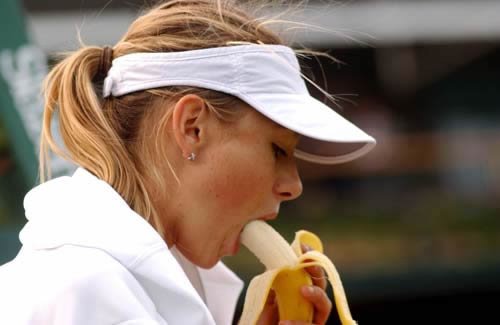
Even more outrageous, though, was the illegal coaching Sharapova received from her father in the stands. The TV commentators documented Mr. Sharapov holding up a cup telling Sharapova when to drink and a banana telling her when to eat, blatantly ignoring the rule forbidding such conduct. Why does Sharapova, seeded #3, need such help against a player not ranked in the world's top 25? Can't she win on her own? Apparently not, since Golovin took Sharapova to two tiebreakers and had numerous chances to take the match. What's next for Maria, steroids? Time will tell.

And then there was the screaming. Sharapova's high-pitched wailing, perhaps a tactic to conceal the sound of the ball striking her racket from her opponent, makes it nearly impossible to watch an entire match, certainly it can't be done without repeated wincing.

So with ten seeded players in the draw only one Russian reached the semi-finals, a "Russian" who speaks English on the court and lives in the United States. Not exactly a breathtaking result.

Sharapova would go on to defeat world #1 Amelie Mauresmo in a truly bizarre semi-final match, winning the first and third sets at love while being easily beaten in the second and taking the match despite having 20% more unforced errors than winners. Mauresmo, the greatest choke player in the history of the women's game, made nearly 40 unforced errors and handed the match to Sharapova in a true laugher, the kind of thing that is seriously underming the sport's fan base.

The news wasn't much better on the men's side. Russia's male hero Marat Safin (brother of Dinara and not, by the standards of Slavic race relations, a "real Russian" at all) was ejected before the quarter finals by a non-top-ten opponent. Unseeded Mikhail Youzhny was a standout, eliminating the number two six in the fourth round and the number two in the quarters before losing honorably to #9 American Andy Roddick in the semis. Youzhny also did well in doubles, his unseeded team ousting the top seeds in the fourth round before being ousted in the quarters. Finally there was #7 seed Nikolai Davydenko, who in the quarters faced the same (lower ranked) player that eliminated Safin and struggled to beat him in five after losing the first two sets. Davydenko went on to lose honorably, as everyone does, to #1 juggernaut Roger Federer, and is another "Russian," since he was born in the Ukraine and lived most of his life in Germany; he now resides in Monte Carlo. How he gets denominated "Russian" along with Youzhny, born and currently residing in Moscow, is anybody's guess.

As for Sharapova, her 6-4, 6-4 win over Justine Henin-Hardenne was a real outrage, and not just because of the excrutiatingly unwatchable quality of Sharapova's one-dimensional play. The TV network hyped Sharapova's pretty face continuously while ignoring Henin-Hardenne's existence, even though Justine had just completed one of the most amazing achievements in the sport's history, appearing in the finals of all four grand-slam events this year; instead, it sought to market the match based on Sharapova's sex appeal. At the trophy ceremony after Sharapova's victory, the presenter called upon the audience to give a round of applause for the match and had to ask twice just to force a smattering of clapping out of those assembled, because the match was just about as boring as they get (a clear pattern where Sharapova is concerned). Weirdly, Sharapova had once again struck 20% more unforced errors than her opponent, just like in the Mauresmo match, yet still managed to prevail by relying on the same uncanny dumb luck that allowed her to emmigrate to the U.S. as a child from Siberia.

So now this is "Russia's" greatest player, someone who owns homes in Florida and California but not in Russia, who speaks English without an accent on the court but not Russian and who has lived her entire life in the U.S. and acquired her game from American coaches, and never once played for the Russian national team. In other words, her victory is really just an embarrassment for Russia and bad for the sport as well, pushing true champions to the sidelines and elevating form over substance.

And so it goes in Russia.

Did you give thanks for tanks on Sunday?

If not, shame on you. As Itar-Tass reported, Sunday was "tank day" in Russia, yet another Soviet holiday to commemorate militarism, aggression and imperialism that Russia has not only not seen fit to abolish but still officially celebrates.

Sunday, September 10, 2006

The Sunday Funnies


English Russia offers readers a wealth of hilarious (and terrifying) candid views of the Moscow subway. Click through to have a gander.

More Truth is Funnier than Fiction

The Moscow Times reports:

A car thief with a tragicomic record of heists gone awry was arrested Thursday morning after the Volkswagen he had stolen ran out of gas in rush hour traffic, police said.A car thief with a tragicomic record of heists gone awry was arrested Thursday morning after the Volkswagen he had stolen ran out of gas in rush hour traffic, police said. Traffic police arrested Alexei Ashurin, 30, at around 9 a.m., after the 15-year-old red Volkswagen he was driving ran out of gas near Tsaritsino Park in southern Moscow, police spokesman Valery Buzovkin said. "The officers helped him push the car off to the side of the road to clear the way for cars behind him, but then they noticed that something was fishy," Buzovkin said. "There was a screwdriver sticking out of the ignition, and the lock on the door had been damaged." Volkswagens are the most commonly targeted imported vehicles by car thieves in Russia. Ashurin, who has been convicted for car theft and drug possession in the past, did not even try to talk his way out of the situation, Buzovkin said. "After the officers asked to see his documents, he immediately told them he had stolen the car," Buzovkin said, adding that Ashurin broke down and cried in front of the arresting officers. Ashurin has been charged with theft and faces up to two years in prison if convicted. It apparently was not the first time that Ashurin ran into technical difficulties while plying his trade. The suspect told police that his previous conviction stemmed from an incident in which he stole a car from an auto repair shop, Buzovkin said. "The owner of the car left it at the shop to get the brakes repaired, and [Ashurin] stole it from the lot," Buzovkin said. "But the brakes had not been repaired yet, and when he tried to stop at a red light, he went through the intersection and slammed into a Jeep." Ashurin also told police that on another occasion, he passed out drunk behind the wheel of a car he had just stolen. He abandoned the car after getting in a single-car accident, Buzovkin said.

CBS News reports:

Just outside the Kremlin, there's a high-level conference going on this week that affects us all: the World Toilet Summit. It's been organized by the WTO — the World Toilet Organization — a very serious group that is flush with ideas on how to improve sanitation. "The World Toilet Organization is the voice for a subject that has been neglected for so long," says WTO founder Jack Sim. "The World Toilet Summit is creating a revolution, because people were not talking about toilets before." He says that about 200 delegates have focused their talks on a number of issues, including how to induce the construction of more restrooms, improving sewage treatment and fighting diseases that can be spread via lavatories. In general, the non-profit organization to influence governments and companies on a wide range of questions related to toilet usage and standards. It also sponsors World Toilet Day every November 19. Toilets are a subject that may make people giggle, but it's heady stuff ... as serious as the subjects raised by that "other" WTO, the World Trade Organization. "Have you ever wondered why we made the acronym WTO? We use humor to propagate our message," explains Sim, who was a businessman in Singapore before founding the group. "When people are inhibited, to break the ice, you make them laugh. After they laugh, then they are listening and eventually they become serious. And they take action." The average person spends about four years of their life in the bathroom. Exhibits at the summit show there are plenty of ways to make that quality time. There are handmade toilet paper holders that play music. One of them has male and female figurines on top, who come together to kiss as the toilet paper is ripped. The music? The theme song to the movie “Love Story.” Another of the toilet paper holders features miniature soccer players — and as the toilet paper is pulled down, a small toy ball goes into a soccer net. The exhibit also features a Japanese commode which comes with its own remote. The remote control can make the toilet flush, make its seat go up or down, or make a retractable bidet attachment pop out from the wall of the bowl. The toilet’s cost? More than $6,000. There are also high-tech public toilets. One freestanding cabin is made of silvery metal and is shaped like a space capsule. Another toilet unit on display has two fake marble bowls attacked to a giant metal box. The bowls spin around so that once can be retracted and disinfected as the other is used. World Toilet Summits have been held each year since 2001. Moscow is a good place for the meeting because, in this department, Russia still has a long way to go to catch up with the West. About a third of Russian homes still have an outhouse. And as for public toilets, port-a-potties are state of the art. Russia has few public restrooms. But at least people who hear the call of nature can now use the plastic portable toilets that have been set up recently in many public spaces. For example, just outside Red Square, there are a number of port-a-johns that can be used for 10 rubles (about 35 cents). In fact, more than 40 percent of the world's population — more than 2½ billion people — lacks indoor plumbing. That means the work of the WTO isn't likely to go to waste.

Sunday Supplement: Rocking Out, Banned in Moscow


The Independent on yet another incident where, when Russians can't handle something, their response is to ban, suppress and destroy it. It has always been so in Russia, leaving the country blind to facts that ultimately destroy it for lack of preparation. This time, it's the rock group Leningrad. Is the Kremlin really afraid of these rockers because they use bad words, or it is it because they appear to be popular free thinkers who don't bow to the Kremlin's authority, and hence a bad example? You be the judge.

If you thought the gypsy-punk theatrics of Eugene Hutz and his band Gogol Bordello were a one-off, you won't have heard of Leningrad. This 15-piece Russian ska/punk/salsa/rock/gypsy/hip-hop outfit, formed by Sergey Shnurov in St Petersburg in 1997, are the darlings of millions of vodka-fuelled Russian youngsters and expat hellraisers.

Their popularity is at odds with the radio play they get - virtually none, owing to their contentious, often obscene lyrics. They were banned by Moscow's mayor Yuri Lushkov from performing in the capital. Perhaps this is because, as the vocalist Shnurov once suggested: "Leningrad is like a porno film." So they remain a guilty pleasure in spite of huge record sales and regular sell-out tours.

"They still don't like us much in Moscow," says Shnur, as he's known, when we meet to talk about their first UK-distributed album, Hleb. Their previous CD was a collaboration with the London-based gypsy cabaret three-piece The Tiger Lillies.

Shnur thinks the new album's title is one of Leningrad's most dubious. "The interpretation comes from the sacred Christian rite of communion," he says, explaining no more. Schnur, who has been described as reclusive, is not a man to waste too much time on long sentences.

When I suggest that all his songs have stories attached, he counters that "the stories are not important at all - [what's] important is the emotional message". Asked which are Leningrad's favourite topics, he says simply: "Corruption, politics, religion and sex."

The only time Schnur gets fired up is when we talk about Chelsea and its Russian owner Roman Abramovich. "It's strange for me that the governor of Chukotka invests in English football, although he has achieved tangible results. I support Zenith [a St Petersburg club] and Arsenal. I don't like Chelsea that much because of their pragmatic style - although what can you expect from a team owned by such a pragmatic man?"

The band's debut album Pulya was recorded by Leonid Fyodorov (ex-leader of the famous Russian band Auktyon) in 1999. Their original vocalist was Igor Vdovin, but he quit and bassist Shnur was thrust to the front with his gravelly voice, which he says is fuelled by "vodka, cigarettes and something else".

"There were great live bands and clubs in St Petersburg then," he says. "It meant more to sell out smaller, hotter venues than play big, cold stadiums. Leningrad tried to become, without much practising, one of the coolest bands around. That's how our style was born."

They were, and still are, inspired by the likes of Led Zeppelin, Massive Attack, Stravinsky, Shostakovich and Grazhdanskaya Oborona (a Siberian punk band). However, unlike many bands, they went out of their way to avoid sounding like just another homogenised Western act.

"The same as any British band doesn't try to sound Russian, we, existing in the context of our culture, feel like a fish in the right water, the way we are," Shnur says. Which might explain why they have such empathy with their fans. "There's no barrier between the audience and us," Shnur says. "Stage and audience, one big performance. But as to who is the more drunk... I still have to think about that."

It doesn't take a genius to work out that booze plays a big role in Leningrad's music. It represents a language most people understand, alongside their street poetry and political criticism. An example, from the track "The Truth", goes: "They don't swear on TV, how nice/ How could we live without a format? We need a format/ Our politicians are great people, they never swear... Nice guys, the policemen/ Teach us good manners/ They also never swear/ And don't take bribes, well, just like our politicians."

Leningrad take the art of swearing to a new level, helped by the fact that Russian swear-words are a language in themselves. Based on a linguistic system called Mat, it provides a wealth of caustic combinations, of which Shnur is a master. He tends to use them to add force to subjects such as corruption, poverty or prison conditions, or even just getting drunk and having a good time. This is what endears Leningrad to common people and intellectuals alike.

"In our country, in virtually every family there is someone who's either been to prison, or in the army - which basically means the same thing. That's why everyone can relate to the songs."

The band's fascination with Russian prison songs of the 1930s onwards is augmented by their use of accordion, double bass, xylophone, balalaikas, singing saws and a sizeable brass section, which blast out reinvigorated versions. But there are more sedate tracks such as "Nebesnyi Tennis" (Heavenly Tennis), a cautionary tale about the gulf between ordinary Russians and their sports idols, in this case the tennis player Maria Sharapova ("Here you have your anti-stress pills, my super princess/ Everything is so trite and simple/ I fall on my bed and cry in my pillow/ It's stupid to wait for heavenly sweets, from Sharapova, fucking, Masha [Maria]...").

The melancholic delivery of "Nebesnyi Tennis" and "Svoboda" has a lineage to underground Soviet writers of the 1970s, such as Arkady Severnyi. Asked why he thinks Severnyi is such a good writer, Shnur says curtly: "If anyone could have explained that, he would have been a bad songwriter." The beauty is not in the explanation, but the emotion - and, like Severnyi, Leningrad have plenty of that.

LR on PP

Click out La Russophobe's latest on Publius Pundit, where she reviews information coming out of Georgia that the Kremlin sought unsuccessfully to foment a coup d'etat against Georgia's elected president, who wants to move Georgia into the EU and NATO, exposing the crazed, seething hatred of the Russophile crowd for the Georgian government.

We've seen the Kremlin poison an opposition candidate for the presidency in Ukraine and use energy blackmail there as well as in Belarus and the Baltics while opening supporting favored leaders like Lukashenko and Yanukovich. Now, apparently, the Kremlin has decided that these methods won't be enough in rebelious Georgia, so it is resorting the the crude tactics of Soviet imperialism in its effort to dominate the scene. Your comments on the unfolding developments and the disturbing future possibilities are welcome.

EnglishRussia

La Russophobe has stumbled across an entertainment blog called EnglishRussia which has some interesting content and statistics.

As to content, there's for example a YouTube video of a clash between two groups of soccer hooligans in St. Petersburg, accompanied by a comment from a reader that states: "This video makes me sad. Why can’t the Russians just get long? Why can’t they target Muslims or niggers instead?" It also offers a series of photos from the Moscow Metro, linked to in the Sunday Funnies, above.

As to statistics, although the blog only contains 2 months worth of archives, Technorati indicates it has been linked to 821 times by 456 blogs, placing it 4,414th out of all blogs in the world and perhaps making it the most popular Russia-relataed blog in the world. Oddly, it doesn't contain a list of blog links or much other information beyond its content. Perplexingly, its site counter states that it has had 919,184 vistors so far, and that 504,627 of these have come in the last week alone. It does not tag itself on Technorati as a "Russia blog" although some of its tags make reference to Russia; its tags do make repeated reference to "Russian girls," for instance.

Perhaps this blog has existed longer than its archives and site counter indicate; in any case its an interesting find, and La Russophobe asks readers if they have any additional information about EnglishRussia or about any other English language Russia blogs which are unknown to her and may not be easy to discover. We are always interested in updating our blog index.

Video from Kondopoga

Yahoo! Russia has video of the Kondopoga violence. Click the link and then find and click "Racie Riot in Russia" under the "Video" heading in the sidebar. You may need to click the link more than once to get it to work, but the video is good quality and worth watching.

Saturday, September 09, 2006

The Russian Navy: Keystone Sailors Running Aground


Reuters reports that the Russian "navy" is slipping slowly beneath the waves:

MOSCOW (Reuters) - A spate of mishaps in Russia's navy has exposed the gap between the Kremlin's ambition of restoring lost military might and the reality of temperamental equipment and badly paid crews.

The navy suffered the double humiliation on Thursday of a fire on a nuclear-powered submarine that killed two crew members and a failed missile test launch.

"The Russian Navy is equipped for parading itself in front of President Vladimir Putin but underneath, there is still a dilapidated infrastructure," said Igor Kudrik, chief submarine expert with the Oslo-based Bellona environmental group.

Russia's submarine fleet -- the second largest in the world after the United States and a key part in Russia's nuclear defense shield -- has been especially accident-prone.

An electrical fire on board an attack submarine in the Barents Sea killed two crew who were trying to put it out. The navy's commander-in-chief said the vessel was overdue for scheduled repairs.

Hours later, a prototype inter-continental missile launched from a submarine in the Pacific Ocean fell back into the sea. The Bulava missile is a flagship project intended as an equivalent to the U.S. Trident, local media reported.

The Kremlin is splurging cash on its military, with the biggest increase in hardware spending. But that is not enough, said Ruslan Pukhov, Director of Moscow military think tank CAST.

"The main problems of the .. navy, including the submarine fleet, is not the equipment, but personnel," he said.

"There is not enough training for crews, they are not at sea very much and they are paid little. Technical accidents, for the most part, stem from the human factor."

The navy has caused Putin personal embarrassment. When the Kursk submarine sank six years ago, killing all 118 crew, he was accused of being uncaring because he did not immediately break off his holiday.

In 2004, Putin dressed up in a military-style outfit to watch a huge missile-firing exercise in the Barents Sea. But one ICBM failed to launch from a submarine.

Navy chief Admiral Vladimir Kuroyedov was dismissed last year. His replacement, Admiral Vladimir Masorin, pledged a radical shake-up. But he too has been dogged by mishaps.

The Jamestown Foundation has more.

Images from the Kondopoga Tragedy: What is this child guilty of in the eyes of the Slavophiles?

Reuters photo: A Chechen family, Fatima (C) and her two sons Magomed (L) and Muslim (R), from Karelian town of Kondopoga stand in the corridor of a rest house in Petrozavodsk, September 8, 2006. The family fled from Kondopoga after hundreds of people marched through the town and looted shops held by Caucasus businessmen.