La Russophobe has moved!

You should be automatically redirected in 6 seconds. If not, visit
http://larussophobe.wordpress.com
and update your bookmarks.

Take action now to save Darfur

Wednesday, September 20, 2006

BW Exposes the Horror of Flying Russian Style

Business Week magazine contains an article reviewing the increasingly terrifying prospect of boarding a commerical jet anywhere in Russia. As is often the case in Russia, the ultimate horror here is not even the sickening loss of life, but the even more sickening indifference to it on the part of both the government and the people. In Russia, individual human lives have lost all significance.

The Deadly Skies of Russia

Russia's air safety standards are in the spotlight after a spate of recent accidents due to dangerous airports, tired pilots, and old planes.

With trademark black humor, Russian pilots call the Irkutsk airport the "Siberian Bermuda Triangle."

The thick fog is ubiquitous; the slippery runways slope at odd angles; garages, sheds, and hangars sit precariously close by. Some superstitious locals also say the airport is cursed due to the presence nearby of a mass grave filled with the remains of victims of the Stalin-era terror. Whatever the cause - bad climate, poor infrastructure, or restless angry spirits - nearly one-fifth of the 26 major Russian airline accidents since the breakup of the USSR have occurred in Irkutsk.

Most recently, on 9 July, a Sibir Airlines Airbus A310 overshot a runway while landing, smashed through a concrete fence into nearby garages and burst into flames. Some 124 of the more than 200 passengers and crew on board were killed.Describing the accident as "ill fate," Prime Minister Mikhail Fradkov told Transport Minister Igor Levitin to draft proposals to improve airport safety in Irkutsk.But while Irkutsk's airport is certainly one of Russia's biggest airline safety concerns, it is not the only one. Tragic incidents sometimes occur mid-flight, during what is normally the safest part of the trip.

The most recent such accident took place on 22 August, when a Pulkovo Airlines Tupolev Tu-154, en route from the Black Sea town of Anapa to St. Petersburg, crashed north of the Ukrainian city of Donetsk killing all 170 people on board.And while the Sibir and Pulkovo airlines disasters attracted international headlines, Russia experienced a series of smaller incidents this past summer that got less attention. On 10 July, just a day after the Irkutsk crash, another potential catastrophe was averted when another A310 was forced to make an emergency landing in Simferopol after a dangerously sharp drop in the oil level of one of its engines. On the same day, a Tu-134 Russian Navy plane was forced to land in the Crimea after one of its engines burst into flames.On 27 July two Russian military jets - a MiG-29 fighter and a Be-103 - crashed.

A day earlier, a Yak-26 aerobatic trainer crashed in the Razan region.So why do airlines suffer so many deadly crashes? Analysts cite a variety of reasons including ageing fleets, poorly trained and unqualified pilots, bad airport infrastructure, and corruption.

OLD PLANES, TIRED PILOTS, AND SCARY AIRPORTS.

A technician who worked on the Airbus A310 that crashed in Irkutsk told the newspaper Komsomolskaya Pravda that the aircraft's thrust-reverse had malfunctioned prior to takeoff.According to Aleksandr Bocharov, spokesman for the Airbus office in Russia, an A310 "can operate" safely "for 25 years and a total flying time of 59,000 hours." Whether or not the A310 - which had undergone regular maintenance in Germany one year before the crash and was scheduled for maintenance in 88 days - had exceeded its recommended flying time, experts say this is a common problem for Russia's cash-strapped post-Soviet airline industry.

When the Soviet Union broke up in 1991, so did the state airline Aeroflot, which budded off 500 smaller, regionally-based companies. The smaller of these had little choice but to stick with their ageing Soviet-era fleets. The larger ones could only afford to purchase older foreign aircraft.Eager to unload their older planes, foreign manufacturers offer aircraft to Russian companies on flexible and attractive conditions: easy credit, installment plans, large discounts, and leasing. Russian airlines tend to economize in procuring and maintaining their fleets at the expense of safety, an industry official said, speaking on condition of anonymity due to the sensitivity of the topic.

One exception is the national carrier Aeroflot, which is planning to spend $3 billion for 22 long-haul aircraft. On 15 September, however, Aeroflot announced that it was indefinitely postponing a decision on whether to buy Dreamliners from the U.S. firm Boeing or A350s from its European rival Airbus. "The date of the new board meeting is not set yet.

The final decision is being put off," Aeroflot's Deputy Director General Lev Koshlyakov told Reuters.But even if all of Russia's airlines could afford to make such a purchase, it would not make the skies safer, according to experts. According to some estimates, 70 percent of Russian air crashes involve human error. Just as Russia's fleet of aircraft is ageing, so are its pilots - and there are few younger cadres to replace them.The average age of a Russian pilot is 42, which means that a significant number are over 50. Some medical experts have suggested that a significant number of Russia's older pilots should be grounded for health reasons.

According to the Russian Aviation Workers' Trade Union, airlines face a shortage of skilled pilots as the younger generation is not going into the profession due to low salaries. Moreover, Russia has just two schools training civilian pilots.Compounding these problems is the decrepit state of Russia's airports.

According to the air transport research organization Skytrax, Russia has three of the world's most dangerous airports: the infamous Irkutsk field, Adler, and Petropavlovsk Kamchatsky. In Adler, the airport for the Black Sea city of Sochi, aircraft must perform a complicated - and terrifying - loop maneuver in order to land on a small strip between the mountains and the sea. Moreover, the airport lacks standard radio and lighting equipment. In Petropavlovsk Kamchatsky on the mountainous Kamchatka peninsula, takeoffs and landings are complicated by extreme turbulence, high hills, and volcanoes.

Overall, 39 Russian airports are in need of emergency repairs on runways. Part of the problem is that runways and landing strips at Russian airports are constructed from concrete blocks. On older runways, the center of these blocks tend to sink and form a bowl that accumulates water, leading to hazardously slippery runways flooded with puddles.And then there is plain old fashioned crime and corruption. Police in Moscow, for example, recently caught workers at the Vnukovo Aircraft Repair Works using uncertified parts stolen from the Saturn plant in Rybinsk. Investigators later discovered that many of these faulty parts had been installed on aircraft engines.

LESSONS LEARNED?

Attempting to reassure the public, some Russian airline executives have suggested that the rise in accidents is not really a cause for concern. Russian authorities register many thousands of road accidents every year, they say. Accidents occur on the railroads, on boats, and at factories as well. This is the price people have to pay for the industrial revolution.

The Russian government was only slightly less cavalier. It promised to pay 100,000 rubles ($3,700) to victims' families in the A310 crash in Irkutsk, and 50,000 rubles to survivors. But despite mounting evidence that airlines' habit of buying second-hand aircraft from abroad is harming airline safety, Transport Minister Levitin said the government does not plan to initiate more comprehensive controls on the process.

"The mechanism works and we will not change it," he said, adding that the A310 that crashed in Irkutsk had been regularly maintained and passed all safety tests.But a looming lawsuit may cause the foreign companies supplying Russian airlines to exercise more caution.

The American law firm Speiser Krause has agreed to represent 27 families who lost relatives in the Irkutsk crash. The firm, which claims that a problem in the aircraft's reverse braking system caused the crash, is preparing to sue U.S. and British companies that manufactured parts for the A310 for $800,000 to $1.5 million in compensation per victim.

Tuesday, September 19, 2006

Annals of Cold War II: NATO Reaches Out to Georgia

Reuters reports that the U.S. has fired off another volley in the escalating cold war between itself and Russia, pushing NATO to reach out to Georgia even as Russia seeks to undermine the Georgian president with a failed coup d'etat.

NATO countries have agreed to offer ex-Soviet Georgia talks on closer ties with the Western alliance, NATO sources said on Monday, a move likely to anger Russia.

"It's been agreed," an alliance source said of an agreement between ambassadors representing NATO's 26 members to open a so-called "intensified dialogue" with Georgia.

The move is to be rubber-stamped by NATO foreign ministers meeting in New York on Thursday. The talks are a first step toward membership of NATO but do not make entry automatic.

The United States has lobbied for closer ties with Georgia, but European allies have cited concerns over its disputes with Moscow concerning two rebel regions backed by Russia.
Some questioned whether NATO's borders should extend to the south Caucasus and whether Georgia could be considered European.

"We made it clear (to Georgia) that with this step comes greater responsibility. It mustn't ruin everything with a crisis now," said an alliance source who declined to identified.

Georgia's dispute with the separatist entities of Abkhazia and South Ossetia are one of the so-called "frozen conflicts" of the former Soviet Union which have become the front line of Russia's battle against Western influence in its backyard.

The Ballot in Moldova

The Associated Press reports that Russia has no problem with votes being carried out in foreign countries asking sections of those countries to break away and crawl to Russia. But let any votes occur in which such sections consider breaking away to move away from Russia, and suddenly there is a great protest from Russia about not interfering in soveriegn political systems. Why can Trans-Dniester vote to break away but not Chechnya?

TIRASPOL, Moldova -- Voters in Moldova's breakaway Trans-Dniester region overwhelmingly approved the separatist government's bid to eventually join Russia, election officials said Monday.

Pyotr Denisenko, head of the Trans-Dniester Central Election Commission, said that 97.1 percent of voters had voted in favor of the region's 16-year-old independence course with the ultimate goal of union with Moscow.

Moldova and the West have vowed not to recognize the referendum, just as they have refused to recognize the Russian-speaking region's de facto independence. They have called on Trans-Dniester to return to talks with Moldova, aimed at giving the region broad autonomy but keeping it in Moldova.

Voters in Sunday's poll were also asked whether they wanted to abandon independence and reunite with Moldova, with whom separatists fought a 1992 war that killed 1,500 people. Denisenko said 94.6 percent voted against a union with Moldova.

Russia has also given no indication that it intends to gobble up the impoverished slice of land, home to about 550,000 people, one-fifth of whom are already Russian citizens. Trans-Dniester shares no border with Russia, and the Kremlin has been cautious about assigning significant legal meaning to the referendum.

ROOSKIZUGZWANG

Two columns in yesterday's Moscow Times juxtaposed against each other show two Russians reaching the same destination by different routes: if Russia goes on as it is, all roads lead to ruin. Russia must retrace its steps before it is too late.

NIKOLAI PETROV

Three weeks have passed since the small Karelian town of Kondopoga was engulfed by ethnic violence, and passions are still running high. In fact, it's unlikely things will calm down much in the near future, since the authorities have not so much run into a blind alley as they have come to a fork in the road, with both options being bad.

Going with the flow of the decidedly anti-Chechen sentiment among the vast majority of the town's residents and kicking people from the Caucasus out of the city -- or rather not letting them return -- is clearly out of the question. This would not only be unfair and unconstitutional; it would also create an extremely dangerous precedent for the rest of the country. On the other hand, acting according to the law and helping the Caucasus natives return to the town could lead to an explosion.

The only alternative is to wait and see. Waiting until tempers calm down could be a long process. Things will not settle down in the short term, as Karelia is set to elect its regional parliament at the start of October, meaning that what happened in the town is likely to remain at the center of attention as a campaign issue.

The recent horrific case of the hazing of Private Andrey Sychov, after which both his legs and his genitals had to be amputated, at the Chelyabinsk Armor Academy brought to light a veritable avalanche of reports about similar cases across the country. Just the same, following the events in Kondopoga we have learaned about a slew of reports about other large-scale ethnic conflicts in Samara, Saratov, and elsewhere.

So we have to ask ourselves: Why did this happen in Kondopoga, a relatively quiet -- and prosperous, by the standards of Russia's regions -- town of 300,000 with a successful pulp-and-paper mill as its main business? Most of the residents are ethnic Russians, and the Chechens -- indeed, natives of the Caucasus in general -- are few. Some of these people have been living there for years, while others didn't arrive until after war broke out in Chechnya in 1994 and more have only just arrived. The long-time residents have long nurtured grievances about upstart newcomers, who, they say, show no desire to live by the rules of the local community.This was what ultimately led to the explosion. The conflict between the ethnic Russians and residents originally from the Caucasus in the local restaurant that sparked the wave of unrest was not the first incident.

But two factors played a part in it becoming the start of broader racial violence: the inaction of the local police, who did not step in to try to break things up until almost the very end; and the involvement of activists from the Movement Against Illegal Immigration, who came up from Moscow to fan the flames. Hot on their heels came commissars from pro-Kremlin youth movement Nashi, looking either to put out the flames or to indulge in some political point-scoring. Elections to the State Duma, after all, are just a year away.

But the conflict between locals and Chechens, police inaction and the Movement Against Illegal Immigration's activities are not unique to Kondapoga. These same conditions could combine in any place in the country at any time.

What did make this case unique was that in a town this size everyone knows each other, so the effect was like a detonation. In Moscow or Samara -- or even the Karelian capital, Petrozavodsk -- where communities are less close-knit, it would probably have turned out differently. In any case, Kondopoga was the first event. Only time will tell whether it will be the last.

Hastily conducted opinion polls show that almost one-third of Russians say that unrest similar to that in Kondopoga have happened where they live. In Moscow, 29 percent of respondents said they saw frequent ethnic clashes, while 43 percent said they happened rarely. In small towns like Kondopoga, the figures were significantly lower, at 4 percent and 25 percent, respectively.

The events in Karelia have placed the authorities in what is referred to in chess as a zugzwang, where every available move will leave the player in a weaker position. In addition, they have highlighted a very dangerous -- especially ahead of next year's elections -- and rapidly growing new force, the Movement Against Illegal Immigration, which looks to be committed to capitalizing on ethnically focused protest sentiment.

ALEXEI PANKIN

"We need a sober assessment of where we are to see our society as it really is, with all its possibilities and needs. That is what we need at the moment." Thus wrote Communist Party General Secretary Yury Andropov in the article "Studying Karl Marx and Some Questions of Socialist Construction," published in Kommunist magazine in 1983. I remember that, at the time, the progressive intelligentsia was asking itself whether Comrade Andropov really was a keen enemy of liberty or a closet liberal reformer. The new general secretary's frank admission that the party could get some things wrong lent significant strength in kitchen-table discussions to supporters of the position that he was a closet liberal. Only now do we know from memoirs and historical investigation that the article was, in fact, written for Leonid Brezhnev before he died, that the historic phrase was inserted by Politburo conservative Mikhail Suslov and polished by his colleague Konstantin Chernenko.

Many years have passed, but the same thought can be heard postulated in almost exactly the same way by political figures today. At a recent round table titled "The Sovereign State and Globalization -- Democracy and National Identity," presidential deputy chief of staff Vladislav Surkov said: "Only a people that has a complete idea of itself -- who we are, where we're going, and why we're going there -- can live and develop organically."

Taking this quotation along with Surkov's as milestones, the conclusion has to be that Russia has spent the time between going from who knows where to some place just as tough to find. It's clearly a peculiarity of the country's sovereign democratic development.

The more I ponder the concept of sovereign democracy, the more I come to look at it as a universal key to life in Russia. And the more I look, the more I sympathize with the country's leaders.

For example, a survey published recently by the VTsIOM polling agency indicates that over the past two years the number of people who put liberty before security has risen noticeably, to 44 percent from 27 percent. On the surface, this would seem to be a cause for celebration. But then, on Sept. 11 -- the day when the world remembered the victims of the terrorist attacks on the United States -- I read an article in the newspaper Moskovsky Komsomolets in which the journalist recounted her journey to Moscow on an airplane, belonging to a Russian airline, that had an engine malfunction.

Before takeoff, the crew worked out that bringing in a replacement plane would be too costly for the airline. The pilots even told the journalist that they would only refuse to fly if they were 100 percent sure the plane would crash. The passengers, who were informed about the problem before takeoff, made no particular fuss either -- apparently in line with the Russian proverb that people born to be hanged don't have to worry about drowning. Disturbed by this attitude toward safety, the journalist reminded her readers about three horrific crashes this summer, near Sochi, in Irkutsk and outside Donetsk. She herself did not refuse to fly and, moreover, apparently guided by some very sovereign idea about journalistic ethics -- did not even name the airline in question. Readers of the popular daily henceforth have the right to harbor concerns about any Russian carrier.

After reading the article, I suddenly felt extreme compassion for another state official: Deputy Prime Minister Sergei Ivanov. It is Ivanov who is responsible for aviation safety in a country where ordinary people and journalists take the liberty to play with their own safety and that of others. Encroaching on this liberty, I fear, would only lead to brutal repressions.

Whichever way you look at it, there is a sort of sovereignty exercised by individuals in Russia's democracy. So there is no special need to build it.

Annals of Cold War II: The First Defector

The Chicago Tribune reports that Cold War II now has its first defector.

MAGNITOGORSK, Russia - The engine that drives this gritty, weather-beaten city of belching smokestacks and trolley lines is steel, but its heart and soul is hockey. The pro team here, Metallurg, polishes its prodigies from the age of 6. And it almost always fills its aging 3,500-seat stadium with screaming fans adorned in Metallurg red, white and blue.

So when Magnitogorsk's favorite son, Metallurg forward Evgeni Malkin, suddenly disappeared from the team Aug. 12 in Helsinki, Finland, Russians here gasped and waited. Four days later, when the 20-year-old superstar turned up in the U.S. to embark on a career in the NHL, they seethed.

"What he did isn't right - it's not honest and it's not fair to the team that did so much for him," said Pavel Alikayev, a Magnitogorsk psychologist, moments before catching a game at Metallurg's Romazan Ice Sports Palace.

The reaction from Malkin's bosses at Metallurg has been far more vitriolic. Metallurg general manager Gennady Velichkin called the affair "disgraceful" and accused the NHL of engaging in "pure sports terrorism."

Malkin is only the latest in a long line of Russian hockey marvels who have parted ways with the motherland for the sake of fat contracts and lucrative endorsements in North America. Since Soviet star Alexander Mogilny's defection in 1989, dozens of Russians have jumped ship to pursue fame in the NHL, from 1994 league most valuable player Sergei Fedorov and the speedy Pavel Bure to 20-year-old Washington Capitals phenom Alexander Ovechkin.

Russian hockey has been enjoying a modest renaissance of sorts, with a stream of middle-tier Russian NHL players returning to their homeland to finish out their careers. Nevertheless, Russian hockey continues to give its rising stars more reasons to leave than stay.

The NHL's average salary, $1.8 million, dwarfs wages in the Super League, the equivalent of the NHL in Russia. Corruption and crime continue to plague Russian hockey; several players and officials have been shot dead in contract killings since the late 1990s. And Russian players readily admit the action on Russian rinks is slower.

"Every hockey player in Russia thinks about playing in the NHL because it's the best league in the world," says Alexei Kaigorodov, 23, a center at Metallurg scheduled to leave Magnitorgorsk later this month to play for the NHL's Ottawa Senators. "It's as simple as this: If the best league were in Russia, players wouldn't leave."

There was a time when Russia stood atop the world hockey scene. Nicknamed the "Big Red Machine," the Soviet team won gold at seven Winter Olympics from 1956 to 1988. They were led by such military-minded coaches as the famed Viktor Tikhonov, who kept his teams on grueling 11-month training regimens and sequestered them in dormitories.

After the collapse of the Soviet Union in 1991, Russian hockey withered. Red Army stars such as Bure and Vyacheslav Fetisov left for North America and storied careers in the NHL. With the advent of the 1998 financial crisis, player salaries dropped to as low as $10,000. Cash-strapped teams couldn't afford to replace aging equipment.

And at times there were telltale signs of organized crime's intrusion into the sport. Russian Ice Hockey Federation President Valentin Sych was shot dead in April 1997. The next year, an apparent contract killing claimed St. Petersburg hockey player Nikolai Nikitin. In January 2001, Metallurg Magnitogorsk goalie Sergei Zemchyonok was shot to death in the lobby of his apartment building.

The economy's rebound under President Vladimir Putin has rejuvenated Russian professional hockey, which now is persuading players who left for North America to return. Most of the players are older or play for NHL minor leagues, but their return has injected new life into Russian pro hockey.

Metallurg left winger Ravil Gusmanov, 34, said he doubled his $100,000 salary by leaving the American Hockey League's Chicago Wolves and returning to Russia. "The situation here has changed since the 1990s," Gusmanov said. "You can earn good money here, and there's a lot of competition to start."

Still, Gusmanov readily admits the NHL is every Russian player's holy grail, which is why he doesn't blame Malkin for what happened. Malkin, who signed with the Pittsburgh Penguins on Sept. 5, had always made clear his desire to play in North America. Velichkin and Metallurg management arranged a meeting with Malkin and his parents Aug. 6 in an attempt to persuade him to stay.

What happened at that meeting remains in dispute. According to U.S. media reports, Malkin's agents say Metallurg pressured Malkin into signing a contract extension that would keep him in Magnitogorsk through the 2006-07 season. Velichkin denies any coercive tactics were used."When a player is offered a $3 million salary, do you consider that to be pressure?" Velichkin said.

Six days later, Malkin and the rest of the Metallurg team flew to Helsinki to play in a tournament. When the team arrived at the Helsinki airport and boarded two buses, players noticed Malkin was missing.

Malkin's agent, J.P. Barry, took his star client to a hotel and hid him there until he could obtain an American visa. Malkin arrived in the United States. on Aug. 16.
Barry told The Associated Press that he hid Malkin from the team because he was worried team officials would try to get him back.

"We were worried . . . they would try to look for him, and if they could find him, they would try to continue the psychological pressure," Barry said.

The NHL usually pays teams from other countries $200,000 as a compensation fee. However, Russia is the only major hockey power to refuse to sign on to the NHL's compensation policy. Instead, Velichkin says Metallurg wants $2 million for Malkin and has threatened to sue the Penguins and the NHL.

Velichkin estimates Metallurg, Magnitogorsk's steel production enterprise, has invested millions of dollars more in Malkin's development - from the age of 6 - through hockey school and junior leagues.

"It's kind of like a factory here," Velichkin said. "We take 100 boys when they're 6, and when they're teens maybe 25 are left. We're taking sand and trying to find gold inside. And that isn't easy."

Even the Russophiles can no Longer Stomach Putin's Russia


Who said this, while describing the contract murder of Russian Central Banker Andrei Kozlov:

One of the most discouraging things about this murder is its reminder that life can be very cheap in Russia. For all the decency that I have seen in people in my travels in Russia, there is also a dark side, all too well known by Russians.The outcome of the Kozlov murder is likely to be minimal. Financial markets will remain intact. Someone may be arrested and even tried for the murder. But that person will only be the one who pulled the trigger and not the real parties responsible for such injustices.Real criminals have no fear of being touched in Russia. And while there will be shock and sadness over Kozlov's murder - will there be the anger or determination to do anything about it?
Must have been some evil "Russophobe," huh? Russians don't care about human life, huh? Dark side to Russians, and they know it huh? Doubts Russians will do a thing about this cowardly murder, much less the others that are sure to follow, huh? Massive societal corruption and conspriracy, huh? Yeah, gotta be an anti-Slavic racist, right? Actually, it was none other than the Accidental Russophile Wally Shedd. La Russophobe can only stand on the sidelines and applaud.

Just one problem, of course. Exactly the way the family of an alcoholic can do him more harm than his worst enemy by enabling his drinking and thereby killing him, dear darling Wally has for months now been spewing out all sorts of rationalizations assisting, in his own little way, those who would do so to justify Russia's slide back into totalitarian darkness. And he's not done yet. Why, even as we speak, he's posted something from propaganda machine Russian Life magagazine showing how mean and cruel and unfair to Russia American cartoons were about Russia 100 years ago. Does he also show how unfair Russian cartoons (like the one above, for instance, entitled "Freedom American-Style") were to America? No. Does he pause to notice how hypocritical he's being, attacking a one-sided portrait of Russia while painting one himself? No. He complains that Russians are shown persecuting Jews, but does he discuss the extent to which Russians actually did persecute Jews? No. He complains of an "overreaction" to Russia's "emergence as a world power" but does he mention what followed, namely Stalin and the Cold War? No. And does he ask whether, today, Russia has a magazine published in Russian that explores American culture the way Russian Life explores Russian culture in English? Once again, no.

Wally makes reference to "Conservative Harper's Weekly and other pro-Republican press at this time" causing lots of problems for poor, innocent little Russia. Hmmm, could it be that our Wally is an idealogue, a Democratic partisan? That wouldn't make sense, of course, because for the last six years America's greatest Russophile has been arch-conservative Republican president George Bush, who "looked into the eyes of Putin." But then, not much your average Russophile does makes sense, which is the main point.

Monday, September 18, 2006

KGB Manual on How to Win "Elections": First, Make Pseudo-Parties, Then Have Them Simply Buy Their Votes

Previously, the Guardian reported that the Kremlin was engaged in manufacturing sham opposition parties in order to further manipulate election outcomes. Now, the Guardian reports that those parties are moving forward to actually buy the votes of Russian citizens, focusing on the poor. What's most disturbing about this behavior is not that the proud clan of KGB spies that occupies the Kremlin would engage in it, that should suprise nobody. What's so sickening is the total lack of opposition from any corner of the country.

Roll up, roll up: get your blue jeans and politics here! United Russia, the party which acts as a legislative sledgehammer for the Kremlin, is opening bargain-basement shops with a weather eye on next year's parliamentary elections.

A cut-price furniture store jointly run by the party and a local business opened this week in Nizhny Novgorod, 250 miles east of Moscow. United Russia bosses have said no profit will be made and denied it is a ploy to curry favour with voters. However, a source inside the party told the Kommersant newspaper the venture promised to be "very beneficial".

"Poor people will be able to buy products in shops with the logo of the party for much less money and will start to trust United Russia," the source said. "It's a simple idea and it'll win political points."

Similar "social" shops selling cheap furniture, clothes and shoes are being opened by United Russia in poor regions across the country. A clothes store opened by the party in Kirov offers pairs of jeans for 100 roubles (£2) to 400 roubles, and T-shirts for 30 roubles. War veterans and the disabled get a discount.

Rival parties have threatened to go to court to prove the shops violate electoral law. "Politically one can make this conclusion: the campaign for elections to the state duma has already begun," said Vadim Solovyev, a secretary of the central committee of the Communist party.

More Objective Proof of Utter Russian Political Failure and Total Lack of G-8 Fitness

La Russophobe has previously reported that the German think tank Transparency International had rated Russia tied with Niger and Sierra Leone for the 9th most corrupt economic system on the planet out of 159 nations surved.

Now, the World Bank has provided further confirmation of Russia's byzantine status as a third-world economic and political system. Its "World Governance Indicators" report isssued last Friday places Russia 151st out of 208 countries surveyed, just ahead of Niger and right behind Swaziland, when judged on various criteria for electoral voice and accountability, political stability, effectiveness of the government, the quality of regulatory bodies, the rule of law and control over corruption.

Saudi Arabia has the same daily amount of oil production as Russia and far greater proven reserves, but it isn't a member of the G-8. China and India both have nuclear weapons, far larger populations and far more formidable conventional armies than Russia, but neither sits on the G-8. Isn't it time to admit that objective scientifically gathered evidence from inpartial third parties conclusively proves that Russia is far too corrupt to constitute a viable G-8 partner and expel it from membership?

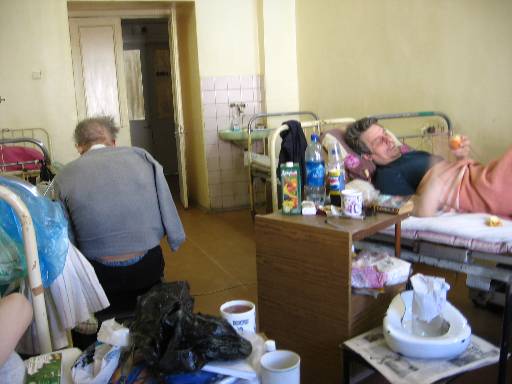
That Form of Torture they Call the Russian Hospital


Global Voices has a harrowing account of a mother's struggle to nurse her son back to health at a Russian hospital. Here is an extract:

A room for five people, one bed’s empty. Gloomy men of various ages lie either with broken legs suspended or simply on their backs. In the room for those who can’t move, there’s no bell to summon the personnel. The door is wide open and this is understandable. First, to yell and be heard in case something happens (this, I guess, is problematic, however - the post is far away and the nurses’ room is all the way around the corner); second, it works like air conditioning. No way to open the window - because they can’t move. And because one bed is underneath the window and the person there can catch a cold.

Mityay has just recovered from a severe cold, he has running nose and cough, and it hurts him to cough. I went to ask the nurse for some nasal drops and [a cough medicine]. I was ready to pay for this “service.” But they don’t have any drops or syrups. They also don’t have any camphora alcohol to prevent bedsores. But I’ve got it with me. As well as a cup, a spoon, toilet paper (thank God, they have sheets - in the children’s hospital […] they once made us bring that, too).

In the Soviet time, I was an in-patient at the traumatology department […]. In general, the hospital was no better. A drunk doctor, lazy nurses. In our room for people who couldn’t move, an old woman with a broken hip died - she had bedsores, she rarely had visitors, it smelled bad in the room. The old woman lied dead for a few hours before my classmates came to visit me and went looking for the staff. I wanted to smoke very much, and when I did light up under the blanket, the other old women said, “Go on smoking, daughter, let there be human smell in here at least…”

You can see the horrible truth about Russian hospitals by clicking here, where a number of photographs of the son's room and the hospital exterior are to be found. Is this a G-8 country flush with oil revenues? You tell La Russophobe.

The Disappearances Begin in Chechnya

The Jamestown Foundation reports that we are now entering the phase of Russia's management of the Chechnya problem where people (including women) that the Kremlin doesn't care for simply start disappearing (like in Argentina):

FEARS GROW OVER MISSING JOURNALIST’S FATE

The Sunday Times reported on September 10 that fears were growing over the fate of Elina Ersenoeva, a young Chechen journalist who was reportedly forced to marry Chechen rebel warlord Shamil Basaev last fall and was abducted at gunpoint, apparently by pro-Moscow Chechen security forces, in Grozny in August, just weeks after Basaev’s death. The British newspaper quoted her mother, Rita Ersenoeva, as saying she was “terrified” that her daughter’s captors had already killed her. “I fear that the men who took her have done terrible things to her,” she said. “She had no choice but to marry Basaev. Now that she is gone I have lost hope. I have lost a golden child.” Rita Ersenoeva told the Sunday Times that she has received anonymous calls warning her not to make a fuss and that she fears that her daughter’s captors will come back for her two brothers, aged 15 and 22. According to the British newspaper, Elina Ersenoeva was approached last autumn by Kheda Saidulaeva, the wife of the late separatist leader Abdul-Khalim Sadulaev, who was a distant relative of Ersenoeva. Saidulaeva told her that she had been chosen to marry a commander known as Ali-Khan Abu Yazidov and that if she refused, her brothers’ lives would be in danger. “On November 30 Elina was approached by an envoy of Abu Yazidov,” the Sunday Times reported. “The man ordered her to get into his car. He blindfolded her and drove her to a house on the outskirts of Grozny. She was led into a room where she came face to face with Basaev.” She was forced to marry the rebel warlord, whom she saw on a few other occasions for several days at a time before he was killed in July of this year. It was only after his death that she revealed to her family that she had been married to Basaev.The FSB questioned Elina Ersenoeva two weeks after Basaev’s death, but they accepted that she had been blackmailed into the marriage and brought no charges against her. On August 17, she was abducted at gunpoint as she and her aunt, Elza Astamirova, were on their way to work in Grozny. “Eight men with machine guns shoved us in and drove us away,” Astamirova told the Sunday Times. “They put sacks over our heads to stop us seeing where they were taking us. I was screaming with fear but they were just laughing. We ended up in a small room with bare walls. Elina was next to me. They let me go and kept her.” On the day she was abducted, Elina telephoned her mother three times to say that she would be released that evening, but she has not been heard from since. The Sunday Times quoted her mother as saying that she fears her captors may have believed rumors that Basaev left behind a stash of millions of dollars and decided to torture her into disclosing its whereabouts. “To think that Basaev would share that information with her is absurd,” her mother said. “To think she lived all those months in fear to protect her family is very distressing. I can’t bear to think what they are doing to her.”

New Zoshchenko

The New Yorker reports that, fittingly, a new translation of the short stories of Russian satirist Mikhail Zoshchenko has just been published. What could be more timely, as the Neo-Soviet Union rises from the ashes of the USSR, that one of the Soviet Union's most acid critics should also reappear.

The Galosh, by Mikhail Zoshchenko, translated from the Russian by Jeremy Hicks (Overlook; $24.95). Though little known to English readers, Zoshchenko was one of the most popular writers in early Soviet Russia—a time when, as Hicks explains in a useful introduction to this collection of brief comic tales, satire was not yet prohibited by the authorities. Describing himself as “a temporary substitute for the proletarian writer,” Zoshchenko wrote in a deliberately simple style, filling his pages with corrupt officials, petty thieves, and confused bureaucrats. Hicks’s fine translations overcome tricky problems—one dénouement involves “Paris” being misread as a word written in Cyrillic—and successfully capture Zoshchenko’s knockabout use of everyday speech. Zoshchenko brought out the latent comedy of people’s adaptation to new ways. In one story, the electrification of an apartment building upsets residents who previously, thanks to the gloom, had not been able to see the squalor in which they lived.

Sunday, September 17, 2006

The Sunday Funnies


The story of Ivan Itchybuttock

CLICK HERE to have your mind read by the deviously inscrutable Russian Magic Square (thanks to RussianEnglish).

More Truth is Funnier than Fiction
Soviet Russians Duped into Planting a Living Swastika


The New York Times reports:

The forest stands overhead in the dusty mountain air, a dense composition of fir trees on a slope, planted by labor gangs decades ago. Its right angles are sharp and clear, forming a square cross with an upraised arm on one side and a turned-down arm on the other. Viewed from this remote village, the effect strongly suggests a living swastika, a huge and chilling symbol, out of place and time.

This is the so-called Eki Naryn swastika, a man-made arrangement of trees near the edge of the Himalayas. It is at least 60 years old, according to the region’s forestry service, and roughly 600 feet across. Legend has it that German prisoners of war, pressed into forestry duty after World War II, duped their Soviet guards and planted rows of seedlings in the shape of the emblem Hitler had chosen as his own.

More than 20 years later, the trees rose tall enough to be visible from the village beneath. Only then did the swastika appear, a time-delayed act of defiance by vanquished soldiers marooned in a corner of Stalin’s Soviet Union. For all the tidiness of legend, however, the tale is not quite true. The provenance of these trees presents a more complicated mystery than a silent subterfuge in a forgotten prison camp. The theory about the prisoners has survived for years, in part because about 1.3 million German soldiers have been missing in the former Soviet Union since the war, according to the German Red Cross. Many were forced to work. They mined uranium and coal, toiled on farms, erected buildings and built roads, railways and canals.

As many as 30,000 of them were sent to Central Asia, the German Red Cross says. The symmetry in the tree line, evidence of their defiance, by this telling, may be the Third Reich’s only practical joke. But aside from the presence of the tree formation itself, unraveling the origins of the lost Nazis’ presumed insubordination is a chore undercut by time. History has become malleable, a yarn by turns sinister, wry, clever and Soviet. It is also warped by errors, a cover-up, competing theories and lies. Yedil Musayev, a teacher, said the trees were planted in the 1940’s by Kyrgyz laborers from the sprawling Lenin Collective Farm, which managed the region’s high plateau. The farm’s managers consisted of Russians and Europeans, he said, sent to distant posts to battle illiteracy and improve efficiency.

Unbeknownst to the Kyrgyz laborers, he said, their forestry supervisor was an ethnic German who had been exiled to the east, as were many Germans during the war. He was a Nazi sympathizer, Mr. Musayev said. The forest was his design

Sultanbek Kandibayev, director of the regional forestry service, gave a different version, saying the trees were planted in 1953, after Stalin’s death, under the supervision of a woman who was a German nationalist.

Ulambek Sheripov, a deputy director, added detail, saying the woman hid her plans by having the slope planted a patch at a time. But he disagreed with his director about when the plantings occurred, saying a survey in 1991 estimated the trees were 50 years old at the time, meaning they were most likely planted before 1953.

Harbinger of Terror: Russian Market Down Over 6% in 10 Days


As RTS data shows above, the Russian stock market has taken yet another nosedive. After having held steady at 1650 for nearly two weeks, the RTS Index plunged 100 points to 1550 over the last ten days, and in fact got a bit below that level before recovering. As the price of oil has fallen and the price of gas at the American pump dropped significantly, the Russian stock market, wholly dependent on oil, has suffered. Without oil, there is no real value in the Russian market at all. In other words, it is directly in the interests of investors in the Russian stock market to see turmoil in the Middle East, jacking up oil prices and protecting their investments. Thus, we should not be surprised to see Russia's corporatist Kremlin fomenting that turmoil by giving diplomatic cover to Iran while supplying them nuclear technology and by supporting the Hezbollah and Hamas terrorist organizations. Could Russia be supporting terrorist activity in Iraq? We can't be sure yet, but Russia not only opposed the Iraq invasion it provided U.S. military secrets to Sadaam while it was in progress, costing American lives. This is the signal hallmark of the New Cold War. We should not be surprised to see new outbreaks of instability and terror in the Middle East as the Russian market continues to plunge.

Annals of Cold War II: Felgenhauer on Neo-Soviet Russia's Violation of the Nuclear Arms Accords

Writing for the Jamestown Foundation's Eurasia Daily Monitor, the brilliant Pavel Felgenhaur exposes Neo-Soviet Russia backsliding on the nuclear arms accords.

On Sunday September 10, during a meeting with Russian President Vladimir Putin aboard the Baltic Fleet's flagship, the destroyer Nastoychivy, at the naval base Baltiysk, Kaliningrad, Defense Minister Sergei Ivanov made public that Russia has apparently abrogated a major nuclear arms control agreement.

During the meeting, Ivanov reported to the president the successful test launch of two submarine-based ICBMs: one from the Pacific Ocean by nuclear sub Svyatoi Georgy Pobedonosets, the other from the North Pole by the Yekaterinburg nuclear sub. Both launches were aimed at a test range in Arkhangelsk region, and Ivanov reported that the ICBM warheads had successfully hit their targets (Interfax, September 10).According to Ivanov, the launch from the North Pole area was the first of its kind in 11 years. It is clear that this test launch imitated an attack from U.S. territory and that the Russian Navy has resumed Cold War training exercises that were previously abandoned.

Then came the real sensation: Putin asked how many Russian nuclear subs were at sea. Ivanov reported: "Today, there are eight nuclear-powered submarines at sea on combat patrols. Five of them are strategic and three are multipurpose, but each of them has nuclear arms aboard" (Interfax, September 10). Ivanov made the statement and then repeated it once again unequivocally, as broadcast the same day by Russian government’s Rossiya television channel: "The subs have different tasks -- some are armed with ICBMs, others are multipurpose -- but each of them has nuclear weapons aboard."

Ivanov's statement is highly significant, because under existing agreements it is illegal for Russia to deploy non-strategic nuclear weapons on board attack (multipurpose) subs.On September 27, 1991, U.S. President George H.W. Bush announced drastic cuts in non-strategic (tactical) nuclear weapons and invited the Soviet Union to follow his lead. Ten days later Soviet President Mikhail Gorbachev agreed to do the same. In January 1992, after the collapse of the Soviet Union, Russian President Boris Yeltsin officially committed Russia to continue tactical nuclear disarmament.

The non-strategic arms limitation agreements required the total destruction of all nuclear artillery shells, tactical land-based missile warheads, and nuclear land mines. They also mandated the partial destruction of anti-missile and anti-aircraft defense missile warheads, non-strategic naval nuclear weapons, and Air Force and Naval Air Force bombs. All the nuclear weapons left after the partial destruction and, in particular, all non-strategic naval weapons were to be detached from delivery systems, taken off ships and subs, and placed in centralized storage facilities away from naval and other military bases. The only exceptions were Air Force tactical bombs that were allowed to be deployed at storage facilities near air bases (Carnegie Endowment for International Peace, Nuclear Status Report, www.ceip.org).

Great Britain later joined Russia and the United States in removing non-strategic nuclear weapons from ships and subs. All cuts of tactical nukes were to be completed by the end of 2000, and only strategic ICBM warheads could be deployed at sea. On April 25, 2000, Russian Foreign Minister Igor Ivanov (now secretary of the Russian Security Council) told the Non-Proliferation Treaty Review Conference in New York that Russia had "practically completed cuts" in compliance with its nuclear non-strategic obligations.The tactical nuclear limitation agreements are not a formal treaty, and no compliance verification mechanism ever existed. Despite statements to the contrary, questions about Russian compliance with non-strategic nuclear disarmament have been raised.

Unlike U.S. naval-based, long-range cruise missiles, their Russian (Soviet) equivalents -- the Granat and Granit -- were not designed or ever tested to carry conventional warheads. Still Russian attack subs continued to deploy these missiles at sea, which did not make sense if only their nuclear tips continued to be in place despite official pledges.However, now the time for speculation is over. Ivanov’s statement, made in front of reporters and President Putin reveals unequivocally that Russian attack subs are being deployed "on combat patrols" against NATO ships with battle-ready non-strategic nukes onboard.

Russia is clearly cheating now and may have been cheating on its signed tactical nuclear arms control promises all along.Ivanov’s de facto abrogation of the non-strategic arms limitation agreement comes at a time when military-to-military relations with the West are at an all time low. Last week prearranged peacekeeping and anti-terrorist military exercises that were scheduled to take place this month in Nizhny Novgorod oblast (U.S.-Russian) and Pskov oblast (NATO-Russian) were suddenly cancelled. Ivanov’s announcement of the battlefield redeployment of non-strategic nukes was hardly a simple slip of the tongue. As the incumbent regime in Russia is preparing for parliamentary elections next year and presidential ones in 2008, anti-NATO and anti-American rhetoric is being supplemented by official anti-Western military actions.

The collapse of the existing tactical nuclear limitation regime is not in Russia’s national interests, since the United States and Great Britain have the capability to deploy tens of times more naval nuclear long-range cruise missiles and other non-strategic nukes than does Russia. But it would seem that the Kremlin is still ready to risk drastically worsening relations. Increased military tension may facilitate a nationalistic anti-U.S., anti-NATO surge of public opinion in Russia that might help carry someone like Ivanov (or whomever Putin chooses) into the Kremlin as the new president.

For more detail, click here.

Russia, Third World Nation, Humiliates Disabled British Lord

Coventry reports:

STRATFORD district councillor Sir William Lawrence has slated Russia's provisionfor disabled people as "absolutely Third World" after coming a cropper during a visit to Moscow. Sir William, who is also a governor at the Royal Shakespeare Theatre, was visiting the country in his capacity as national chairman of the British Toilet Association, which seeks to raise the standards of public loos. Sir William, who needs to use a wheelchair after suffering polio as a child, suffered a fall at the Holiday Inn, in which he damaged his knee. He said he was then carried through Moscow Airport on a makeshift "stretcher". He said: "Somebody got the bright idea of getting a fork-lift truck and physically lifting the ambulance up to the plane doors and getting me in that way. They then started dragging me across the floor of the plane on a metal sheet nailed to two bits of wood. Flight operator Lufthansa has pledged to investigate the matter. Sir William, who is now recovering in Warwick Hospital, said: "The reality is that Moscow is absolutely Third World when it comes to the disabled."

La Russophobe has already reported how the Toilet Conference revealed a first indication of Rusisa's third-world status, the fact that "about a third of Russian homes still have an outhouse. And as for public toilets, port-a-potties are state of the art. Russia has few public restrooms." You can add into the mix sewage treatment plants, one of which exploded yesterday outside Moscow killing at least one person and depriving the countryside of water services.

Now we have a second indication from the Conference in Russia's barbaric treatment of the disabled. Shall we tick of some more? Let's:

#3 -- Orphanages & Mental Institutions

#4-- AIDS/Homosexual policy & Medical Care & Adult Lifespan

#5-- Elections

#6 -- Per Capita GDP

#7 -- Environmental Policy

#8 -- Military Conscription

#9 -- Roads & Public Buses

#10 -- Official Corruption

When we review our list, we must ask what in what categories Russia is NOT a third-world state. Here the list is shorter: Intercontinental Ballistic Missiles and High Culture (opera, ballet, literature, etc.). Now, gentle reader, you decide which list outweighs the other.

Saturday, September 16, 2006

Madonna's Russia Tour (1 Gig) Ends in Disastrous, Humiliating Failure for Russia

The Daily Mirror reports that Madonna's fans were scared off by outrageous ticket prices and those who showed up at her first-ever Moscow concert were too scared to dance, making the concert a total failure and blinding humiliation for Russia. Chechens 1, Putin 0.

MADONNA played the most incredible concert ever in Moscow - with 10,000 soldiers and riot police armed to the teeth in the audience.

Following mafia kidnap fears and warnings of Chechen terrorist attacks thousands of police and army cadets were out in force, bristling with weaponry, at her Russian gig. So it was little wonder her fans found it hard to get in the party mood - many punters said they found the huge police presence menacing and intimidating.

One fan told us: "There was very little atmosphere or dancing and Madonna was really struggling to get the crowd going Most events have a security presence but this did seem to be extraordinary.

"I was at the G8 summit and the security was comparable. Everywhere you looked there was a ring of security guards. It did make it hard to dance when you're standing beside a guy in a uniform."

Madonna was playing the Luzhniki Stadium, and it must have been odd looking out into the crowd and seeing nearly as many police as punters.

The concert began with the 48-year-old descending from the roof in riding gear shouting: "Hello Russia! Ladies and gentlemen, thanks for coming."

The 55,000 capacity venue wasn't full - partly because tickets for the Confessions tour cost up to £500, nearly two and a half times a monthly Muscovite wage.

And at least a third of the seats were empty.

Sniffer dogs, explosives experts and soldiers from the Dzerzhinsky special task force were on hand while helicopters circled the stadium on Tuesday night.

Queues grew as every guest had to go through a metal detector and have their bags checked.

The world's biggest-selling female artist was scheduled to perform in a park close to Moscow State University and more than 35,000 tickets were sold within days of becoming available.

But police demanded a change of venue two weeks ago amid fears that as many as 200,000 people could gatecrash one of the biggest showbiz events in Russia this year.

Madge has also had criticism from church chiefs and Russian Orthodox leaders demanded she ditch religious imagery from her act.

One fan moaned later: "It was closer to a Lionel Richie concert than a satanic orgy."

Maybe Russia's new song should be, sung to the tune of "New York, New York" something like "If you can't fail there, you can't fail anywhere . . ."

Postcards from the Land of the Midnight Gun

CNN reports:

MOSCOW, Russia (Reuters) -- Gunmen have shot and killed a senior Russian central banker who strove to stamp out money laundering in one of the most high profile suspected contract killings since Vladimir Putin came to power in 2000.

There have been dozens of contract assassinations since the fall of communism in 1991 but the murder of 41-year-old Andrei Kozlov, the Central Bank's first deputy chairman, has jolted Russia's business and political community which had begun to enjoy a higher degree of safety and stability.

The following is a list of five of the highest profile contract killings in Russia since 1991:

March 1995 - Gunmen kill Vladislav Listyev, the charismatic anchorman of a highly popular news talk show. The attack is linked to opponents of an advertising ban he had proposed for a new version of Russia's main television channel.

November 1998 - Galina Starovoitova, a leading liberal deputy and human rights campaigner, is shot dead by gunmen at her apartment building in St Petersburg.

October 2002 - Valentin Tsvetkov, governor of the Magadan region in Russia's far east, is shot dead in central Moscow. He had been trying to crack down on rampant crime in his Pacific region's gold and oil industries.

July 2004 - Gunmen shoot dead Paul Klebnikov, a U.S. citizen and editor of Forbes's Russian magazine, outside his Moscow office. Klebnikov had written at length about corruption in Russia and Forbes had published a list of Russia's richest people.

October 2005 - The former head of a bank that had its license revoked for suspected money laundering and triggered a general banking crisis in Russia, Alexander Slesarev, is gunned down in his car with his daughter and wife.

In Russia, Written Contracts are not Worth the Paper they are Printed on

The Houston Chronicle reports that Russia is trying to cheat Exxon as part of its latest assault on property rights:

Exxon Mobil Corp. on Thursday warned Russia to honor a decade-old production-sharing agreement to develop the Sakhalin-1 oil and gas block or risk spooking other foreign investors in the country.

The statement comes as Russia and Irving-based Exxon Mobil squabble over whether the company has automatic rights to develop newly discovered reserves around existing deposits in the Sakhalin-1 project.

Russia plans to auction off the new deposits, while Exxon Mobil believes its license territory should be automatically enlarged to include them. Exxon Mobil said it was in talks with the Russian government to resolve the issue.

But Exxon Mobil said that any resolution should account for the rights of consortium members and strictly comply with the Sakhalin-1 agreement and Russian laws.

Analysts have said the Kremlin — which had already alarmed foreign investors with its dogged pursuit of oil company Yukos for back taxes — is showing signs of increasing unhappiness with major projects controlled by foreign investors.

Weeks of pressure by Moscow on the rival Sakhalin-2, led by Royal Dutch Shell, culminated this week with Russia's environment watchdog saying it had asked a court to recognize that the scheme did not comply with ecological rules. Work would have to stop at that project if the suit is successful.

Exxon Mobil meanwhile said it had started the process of exporting oil from Sakhalin-1 on schedule, marking a major milestone for the closely watched project.

That met Exxon Mobil's own forecast of exports starting in August, despite some reports earlier in the summer that they could be delayed to October.

Sakhalin-1 is the biggest new oil find in the area in many years and is expected to boost supply in a tightly stretched global market. It could help ease high crude prices and displace sales of competing African and Mediterranean crude into Asia.

First oil from Sakhalin-1 began flowing into the export system on Aug. 29, and the initial tanker will begin loading at the newly built DeKastri terminal this month, Exxon Mobil said.

Oil production from the project should ramp up to a peak rate of 250,000 barrels a day by the end of 2006, it said.

Annals of Cold War II: U.S. Senate Condemns Neo-Soviet Repression by Unanimous Consent

On July 25, 2006, the United States Senate passed a resolution by unanimous consent condemning the Russian government for failing to control brutal violence against Russian journalists. The resolution was sponsored by Senator Hillary Rodham Clinton of New York. It read:

Whereas, on July 9, 2004, United States journalist Paul Klebnikov was murdered by gunmen as he exited the Moscow offices of Forbes Magazine;

Whereas no person has been convicted of any offense in connection with the murder of Mr. Klebnikov;

Whereas Mr. Klebnikov is survived by his wife Helen and his 3 young children;

Whereas 12 journalists have been murdered in the Russian Federation since 2000 and Mr. Klebnikov was the first and only citizen of the United States among those journalists;

Whereas the Office of the Russian Prosecutor General arrested and tried Musa Vahaev and Kazbek Dukzov for the murder of Mr. Klebnikov;

Whereas Musa Vahaev and Kazbek Dukzov were acquitted on May 5, 2006, of the charges of murdering Mr. Klebnikov;

Whereas the Government of Russia has stated that the murder of Mr. Klebnikov was ordered by Khozh-Akhmed Nukhayev, a fugitive Chechen criminal gang leader, but has not publicly released any evidence of the complicity of Mr. Nukhayev;

Whereas it remains unclear who ordered the murder of Mr. Klebnikov or if any party will be convicted of that crime;

Whereas the attorneys that represented the Klebnikov family have alleged that numerous procedural violations occurred during the trial;

Whereas a group of investigative journalists from the United States has launched an independent inquiry into the death of Mr. Klebnikov;

Whereas the 2005 Country Reports on Human Rights Practices published by the Department of State indicated that the Government of Russia had continued to weaken the independence and freedom of expression of the media industry of Russia, particularly among the major national television networks and regional media outlets of that country; and

Whereas, on June 4, 2006, President Putin told a conference of the World Association of Newspapers that ``A progressive state requires a free press.'': Now, therefore, be it

Resolved, That the Senate--

(1) condemns--
(A) the murder of United States journalist Paul Klebnikov on July 9, 2004, in Moscow; and
(B) the murders of other members of the media in the Russian Federation;
(2) commends the Office of the Russian Prosecutor General for its continuing investigation of the murder of Mr. Klebnikov;
(3) urges the Government of Russia--
(A) to continue its inquiries to determine all parties involved in the murder of Mr. Klebnikov; and
(B) to bring those parties responsible for the murder of Mr. Klebnikov to justice;
(4) urges the Government of Russia to accept offers of assistance with the investigation of the murder of Mr. Klebnikov from--
(A) the United States; and
(B) other concerned governments;
(5) urges the Government of Russia, upon request, to extend appropriate assistance to investigative journalists who have started to conduct independent inquiries relating to the death of Mr. Klebnikov, to the extent that such assistance conforms with the privacy safeguards and the laws of Russia; and
(6) urges the Government of Russia to take appropriate action to protect the independence and freedom of--
(A) the media of Russia; and
(B) all visiting members of the media.

The Dubrovka Coverup


Which is worse: (a) The terrorist attack by Islamic radicals on the Dubrovka theater; (b) the mass-murder of those inside by the Kremlin, or (c) the Kremlin's shamless attempt to bury the whole matter in the aftermath? You decide. The Times of London reports:


The buried truth
Stefanie Marsh

Our correspondent meets families fighting the apparatus of the Russian state to find out why 129 hostages died in the 2002 Moscow theatre siege

“I asked to see the body. It was covered in a blue sheet. Only her face and her fingers were visible. I was not allowed to inspect her. I asked to straighten out the hair covering her face. I noticed a large swelling beneath her nose, also that her hands were almost black and hugely bloated.”

This is Dmitri Milovidov, a middle-aged Muscovite, describing the body of his 14-year-old daughter Nina, discovered two days after her death. If we are to take Vladimir Putin’s word for it, Nina died as a result of “dehydration, chronic disease or the very fact that she had been confined in the building” during the stand-off between Chechen terrorists and the Russian security services at the Dubrovka theatre in Moscow, which came to a sudden and messy end on October 26, 2002.

Not the least remarkable thing about Dmitri Milovidov’s story is the fact that it happened on October 28. That is to say: 48 hours after having been reassured that there had been no fatalities among the hostages; 46 hours after having been told that fatalities had occurred but that there were no children among them; 31 hours after having been notified of a government helpline for frantic relatives, a number which, when dialled, was never answered; and 24 hours after Dmitri and his wife, Olga, bewildered by the official silence, began their long search for their daughter, at first through the chaotic hospitals of the capital and then, as hope drained, through its morgues. “I was feeling Nina’s existence until 10am on the 26th,” Olga told me. “At 10am there was no connection with my daughter. I can’t prove that’s when she died, but that’s what I felt.”

The story of the Moscow theatre siege is well known, up to a point. On October 23, 2002, during a packed performance of the Russian musical Nord Ost, around 40 armed Chechen terrorists gained access to the Dubrovka theatre. The 800 or so audience members and theatre staff were held hostage while the notoriously brutal terrorists demanded the withdrawal of Russian troops from Chechnya. The world’s gaze swivelled on to the Dubrovka. On that mythical level where acts of violence gain or fail to gain the world’s attention, the audacity of the collision engineered by the terrorists — between the blithe metropolitan theatregoers and the hardest edge of ultra-nationalism — captivated the global media.

Three hostages were killed, probably inadvertently: 200 other hostages were released during negotiations. Unlike at Beslan two years later, the siege of the Dubrovka wasn’t a slaughterhouse. But at around 5am on the 26th, the state security forces began to pump an opiate-based gas through the theatre’s air vents. The Russian Government has refused to name the gas, but medical experts believe it was fentanyl. In Britain fentanyl is used primarily in intensive care wards as an analgesic: in excess it can be fatal. It disarmed the terrorists, certainly, and most probably killed some of them: those who weren’t fatally poisoned were shot dead when the theatre was subsequently stormed. What Dmitri and Olga want to know is this: what did the gas do to the hostages?

And here we come up against the first of many riddles and contradictions that surround the events of October 26. Although a plaque recently erected outside the Dubrovka numbers 129 dead among the former hostages, officially none of them was killed by gas. Shortly after the building was stormed, Russia’s health minister at the time stated: “Similar preparations are widely used in medical practice and as such cannot cause a lethal outcome.”

Mr Putin vigorously denied any connection between the gas and the subsequent fatalities: “Those people did not die because of the effects of the gas, for the gas is not harmful,” he emphasised in an interview with American journalists in 2003. “And we can say that none of the hostages were injured in the course of the operation.”

The 26th was a terrible day for the Milovidovs, followed by a terrible night, and then another terrible day among thousands of other desperate relatives (there were still at least 600 hostages inside the theatre when the security services stormed it) and at the end of it all there was Nina, her face and hands swollen as if she had choked, her internal organs “ flooded with liquid” as a doctor confided to them, and on her death certificate, along with Time of Death and Place of Death, was a simple entry next to Cause of Death: “Terrorism”.

“I learnt about Sasha’s death on the radio on 27 October 2002. I learned about the circumstances of her death, that she was crushed while being taken to hospital by bus, later on from the press and people who were present during formal identification.” Svetlana Gubareva
It isn’t wholly inaccurate to say that terrorism killed Nina Milovidova, Sasha Gubareva and the other 127 victims. But terrorists didn’t. A Kremlin investigation into the hostages’ deaths has been quietly shelved. The gassing and subsequent storming of the Dubrovka theatre was a success: all the terrorists were killed there and then. And it was also a failure: by late on the 28th more than 100 hostages had died, directly or indirectly as a result of “terrorism”.

Compensation has been derisory: the coffins provided for the dead were so undersized that one victim’s mother broke one trying to bend her son’s rigid corpse into it. And that, in Russian life, would tend to be that, a country which, by official reckoning, suffered only 41 casualties from the Chernobyl disaster; a country where, 24 hours after the Kursk nuclear missile submarine sank with the loss of 118 lives, Mr Putin was photographed hosting a barbecue on holiday.When, subsequently, a mother of one of the men killed in the disaster shouted abuse at a senior minister on television, she was forcibly sedated. In Russia you don’t tend to respond to calamity by devoting four years of your life to pestering the government for answers.

But four years after the theatre siege a group of survivors and relatives called Nord Ost, has presented a case against the Russian Government at the European Court of Human Rights in Strasbourg. Crucial to its case is a book, published just in time for the St Petersburg G8 summit, also entitled Nord Ost: a 192-page volume of testimonies from survivors, relatives, ambulance drivers, doctors, journalists and anyone who witnessed the theatre seige. The book, although harrowing, doesn’t simply mourn the victims: it is a reconstruction. The testimonies, taken together, build a case against the Russian Government. Even five years ago, such a campaign was inconceivable.

Here are some of its grim highlights. Witnesses recall how, once the theatre was stormed, bodies were piled up on the pavement outside, before being loaded into ordinary buses — the living, in the instance of one 13-year-old girl, crushed to death beneath the dead. It quotes an ambulance driver, Dmitri, who watched as medically untrained and panic-stricken policemen haphazardly injected survivors, sometimes repeatedly, with antidote; how, in other cases, lack of antidote and plain ignorance led to others being left to die on hospital floors. Several witnesses describe seeing hostages emerge from the building, their skin sickly green and blue. They conjecture that acutely sick former hostages were prematurely discharged from hospital so as not to create a scandal, and that their medical documents were falsified. Survivors describe their ensuing and still unexplained kidney, heart, breathing and memory problems. One woman, four months pregnant at the time of the crisis, later gave birth to a disabled child: was there a connection? She wants to know.

The abiding impression is of the collapse of state competence in the face of a self-inflicted calamity. It’s thought that several hostages died of asphyxiation, having been left on their backs on the pavement. If the Russian Government had wanted to broadcast the statement “The destruction of our enemies is more important than the protection our citizens”, it could not have done so more clearly.

Naturally the viewpoint of most contributors to the book is skewed against the Government. After a while the reader begins to hunger for the other side of the story — and yet there isn’t one. Three weeks after The Times contacted the Kremlin for a response there has been only silence. A member of the British Embassy staff in Moscow who witnessed the evacuation scene at first hand told me: “The security services made a very calculated decision to pump that building full of synthetic narcotic morphine. But there was simply no preparation for what would happen next: there was no fleet of ambulances; none of the hospitals had been notified; bodies, alive and dead, were being dragged along the street by their hands, there were grazes on their backs from this. Many people died needlessly. It was botched. In a country like Britain there is no doubt in my mind that it would have brought down the government.”

“The hostages were already lying on the floor outside the theatre. There was a box of syringes and antidote capsules. Some man cried out, ‘Begin injecting!’ We began opening up packaging and collecting syringes. Injections were given to hostages both by those who knew and who did not know how to give them: special forces soldiers, city rescue workers, the Ministry of Emergency Situations (MChS) soldiers, even militiamen from the cordon. Nobody took notes about injections administered: two, three injections were given. And these are lethal doses. The chaos was unimaginable.”

In a run-down café in a Moscow suburb I meet Tatiana Karpova, her enormous squat frame wedged between those of her two sons, Nick and Ivan, who sit like respectful bouncers on either side of their mother while she talks and smokes and jabs the smouldering point of her slimline cigarette into the air for emphasis. Her third son, Sasha, died during the theatre siege, or so she thought until she somehow she got her hands on a note written by the driver of the ambulance in which Sasha had died. It read: Time of Death: 12.45pm. Place of Death: This ambulance. “Seven hours after the theatre was stormed,” she rages angrily at me. “And this is what they call a ‘brilliant military operation’.”

Karpova used to be a teacher and one can well imagine the effect her fierce rhetoric might have had on her students. Now, as the driving force behind Nord Ost, the woman who personally collated the information in the booklet, scraped together the money to have it published and then had it delivered to each of the G8 embassies, she is an intimidating, uninterruptible presence, even, one guesses, to the officials who tell her to wind up her peaceful demonstrations or try to talk her out of publishing controversial booklets.

She tells me that Sasha was a talented musician, the translator of the musical Chicago into Russian, and how, on hearing of his death, the American Embassy sent a letter of condolence and how she received nothing from her own Government. “Between 1998 and 2006 there have been 16 terrorist acts and after every terrorist act the government tries to cover it up,” she says. “They hoped the same would happen after Nord Ost. They didn’t expect that the people would be brought together by this tragedy.”

But in post-Soviet Russia that is just what happened. And these were people reeling from a whole series of events, not just Nord Ost. Karpova’s organisation now includes survivors of all sorts of tragedies of the old Soviet Union: the explosion in a group of Moscow flats in 1999; another bomb attack, this time in the Moscow Underground in 2004; when Chechen terrorists bribed their way on to two planes at a Moscow airport before blowing them up, Karpova was there; Beslan; even the families of soldiers killed through maltreatment in Russia’s armed forces are in touch with Karpova.

Last month she attended the second anniversary of the crash of one of the planes and flew out to Beslan to mark the second anniversary of the tragedy. Next month she is organising a memorial ceremony at Dubrovka. “Normal people are supporting us,” she says proudly. “The Government doesn’t understand. They are rich, they don’t understand us poor. Dubrovka wasn’t an operation to save hostages. It was an operation to save the reputation of the state. Many people don’t realise that the state is actively keeping secrets. You have to understand that when you lose your family and nobody says anything, you want to die. A lot of people just wanted to die. They got no support, nothing.”

Under her arm Karpova carries a lever arch file with the medical histories of 34 former hostages: 14 of them are now categorised as invalids. She can’t know everything, she says. Of course there are people who wanted to put the past behind them. And she doesn’t know for sure if there’s a correlation between that gas and what’s happened to these invalids, but they’re sick nonetheless, with kidney problems and memory loss. Karpova has obtained 117 of the official post-mortem reports: 68 of these contain the phrase “No medical help given”. Another 12 of the survivors have totally or partially lost their hearing. Why?

“The attendants seized the dead body by its hands and legs and carried it to a special room. I saw how this young woman, thought to be dead, waggled her head. ‘She’s alive!’ said a male nurse, crossing himself.” Yuri Snegiryov

A day later, in another run-down Moscow café, Alexander Shalmov turns up to meet me. He wears a pinstripe suit, although since the siege he is practically unemployable. Shulmov miraculously survived the siege with both his son and wife, but he is not well. “I do not feel like a father,” he says. “I feel like a ghost.” Perhaps the most terrifying part of what Shalmov has to say is about what he experienced when he first came to after the siege. His theory is that there were two gases pumped into the building. “I remember a strange atmosphere for several hours before we were knocked out,” he says. “I think we must have been sedated because there was a feeling of nobody being afraid. Then I remember seeing what looked like dust coming through the air vents. I remember trying to cover my son’s nose and mouth with cloth, nothing more.”

Alexander was unconscious for 15 hours. When he came to the first thing he saw was a clock on the wall. He became aware of an overwhelming animal terror. “I’ve been put under general anaesthetic before and I know how it feels to come out of that: a sort of joyful feeling and an urge to talk. This was absolutely different. I was shaking so hard that I felt people holding me so that I wouldn’t fall off the bed. My body was shaking so hard that it was impossible for me to even say my own name. Somebody gave me an injection which must have been a sedative because I became unconscious. But I was so disorientated I could only just make out human forms. I couldn’t tell whether the person who was giving me the injection was a man or a woman.”

Relieved to have survived the ordeal, Shulmov carried on with his life. Three months later began a series of health problems, mostly related to his kidneys and heart. Since the siege he has spent a month in hospital every year. His greatest dilemma is whether to use his dwindling financial resources to pay for a heart operation or to bribe the authorities not to conscript his son. Alexander worries that in the army his son will suffer a nervous breakdown.

“In the theatre a group of us had a long conversation. Either way, we thought were going to die,” says Shulmov. “We knew that we were going to be killed: either by the people inside the theatre, or by the people outside, the Government. Our Government would never think about saving a life: everyone, the ordinary people, knows that. The Government has a separate existence.”

“State security representatives were already waiting for us. They said that if we wanted to bury her quickly and without any problems, we should not ask unnecessary questions. I agreed. According to protocol, she died in the theatre. But as we learned later, she died in hospital because she was not given any medical help.”

Tomorrow sees the premiere of a play about the siege. Banned from Moscow (as is a film commemorating the events), the play has come to London. Natalia Pelevine wrote In Your Hands after conversations with survivors. For the campaigners, one or two of whom will be in the audience in the New End Theatre in Hampstead, this is a huge moment, an acknowledgement of their efforts and perhaps another step towards embarrassing their Government into a proper investigation.

Is it enough? Zoya Chernetsova is not sure. I met Zoya in Moscow, her face a concentrated frown of grief. Her son Danila had been killed in the siege, three months after his wedding. She explained how her daughter-in-law, pregnant at the time, lost the child; how she met Olga at the graveyard where her son is buried. The two mothers struck up a friendship, a friendship cemented by a determination to uncover the truth.

Zoya says: “We don’t forget despite our Government’s best efforts. The Government has tried to forget the tragedy and whitewash the memory. I have waited four years to get this far. Time is nothing to me: my life is over. I can wait another ten years, twenty. I want to see the Government understand what they have done: they are guilty.”

If an opiate like fentanyl was used in the theatre its effects would include respiratory depression, which could lead to death. Fatalities occurring at the time, or in the immediate aftermath, were almost definitely caused by the agent used. A cut-off of two to four weeks would be my guess for exposure-related death, unless the patient was in hospital for the whole time.

For the size of space in the theatre it is likely that a similar but more potent opiate than fentanyl could have been used. Again, too much of such a drug would cause a fatal suppression of breathing. The after-effects in survivors could include brain damage due to lack of oxygen. At smaller doses this might cause intellectual and memory loss, with a mixture of intellectual and motor impairment in severe cases. If there is not a spectrum of these effects, depending on the degree of acute damage, this is very unlikely to be the explanation for the reported impairment of higher brain function.

There are reports of a period of mood change in the audience, preceding the end of the siege. It seems likely therefore that some attempt at pre-treatment was used. The agent causing death could have been one of a number of chemicals.

Small pupils are a feature of nerve agent and opiate poisoning, and this may have caused some confusion. Nerve agents kill quickly, and have a clear set of symptoms, such as excess salivation, abdominal cramps and blurred vision.

Friday, September 15, 2006

Annals of Cold War II Part 1: Neo-Soviet Russia Announces International Law no Longer Applies to Former USSR

RIA Novosti reports that Russia has unilaterially decided that the United Nations charter has no applicability within the former USSR, where Russian hegemony will decide all conflicts.

MOSCOW, September 13 - Russia is against involving the UN General Assembly in the resolution of long-running conflicts in the former Soviet Union, the Foreign Ministry's official spokesman said Wednesday.

The assembly's general committee discussed September 12 an initiative put forward by Georgia, Ukraine, Azerbaijan and Moldova to include this issue on the current 61st session's agenda.

Mikhail Kamynin (the demonically Neo-Soviet countenance pictured above left) said that Russia had spoken against this initiative and most members of the general committee had supported its decision. Accordingly, the issue was not added to the session's agenda.

"We have from the outset been against politicizing this issue and involving the General Assembly," Kamynin said.

Russia has had peacekeepers stationed in the conflict zones of unrecognized republics of Abkhazia and South Ossetia in Georgia, as well as the self-proclaimed republic of Transdnestr in Moldova, since ceasefires were brokered between the breakaway and central authorities in the early 1990s. Armenia and Azerbaijan have observed an often tense truce over Nagorno-Karabakh, a region in Azerbaijan with a largely Armenian population, since about three years of fighting came to an end in 1994.

"Russia regards attempts to eliminate the existing mechanisms of resolving the Nagorno- Karabakh, Georgian-Abkhazian, Georgian-South Ossetian and Transdnestr conflicts as counter-productive," Kamynin said.

Annals of Cold War II Part 2: At Ground Zero in Moldova

The Organization for Security and Cooperation in Europe (OSCE) has maintained an outpost in Molodva since 1993; the region is a flashpoint for skirmishing between the U.S. in Russia as Cold War II unfolds, particularly in the disputed area known as Transnistria. Reader Jeremy Putley directs us to the comments of Moldova scholar Vladimir Socor regarding the replacement of the outpost's former director, William Hill, by Louis O'Neill (pictured). Mr. Putley tells us that "Russia wants to retain its own little enclave sandwiched between Moldova and Ukraine primarily for use as a military base. That is the long and the short of it. The feeble-minded William Hill has been a disaster as head of the OSCE mission in Moldova, and the Russian position has been greatly strengthened as a result of positions he has taken." He relates Socor's analysis, from the Eurasian Daily Monitor, as follows:

A new American chief has just taken over at the OSCE’s Mission in Moldova, scene of a “frozen conflict” orchestrated by Russia on what has now become the border of NATO and the EU. From 1993 to date, the OSCE has attempted in vain to resolve the Transnistria conflict. It is not just the fact of that failure, but the particular ways and means of that failure that have contributed to discrediting this organization as a security actor.

Led by U.S. diplomat William Hill for a record-breaking period of more than six years until August 2006, the OSCE’s Moldova Mission has accumulated considerable political and conceptual ballast that the new Mission Chief, Louis O’Neill, will have to clean out in order to restore the Mission’s credibility.

That problematic legacy stems in part from a few U.S. State Department diplomats of the “Russia-First” school of thought who were in charge of the Transnistria dossier in 1999-2004, and the last of whom left in 2006. It also stems in part from some of their German and French counterparts in the respective capitals and in this Mission from 1994 to date. Moldovan authorities are eager to work closely with the Mission’s new chief: indeed, Chisinau insisted, as did Washington, that the post of Mission Chief remain in American hands, notwithstanding the outgoing chief’s track record. While Washington and Brussels have demonstrated a far clearer understanding of the Transnistria conflict since 2005 than had previously been the case, and corrected their policies accordingly to a significant extent -- as did their representatives at OSCE headquarters in Vienna -- the OSCE’s Moldova Mission awaited its own perestroika.

The Transnistria conflict is not one between two parts of Moldova, or the two banks of the Nistru River and their respective populations, or some kind of inter-communal conflict. The OSCE will continue to fail unless it recognizes the conflict’s real nature: An inter-state conflict in which Russia has seized a part of Moldova’s territory by military force and installed its political and administrative appointees there. The ongoing “negotiating process” and diplomatic terminology long associated with it are obscuring that reality. Imposed by Yevgeny Primakov in 1997 on a then-isolated Moldova, and supported by a line-toeing OSCE Mission to date, that process and that terminology misdefine Transnistria as a “party to the conflict” (ostensibly co-equal with the rest of Moldova); and Russia as “mediator” between two parts of Moldova, ignoring Russia’s actual role as initiator of and party to the ongoing conflict. Moreover, Russia claims the role of “guarantor” of an eventual political settlement of the conflict thus defined.

Those concepts have no basis in any legally valid documents. They are only set in records of discussions within the “negotiating process” over the years, which Moscow and Tiraspol regularly cite in demanding “observance of previously reached agreements” as a condition to progress in the negotiations. Chisinau broke out of that trap in 2004-2005, avoiding any reference to Russia as a “mediator” and “guarantor.” Continuing use by the OSCE of that terminology would be seen, at best, as confirmation that the discredited “negotiating process” goes nowhere; and, at worst, as a fallback to the 2002-2004 policy of consigning Moldova to Russian dominance.

Power-sharing between Chisinau and the Tiraspol authorities, under any constitutional guise -- “federalization,” “autonomy,” “distribution of competencies,” “devolution” -- is a goal that condemns the negotiations and the OSCE itself to failure. The authorities in Tiraspol represent Russia, not the population of Transnistria. As part of any such deal, Moldova would in fact be sharing power with Russia on Moldova’s territory and in the presence of Russian troops. “Federalization” is only the most radical among these power-sharing proposals; and Russia’s 2003 Kozak Memorandum differs only in degree, not in kind, from the 2002-2004 “federalization” project -- a mainly Russian draft championed by the OSCE Mission at the public level. Even now, the departing Hill and others want the Mission to dust off the 2004 “mediators’” document as a basis for negotiations, although Chisinau had rejected all versions of “federalization” in 2004 when it chose Europe over Russia.

A package of military Confidence and Security Building Measures (CSBM), worked out at the OSCE’s Vienna headquarters and by a French general seconded to the Mission, forms a military accompaniment to the political project of “federalization.” It would legalize Transnistria’s armed forces and put them on a par with Moldova’s army for an open-ended period, for the declared purpose of reducing tension and cutting force levels toward the demilitarization of Moldova’s entire territory, under a Russian-dominated inspection mechanism that could not function effectively in Transnistria. The proposal explicitly exempts Russia’s forces in Moldova from cuts or inspections. Presented officially as late as 2005, the package was publicly criticized by Western military attaches at the OSCE in Vienna as well as by leading analysts in Chisinau. Other than the first, symbolic and redundant step of voluntary exchanges of data on force levels, implementation of this CSBM package would adversely affect Moldova’s security.

The conceptual cleanout ought also to include the postulate that Transnistria possesses a special political identity that could serve as one of the bases for autonomy of the left bank. This postulate originates with the 1994 report of a German diplomat in the OSCE Mission on his first, and brief, assignment to Moldova, where he never returned afterward. In reality, the left-bank and right-bank population contains the same ethnic mix (Moldovans, Ukrainians, and Russians being the main ethnic groups, in that order) with many related families on both banks. The one specific feature in Transnistria, however, is the successful Soviet political socialization among Russian and Russified town dwellers --- a feature hardly worth considering as part of a left-bank political identity, let alone justifying autonomy for the left bank.

Edward Lucas
also has recent comments on the Transdniestria issue. Additional updates can be found here and here.

Chechnya Strikes Again? Or Just total Russian Incompetence?

The BBC reports that Chechens rebels have claimed they shot down a Russian helicopter, killing eleven Russian soliders including two generals. The Russians claim the helicopter crashed into a tree. Which version is more compelling proof of Russia's total military failure in the region? You decide.

Islamist rebels claim they shot down a Russian military helicopter which crashed on Tuesday killing 11 people, including high-ranking officers. The Mi-8 helicopter came down in Russia's North Ossetia region in the Caucasus. A little known insurgency group said in a statement on a Chechen rebel website that the Mi-8 was taken down, using a shoulder-fired anti-aircraft missile. Russian military say the most likely cause of the crash was poor visibility. The defence ministry in Moscow confirmed that two generals were among the dead but has not released the names of those killed. One of the commanders in the North Caucasus District was among the dead, officials said. The insurgency group, calling itself the Ossetia Jamaat, claims it shot down the helicopter after receiving intelligence that it was carrying high-ranking officers. The ministry has not commented on the statement. Defence ministry officials, quoted in the Russian media, say the aircraft struck a tree in thick fog during exercises near Vladikavkaz, the provincial capital of North Ossetia. However Russian media quoted investigators saying they are looking into all possible causes, including hostile action.